Take Control of Vendor Risk Before It Controls You
Detelix delivers real-time monitoring across your vendor-facing ERP processes — detecting fraud, errors, and compliance gaps the moment they occur.
- What Is Vendor Risk Management Software and Who Needs It?
- Why Spreadsheets and Email Chains Create a False Sense of Control
- How Does Third-Party Risk Management Differ from Vendor Management?
- What Does Vendor Due Diligence Software Actually Examine?
- A Typical Vendor Onboarding Workflow Inside the Platform
- Five Common Mistakes That Undermine Vendor Risk Programs
- What Does Vendor Compliance Monitoring Look Like in Practice?
- How Does the Right Platform Reduce Cyber Risk from Third Parties?
- Mapping Business Needs to Platform Capabilities
- When Is an Out-of-the-Box Solution Better Than a Custom Build?
- Benchmarks and Metrics That Reveal Program Effectiveness
- A Scenario: What Happens When Continuous Monitoring Is Missing
- How Detelix Strengthens Control Across Vendor-Facing Processes
- Frequently Asked Questions
Every organization depends on external vendors for IT infrastructure, cloud services, logistics, data processing, and professional consulting. Yet for many finance and operations leaders, the actual level of control over those relationships is far weaker than it appears. Approval flows exist, contracts are signed, and periodic reviews are scheduled — but between those checkpoints, risk accumulates silently. A vendor’s security posture deteriorates, an insurance certificate expires, a subcontractor gains unauthorized data access, or a compliance requirement changes, and no one notices until damage has already occurred. Modern protection platforms such as Detelix are built to detect exactly these kinds of external threats, process failures, and human errors in real time, giving leadership teams the visibility they need to act before losses materialize. The shift from reactive spreadsheets to structured vendor risk management software is no longer optional — it is a fundamental control requirement for any organization that takes financial integrity seriously.
Key Takeaways
- Vendor risk management software replaces fragmented spreadsheets with structured, auditable workflows for the entire supplier lifecycle — from onboarding through continuous monitoring.
- Spreadsheets and email chains create a dangerous false sense of control; they cannot trigger automated alerts, enforce approval hierarchies, or detect expired certifications.
- Risk tiering ensures that critical vendors receive proportionally deeper assessments, while low-risk suppliers are processed efficiently without wasting resources.
- Continuous compliance monitoring — not annual reviews — is the only reliable way to detect material changes in a vendor’s security posture, ownership, or regulatory standing.
- Detelix adds a critical layer by monitoring vendor-facing ERP processes in real time, flagging irregularities in supplier payments, bank account changes, and procurement approvals before they cause financial damage.
What Is Vendor Risk Management Software and Who Needs It?
Vendor risk management software is a centralized platform that consolidates every step of the supplier risk lifecycle into a single, auditable environment. It replaces fragmented email threads, shared drives, and disconnected spreadsheets with structured workflows for identifying, assessing, mitigating, and monitoring the risks that vendors introduce to your organization. The scope typically covers operational risk, financial exposure, legal and contractual obligations, regulatory compliance, data privacy, and cybersecurity posture.
The audience for this type of system extends well beyond IT security teams. CFOs need it to protect payment processes and ensure audit readiness. Procurement leaders use it to standardize onboarding. Internal auditors rely on it for evidence collection. Risk officers depend on it for consistent scoring and reporting. Any organization that works with vendors who touch sensitive data, financial transactions, or critical operations — whether in banking, healthcare, manufacturing, or technology — benefits from a purpose-built risk management system rather than manual tracking.
Tip
Start by mapping which vendors have direct access to your most sensitive data or financial systems. These are your “Tier 1” vendors and should be the first group migrated into a dedicated risk management platform, even before the full rollout is complete.
Why Spreadsheets and Email Chains Create a False Sense of Control
When vendor risk management lives inside spreadsheets, the organization faces several hidden dangers. Version control breaks down quickly: one team updates a file while another works from an outdated copy. There is no enforced workflow, so approvals are inconsistent and difficult to trace. Document expiration dates go unnoticed because no automated alert exists. Evidence collection becomes a slow, frustrating process of chasing vendors through email, with no central record of who responded, when, or with what.
The deeper problem is that spreadsheets provide a snapshot, not a living process. They cannot trigger a re-assessment when a vendor’s risk profile changes, flag an expired SOC 2 report, or escalate a remediation task that has been sitting untouched for weeks. The cost is not just inefficiency — it is undetected risk. When auditors or regulators ask “who approved this vendor, and on what basis?”, the organization struggles to produce a clear answer. Moving to dedicated vendor risk management software eliminates these gaps by design.
Did You Know
Organizations that rely on manual vendor tracking methods spend an average of 40 percent more time per assessment cycle compared to those using automated platforms — and still report higher rates of incomplete documentation at audit time.
How Does Third-Party Risk Management Differ from Vendor Management?
The terms “vendor risk management” and “third-party risk management” are often used interchangeably, but there is an important distinction. Vendor risk management traditionally focuses on suppliers — the companies you purchase goods or services from through a procurement process. Third-party risk management is broader: it includes any external entity that has a relationship with your organization and could introduce risk. This covers partners, distributors, subcontractors, consultants, and even joint-venture participants.
A well-designed platform handles both scenarios with the same underlying mechanics — risk classification, assessment questionnaires, document management, monitoring, and remediation — but allows you to categorize and tier each relationship according to its actual risk exposure. The key question is not what you call the relationship, but whether the third party has access to your data, systems, customers, or financial processes. If it does, it belongs inside your risk management framework regardless of whether it carries the label “vendor” or “partner.”
Tip
Audit your current third-party inventory and identify any relationships that fall outside your formal vendor management process — consultants with VPN access, marketing agencies handling customer data, or logistics partners with warehouse system credentials. These are often the highest-risk blind spots.
What Does Vendor Due Diligence Software Actually Examine?
Vendor due diligence software standardizes the pre-engagement assessment process so that every new supplier undergoes a consistent, documented evaluation before contracts are signed. According to NIST guidance on cybersecurity supply chain risk management, even a minimal but well-structured due diligence process significantly reduces the likelihood of onboarding a vendor whose controls are insufficient for the level of access they will receive (NIST SP 1326 — Due Diligence Quick-Start Guide).
Common Document and Certification Checks
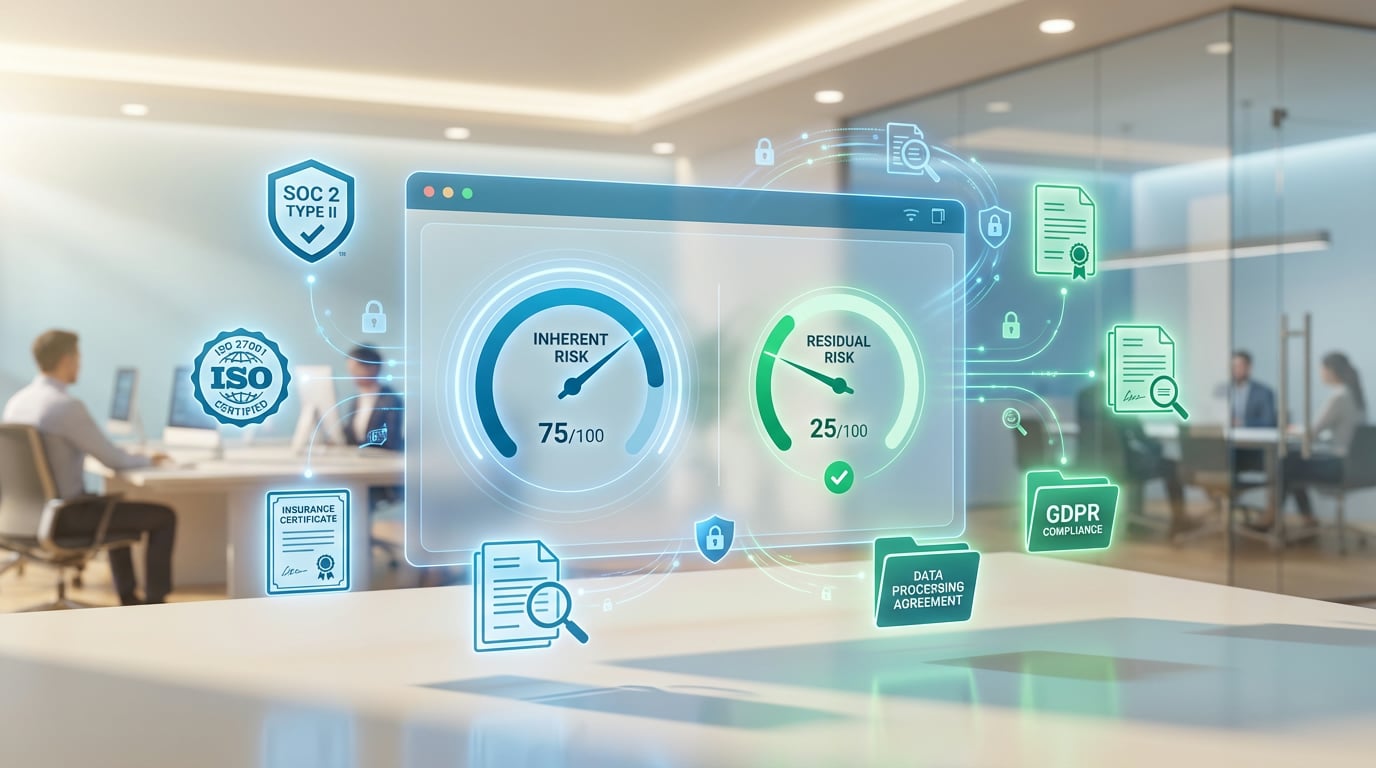
The platform typically collects and validates SOC 2 or ISO 27001 certifications, business continuity and disaster recovery plans, cyber-liability insurance certificates, data processing agreements, and evidence of regulatory compliance relevant to the vendor’s industry. Each document is stored with its expiration date, and the system automatically alerts the responsible team when renewal is due.
Did You Know
Expired insurance certificates are one of the most frequently overlooked vendor compliance gaps. A dedicated platform with automated expiration tracking catches these lapses months before they become audit findings or — worse — leave your organization financially exposed during an incident.
Risk Scoring: Inherent vs. Residual
During due diligence, the system calculates an “inherent risk” score based on factors like the type of data the vendor will access, the criticality of the service, geographic location, and reliance on subcontractors. After reviewing the vendor’s controls and documentation, a “residual risk” score reflects how much risk remains after mitigation. This dual-score approach allows decision-makers to approve, reject, or conditionally approve a vendor with specific remediation requirements — all documented in an auditable trail. Israeli regulatory frameworks, such as Bank of Israel Directive 359A on outsourcing, explicitly require organizations to maintain accountability for outsourced activities and to conduct thorough due diligence before engagement (Bank of Israel — Directive 359A).
A Typical Vendor Onboarding Workflow Inside the Platform
A structured onboarding process inside vendor risk management software follows a clear sequence. First, a business unit submits an intake request that captures the vendor’s name, service type, data access level, processing location, and any known subcontractors. The system automatically classifies the engagement into a risk tier — critical, high, medium, or low — based on predefined criteria.
Next, the platform sends the appropriate questionnaire and document requests directly to the vendor through a self-service portal. Responses flow back into the system, where designated reviewers from security, legal, procurement, or compliance evaluate the answers. The workflow engine routes the assessment through the required approval chain, enforcing segregation of duties so that no single person can both evaluate and approve a high-risk vendor. The final decision — approve, reject, or approve with conditions — is recorded with timestamps, reviewer identities, and supporting documentation. This entire cycle, which once took weeks of manual coordination, can be compressed into days when the workflow is automated.
Tip
Configure your platform to require a minimum of two independent reviewers for any vendor classified as “critical” or “high risk.” This enforced segregation of duties creates accountability and prevents a single point of failure in the approval process.
Five Common Mistakes That Undermine Vendor Risk Programs
| Mistake | Consequence | How Software Prevents It |
|---|---|---|
| Treating assessment as a one-time event | Vendor risk drifts undetected between reviews | Continuous monitoring with automated reassessment triggers |
| Applying the same depth of review to all vendors | Wasted resources on low-risk vendors, insufficient scrutiny on critical ones | Risk tiering drives proportional assessment depth |
| No centralized document repository | Expired certificates, missing contracts, audit failures | Single source of truth with expiration alerts |
| Manual follow-up for questionnaire responses | Delays, incomplete data, “questionnaire fatigue” among vendors | Self-service portal with automated reminders and answer reuse |
| No remediation tracking | Identified gaps remain open indefinitely | Task assignment, SLA enforcement, escalation workflows |
Did You Know
Research on supply chain risk frameworks shows that organizations with automated remediation tracking close identified vendor gaps 3x faster than those relying on manual follow-up — significantly reducing the window of exploitable exposure.
Your vendor ecosystem is only as secure as your weakest link. Detelix monitors the financial processes that connect you to your suppliers — in real time, around the clock.
What Does Vendor Compliance Monitoring Look Like in Practice?
Vendor compliance monitoring is the process of continuously verifying that suppliers remain aligned with your organization’s requirements after the initial assessment is complete. Unlike a one-time check, this ongoing loop tracks document validity, SLA adherence, incident reports, regulatory changes, and material shifts in the vendor’s business — such as a merger, leadership change, or geographic expansion that alters data residency.
A robust supplier risk management platform automates much of this work. It schedules periodic reassessments based on risk tier, sends renewal requests before certifications expire, and flags anomalies such as a vendor that suddenly stops responding to questionnaire updates. Research on supply chain risk frameworks emphasizes the importance of transparency and traceability in continuous monitoring, noting that automated tracking mechanisms significantly reduce the time between a vendor’s control failure and the customer’s awareness of it (arXiv — Blockchain-Enhanced Vendor Risk Management).
Tip
Set monitoring frequency proportional to risk tier: critical vendors should be reassessed quarterly, high-risk vendors semi-annually, and medium/low-risk vendors annually. Automate these schedules inside your platform so no reassessment is ever skipped due to calendar oversight.
How Does the Right Platform Reduce Cyber Risk from Third Parties?
Third-party cyber risk is one of the fastest-growing threat vectors for organizations of every size. A vendor with weak access controls, unpatched systems, or poor data handling practices can become the entry point for a breach that affects your organization’s customers, finances, and reputation. The Bank of Israel has intensified its requirements for managing cyber risks specifically within the banking sector’s external supply chain, mandating that organizations establish binding principles for material vendors and verify ongoing compliance (Bank of Israel — Cyber Risk in Supply Chain).
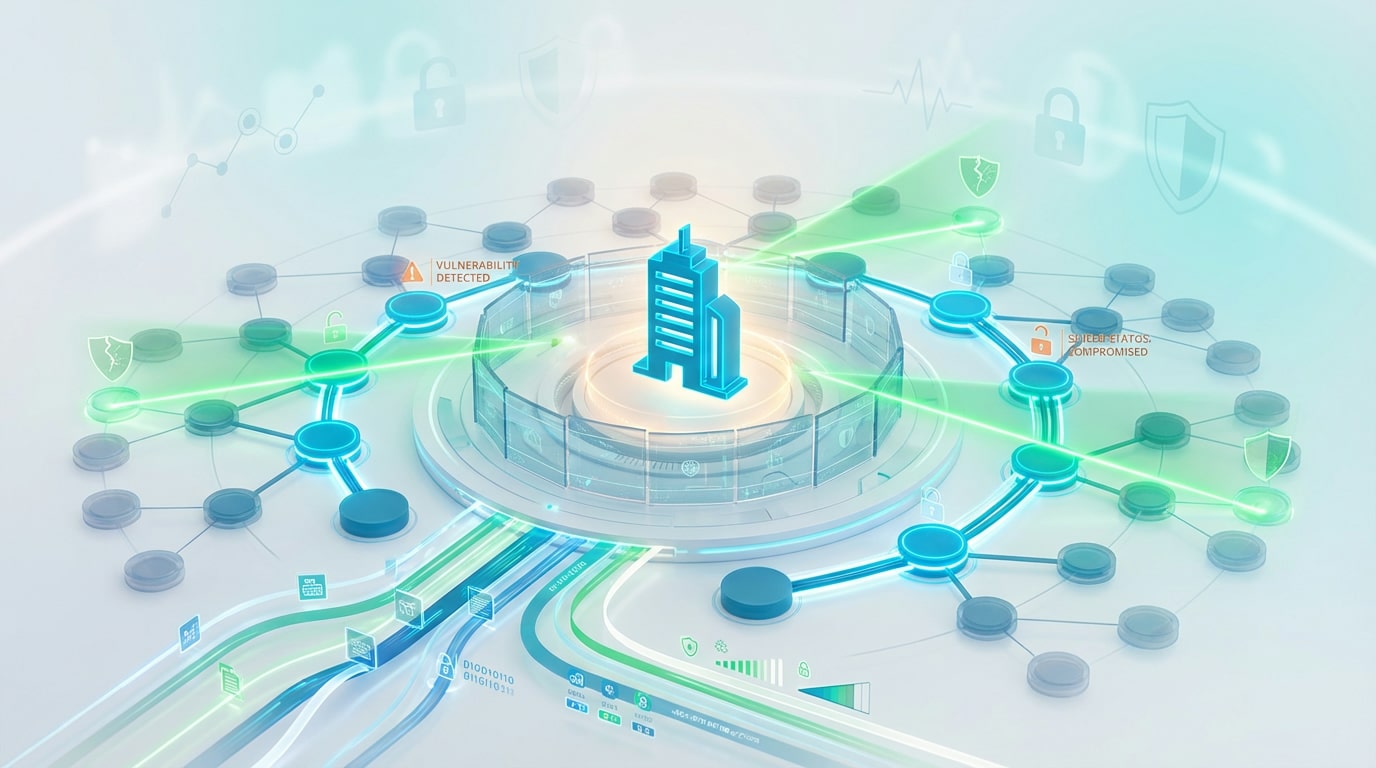
Vendor risk management software addresses this by segmenting vendors based on their level of access to sensitive data and systems. High-access vendors receive deeper security questionnaires, more frequent monitoring cycles, and stricter remediation SLAs. The platform can also integrate external security rating feeds, providing a near-real-time view of a vendor’s publicly observable cyber posture — open vulnerabilities, compromised credentials, or blacklisted IP ranges — without waiting for the vendor to self-report.
Did You Know
External security rating feeds can detect changes in a vendor’s cyber posture — such as newly exposed services, compromised employee credentials, or blacklisted mail servers — within hours, compared to the months-long gap typical of manual reassessment cycles.
Mapping Business Needs to Platform Capabilities
| Business Need | What the Platform Delivers |
|---|---|
| Centralized vendor records accessible to all stakeholders | A single repository for contracts, certificates, questionnaires, and risk scores with role-based access |
| Consistent, repeatable assessment process | Standardized questionnaire templates mapped to frameworks (ISO, NIST, SOC 2, GDPR) |
| Reduced manual follow-up effort | Automated reminders, self-service vendor portal, and answer-reuse across assessments |
| Clear audit trail for regulators | Timestamped approvals, reviewer identity, decision rationale, and full document history |
| Real-time visibility into vendor risk posture | Dashboards with heatmaps, expiration calendars, remediation backlogs, and trend analysis |
| Early detection of process failures and unauthorized changes | Real-time alerts when vendor data deviates from expected patterns — a capability that Detelix brings to ERP-driven financial processes, ensuring that irregularities in supplier payments, bank account changes, or procurement workflows are flagged before damage occurs |
When Is an Out-of-the-Box Solution Better Than a Custom Build?
Organizations sometimes consider building a custom vendor risk management tool on top of existing GRC platforms or internal databases. While this approach offers maximum flexibility, it typically demands significant development resources, extended timelines, and ongoing maintenance. For most mid-market and enterprise organizations, an out-of-the-box vendor risk management software solution delivers faster time to value because it arrives pre-configured with industry-standard questionnaire libraries, regulatory framework mappings, and workflow templates that can be adjusted rather than built from scratch.
The decision should hinge on three factors: the complexity of your vendor ecosystem, the maturity of your existing risk processes, and the internal resources available for long-term maintenance. If your team is spending more time maintaining the tool than managing actual risk, the balance has tipped in the wrong direction. Detelix, for example, offers continuous, real-time monitoring across sensitive ERP processes without requiring organizations to build detection logic from the ground up — the system arrives with the knowledge and rules needed to identify anomalies in supplier payments, procurement, and bank reconciliation immediately upon deployment.
Tip
Before committing to a custom build, calculate the total cost of ownership over three years — including developer salaries, maintenance cycles, framework updates, and user training. Most organizations find that a pre-built platform with configuration options delivers lower TCO and faster deployment.
Benchmarks and Metrics That Reveal Program Effectiveness
Implementing vendor risk management software is only valuable if you can measure whether it is actually reducing risk and improving efficiency. Strong programs track a defined set of operational metrics that go beyond “number of vendors assessed.” Consider measuring average onboarding cycle time (from intake request to approved vendor), percentage of vendors with current and valid documentation, mean time to remediate identified gaps, ratio of vendors monitored continuously versus assessed only once, and the number of risk exceptions approved versus rejected per quarter.
These metrics create accountability and reveal whether your vendor risk program is maturing or stagnating. A declining remediation backlog signals that your team is closing gaps faster. A rising percentage of vendors with expired documents signals that monitoring automation needs attention. Leadership teams that receive these metrics in a structured dashboard — rather than in ad-hoc reports — gain the confidence to make informed decisions about vendor relationships and resource allocation.
Did You Know
Organizations that track mean time to remediate (MTTR) for vendor risk findings and report it monthly to leadership reduce their average MTTR by over 30 percent within the first year — simply because the metric creates visibility and accountability that did not exist before.
A Scenario: What Happens When Continuous Monitoring Is Missing
Consider a mid-sized financial services firm that conducted a thorough assessment of its cloud hosting vendor two years ago. The vendor passed with a strong residual risk score, and the contract was signed. Since then, the vendor has been acquired by a larger company, migrated data centers to a different jurisdiction, and replaced its CISO. None of these changes triggered a reassessment because the firm relies on annual reviews and the next one is not scheduled for three months.
During those three months, the vendor’s security posture has degraded — a fact visible through external rating feeds but invisible to the firm’s risk team. When a data breach occurs, the firm discovers that its data processing agreement no longer reflects the actual data residency, that the vendor’s updated insurance policy has a lower coverage limit, and that the incident response plan references contacts who no longer work there. Every one of these issues would have been flagged by a system running continuous vendor compliance monitoring with automated alerts on material changes. The cost of reactive discovery far exceeds the cost of proactive detection.
Tip
Subscribe to public news feeds and corporate registry changes for your critical vendors. Configure your platform to trigger an immediate reassessment whenever a material event — acquisition, leadership change, regulatory action, or data breach disclosure — is detected, regardless of where the vendor sits in its scheduled review cycle.
How Detelix Strengthens Control Across Vendor-Facing Processes
While vendor risk management software focuses on the vendor lifecycle itself, the financial and operational processes that connect your organization to its vendors also require real-time protection. This is where Detelix delivers a critical additional layer. Detelix continuously monitors sensitive ERP processes — supplier payments, bank account changes, procurement approvals, and vendor master data modifications — cross-checking every action against expected business rules and flagging deviations as they happen.
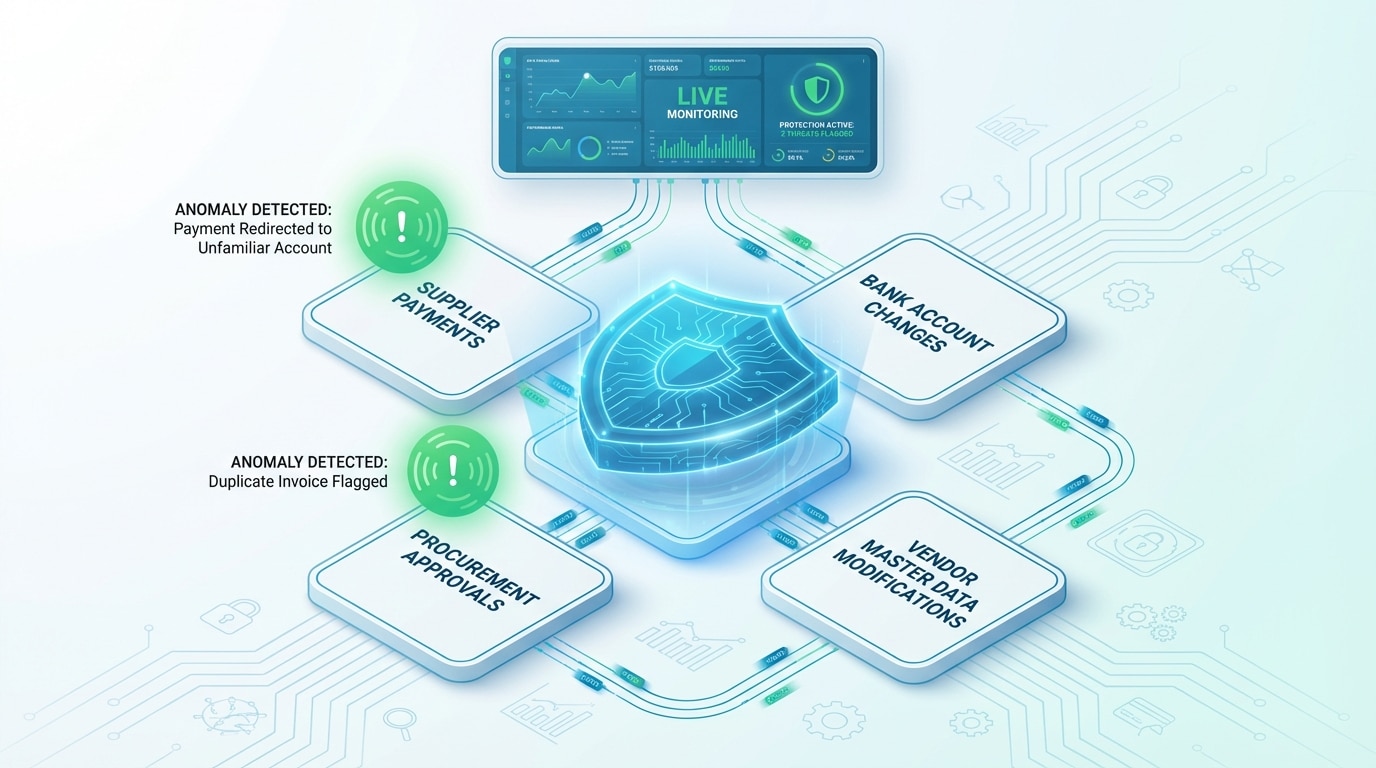
For organizations that manage hundreds or thousands of vendor relationships, this means that even if a vendor passes its risk assessment, any irregular transaction involving that vendor inside your ERP is still detected. A payment routed to an unfamiliar bank account, a duplicate invoice processed under a slightly different vendor name, or a purchase order approved outside the normal segregation-of-duties policy triggers an immediate alert. This combination of vendor lifecycle management and real-time ERP process monitoring moves an organization from periodic review to actual, continuous control — supported by a team of experts dedicated to effective protection against fraud and errors.
Did You Know
Duplicate invoice fraud — where a slightly modified vendor name or invoice number is used to process the same payment twice — accounts for billions of dollars in annual corporate losses globally. Real-time ERP monitoring catches these patterns by cross-referencing vendor master data, invoice amounts, and payment timing automatically.
Detelix Continuous Control Solutions

Proactive Monitoring
Continuous surveillance of sensitive ERP processes to detect anomalies, unauthorized changes, and policy violations before they cause damage.

Real-Time Alerts
Instant notifications when vendor payments, bank account modifications, or procurement actions deviate from expected business rules.

GateKeeper
Automated enforcement of segregation of duties and approval hierarchies across vendor-facing financial transactions.

Industry Experience
Deep domain expertise across banking, healthcare, manufacturing, and technology — with detection rules tailored to each sector’s unique vendor risk profile.
See Detelix in Action
Frequently Asked Questions
How long does it take to implement vendor risk management software?
Implementation timelines vary based on the size of your vendor ecosystem and the maturity of your existing processes. Organizations migrating from manual spreadsheets to a dedicated platform typically complete initial configuration, data migration, and user training within four to twelve weeks. The most time-consuming step is usually standardizing existing vendor data and mapping it to the new system’s taxonomy. Platforms with pre-built templates and framework mappings significantly shorten this phase.
What is the ROI of using vendor due diligence software?
ROI comes from three areas: time savings on manual questionnaire distribution and follow-up, risk reduction through earlier detection of vendor control failures, and audit readiness that reduces the cost and disruption of regulatory examinations. Organizations that previously spent dozens of hours per vendor on manual due diligence often report a reduction of 50 percent or more in cycle time after implementing an automated platform. The cost avoidance from preventing even a single vendor-related breach or compliance penalty typically exceeds the annual software investment.
Can these systems handle international regulatory frameworks?
Yes. Most mature vendor risk management platforms support multiple compliance frameworks simultaneously — including ISO 27001, NIST CSF, SOC 2, GDPR, and sector-specific regulations. The system maps questionnaire responses to the relevant control requirements, so a single vendor assessment can satisfy multiple compliance needs without duplicating effort. For organizations subject to Israeli privacy regulations, the system can also support evidence collection aligned with reporting obligations to the Privacy Protection Authority.
How do you handle vendors that refuse to complete questionnaires?
Vendor non-responsiveness is a real operational challenge. Effective platforms address it through multiple mechanisms: simplified questionnaire formats that reduce burden, the ability for vendors to reuse prior answers across customers, automated escalation reminders with clear deadlines, and the option to accept alternative evidence such as existing audit reports or certification documents. If a vendor remains unresponsive after escalation, the system can automatically flag the vendor as “incomplete” and restrict approval until documentation is provided — creating a clear decision point for leadership rather than leaving the gap unresolved.
Is vendor risk management software only relevant for large enterprises?
No. While large enterprises were early adopters, mid-market organizations increasingly recognize that their exposure to vendor risk is proportionally just as significant. A mid-sized company with 50 critical vendors faces the same types of risk — data breaches, compliance failures, service disruptions — as an enterprise with 500. The difference is that mid-market teams often have fewer people available to manage the process manually, making automation even more valuable. Scalable platforms allow smaller organizations to start with core functionality and expand as their vendor ecosystem grows.
Ready to Move from Periodic Reviews to Continuous Control?
Stop relying on annual assessments and hoping nothing changes between them. Detelix gives your team real-time visibility into vendor-facing risks across every financial process.