Take Control of Your Vendor Risk Before It Controls You
Detelix helps organizations detect threats, policy violations, and fraud across vendor-connected financial processes in real time.
- What Does Modern Vendor Risk Management Software Actually Do?
- Why Are Organizations Abandoning Excel for Dedicated Platforms?
- A Common Mistake: Treating VRM as a One-Time Project
- Critical Features to Evaluate Before You Buy
- How Does the Full Lifecycle Work Inside a VRM Platform?
- Inherent Risk vs. Residual Risk — Why the Distinction Matters
- What Happens When You Compare VRM, TPRM, and Supplier Risk Management?
- How Does Continuous Monitoring Reduce Workload Instead of Increasing It?
- A Scenario: What Happens Without Real-Time Alerts?
- How Detelix Strengthens Control Across Sensitive Business Processes
- Which KPIs Should You Report to the Board?
- Measuring ROI: How to Justify the Investment
- How Long Does Implementation Take — and What Affects the Timeline?
- Does This Only Apply to Large Enterprises?
- Five Questions to Ask During Every Vendor Software Demo
- Frequently Asked Questions
Every organization depends on external vendors for cloud infrastructure, payroll processing, logistics, consulting, and dozens of other critical functions. The moment a vendor gains access to sensitive data, financial systems, or operational processes, the organization inherits risk it may not fully see. Vendor risk management software closes that visibility gap by replacing scattered spreadsheets, expired certificates buried in email threads, and gut-feel assessments with a structured, auditable, and continuous control process. For finance leaders, internal auditors, and risk managers, understanding what this software actually does — and what separates a capable platform from a checkbox exercise — marks the difference between the illusion of control and real control.
Key Takeaways
- Vendor risk management software centralizes vendor data, automates risk assessments, and provides continuous compliance monitoring across the entire supplier lifecycle.
- Spreadsheet-based vendor tracking creates dangerous blind spots that dedicated platforms eliminate through automated alerts, workflow enforcement, and audit trails.
- Effective platforms distinguish between inherent risk and residual risk, enabling organizations to prioritize resources where exposure is greatest.
- Continuous monitoring reduces team workload by surfacing only actionable exceptions rather than requiring manual checks across hundreds of vendors.
- Complementary controls like Detelix protect the operational execution layer by detecting suspicious vendor-related transactions inside ERP systems in real time.
What Does Modern Vendor Risk Management Software Actually Do?
At its core, vendor risk management software is a centralized platform that manages the entire relationship lifecycle with every external provider your organization relies on. It consolidates vendor data into a single repository, automates risk assessments through configurable questionnaires, assigns risk scores based on objective criteria, tracks remediation tasks when gaps are found, and generates audit-ready reports for regulators and the board.
The evolution has been significant. A decade ago, “vendor management” meant a procurement database with contract dates. Today, third-party risk management encompasses cybersecurity posture, regulatory compliance, financial stability, operational resilience, and even fourth-party exposure — the vendors your vendors depend on. The NIST SP 800-161 Rev. 1 framework formalizes this shift, outlining a structured Cybersecurity Supply Chain Risk Management (C-SCRM) approach that includes policy development, risk assessment, continuous monitoring, and iterative improvement across the entire vendor engagement lifecycle.
Did You Know
The NIST SP 800-161 Rev. 1 framework specifically addresses fourth-party risk — requiring organizations to evaluate not just their direct vendors, but the entire supply chain of dependencies those vendors carry. Many organizations still overlook this extended exposure.
Why Are Organizations Abandoning Excel for Dedicated Platforms?
Spreadsheets served their purpose when vendor portfolios were small and regulatory scrutiny was light. Today, with hundreds of suppliers — many of them SaaS providers with direct API access to production systems — Excel creates dangerous blind spots. A cell cannot send an alert when a SOC 2 report expires. A pivot table cannot enforce that a high-risk vendor completes a remediation task within an agreed SLA. And no spreadsheet provides the audit trail a regulator expects to see.
The compliance gap is real. The Bank of Israel Circular H2660 on outsourcing risk explicitly requires organizations to maintain documented due diligence for service providers, enforce contractual controls, and demonstrate ongoing oversight capability. Without workflow automation, meeting these expectations relies on individual diligence — a fragile foundation when teams are stretched thin and vendor volumes grow.
Tip
Before migrating from spreadsheets, export your current vendor list and classify each supplier by data access level and business criticality. This pre-work accelerates platform onboarding and ensures your highest-risk relationships are assessed first.
A Common Mistake: Treating VRM as a One-Time Project
Many organizations invest heavily in the initial vendor assessment — sending questionnaires, collecting certifications, scoring risk — and then file everything away until the next audit cycle. This “set and forget” approach is one of the most common failures in third-party risk management. A vendor’s security posture can deteriorate within weeks: staff turnover, infrastructure changes, sub-contractor switches, or a data breach at a fourth-party can all shift the risk profile without warning.
Vendor compliance monitoring must be continuous, not episodic. The best platforms automate expiration tracking for ISO 27001 certificates, insurance policies, penetration test reports, and privacy impact assessments. When a document lapses, the system alerts both the internal owner and the vendor, creating accountability without manual follow-up.
Did You Know
Research consistently shows that vendor risk profiles can shift materially within 90 days of an initial assessment — driven by staff changes, infrastructure migrations, or sub-processor substitutions. Annual reviews alone miss these shifts entirely.
Critical Features to Evaluate Before You Buy
Not every vendor risk management software platform delivers the same depth. Before scheduling demos, your team should align on a clear set of non-negotiable capabilities. The following breakdown covers the essentials.
Centralized Vendor Repository
A single source of truth for every vendor record — contact details, contracts, risk tier, assessment history, open findings, and compliance status. Without centralization, different departments maintain conflicting data, and nobody has a complete picture. The repository should support role-based access so procurement, security, legal, and audit each see what they need without exposing sensitive details unnecessarily.
Automated Risk Scoring and Tiering
Effective vendor due diligence software assigns an inherent risk score based on data sensitivity, system access level, regulatory exposure, and business criticality. This score determines the depth of assessment required: a catering supplier does not need the same scrutiny as a cloud hosting provider with access to customer PII. Tiering ensures that your team invests effort where risk is highest.
Tip
Define at least three risk tiers (Critical, High, Low) before configuring your platform. Map each tier to specific assessment depth requirements, reassessment frequency, and escalation paths. This framework prevents over-assessing low-risk vendors and under-assessing critical ones.
Remediation Workflows and Audit Trail
Identifying a gap is only half the job. The platform must track remediation — who is responsible, what the deadline is, whether evidence of the fix has been uploaded, and whether the residual risk score has been recalculated. Every action should be logged with timestamps so that auditors can verify not just the outcome, but the process. A team of experts committed to effective protection understands that without this audit trail, compliance evidence crumbles under scrutiny.
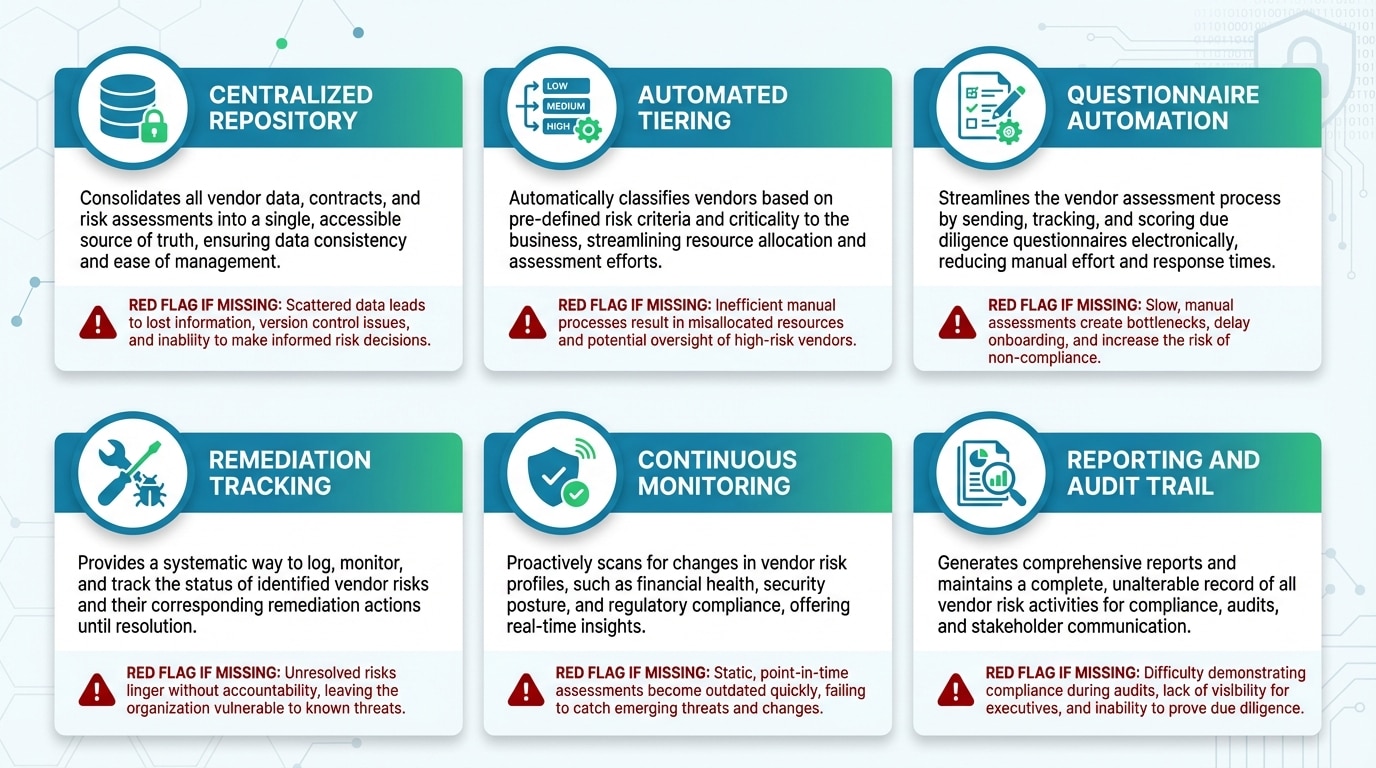
| Feature Category | What It Solves | Red Flag If Missing |
|---|---|---|
| Centralized Repository | Eliminates scattered data across departments | No single view of all vendors and their risk status |
| Automated Tiering | Prioritizes high-risk vendors for deeper assessment | Every vendor gets the same questionnaire regardless of exposure |
| Questionnaire Automation | Reduces manual email chains and accelerates response times | No vendor portal; all communication via attachments |
| Remediation Tracking | Ensures findings are fixed within SLA, not just documented | No task assignment, deadline, or evidence upload |
| Continuous Monitoring | Catches expiring documents and changing risk profiles | Only point-in-time snapshots with no automated alerts |
| Reporting and Audit Trail | Satisfies regulators and board-level oversight | No exportable evidence packs or timestamped logs |
How Does the Full Lifecycle Work Inside a VRM Platform?
Supplier risk management is not a single event — it is a cycle with distinct stages. Understanding these stages helps you evaluate whether a platform truly covers your needs end to end, or whether it leaves gaps that will require manual workarounds.
Intake: A new vendor request enters the system, typically triggered by procurement or a business unit. Basic information is captured, and the system runs an initial risk classification.
Assessment: Based on the tier, the platform generates a tailored questionnaire and requests supporting documents (SOC reports, privacy policies, insurance certificates). The NIST SP 1326 Quick-Start Guide emphasizes that this due diligence must occur before a contract is signed, not after — a principle many organizations still fail to enforce.
Mitigation: Findings from the assessment are converted into remediation tasks with owners and deadlines. The vendor may need to implement encryption, update a policy, or provide proof of a penetration test.
Monitoring: Once onboarded, the vendor enters the continuous monitoring cycle. Automated checks track document validity, trigger re-assessments on schedule, and flag anomalies that warrant investigation.
Did You Know
According to the NIST SP 1326 Quick-Start Guide, vendor due diligence should be completed before contract signing — yet many organizations still perform their first formal assessment only after the vendor is already operational and has access to sensitive systems.
Inherent Risk vs. Residual Risk — Why the Distinction Matters
One of the most misunderstood concepts in vendor risk assessment is the difference between inherent and residual risk. Inherent risk reflects the exposure that exists simply because of the nature of the relationship: a payroll processor handles salary data and bank account numbers, so its inherent risk is high regardless of its controls. Residual risk is what remains after the vendor’s safeguards — encryption, access controls, incident response plans — are factored in.
A capable vendor risk management software platform calculates both scores independently. This matters because two vendors with identical inherent risk profiles can have vastly different residual risk levels. The platform should let you set thresholds: if residual risk exceeds a defined appetite, the system blocks approval or escalates to a senior decision-maker. This is the control mechanism that transforms risk assessment from a documentation exercise into an actionable governance process.
Tip
When configuring risk thresholds, involve both the CISO and the CFO. Security teams tend to set conservative thresholds that block too many vendors, while business leaders may accept too much risk for operational convenience. A joint threshold ensures balance between protection and productivity.
Need real-time visibility into vendor-related risks across your financial processes? Detelix monitors ERP transactions continuously to catch suspicious changes before they cause damage.
What Happens When You Compare VRM, TPRM, and Supplier Risk Management?
| Term | Primary Focus | Typical Stakeholders |
|---|---|---|
| Vendor Risk Management (VRM) | Risk from commercial suppliers, often IT/SaaS, across procurement and operations | Procurement, InfoSec, Legal |
| Third-Party Risk Management (TPRM) | Broader framework covering all external parties — vendors, contractors, partners, affiliates | Risk Committee, Board, CISO |
| Supplier Risk Management | Supply chain continuity, quality, logistics, and operational resilience | Operations, Supply Chain, Quality |
In practice, the boundaries blur. Many organizations use a single platform for all three, configuring different assessment templates and workflows per category. The important takeaway is that whether you search for vendor due diligence software or supplier risk management tools, you need a platform flexible enough to handle varying risk domains — not just cybersecurity, but also financial stability, regulatory compliance, business continuity, and reputational exposure.
How Does Continuous Monitoring Reduce Workload Instead of Increasing It?
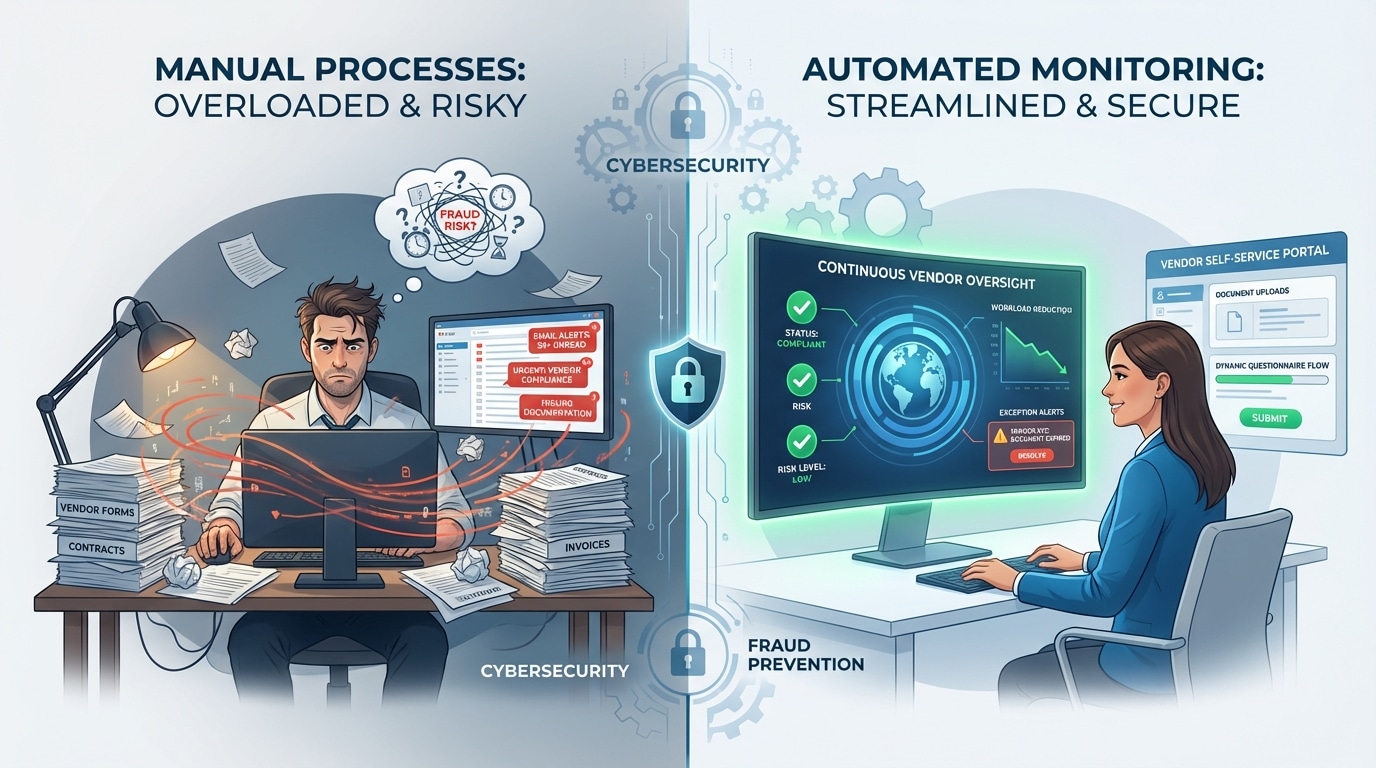
A frequent concern is that continuous monitoring means more alerts, more tasks, and more fatigue for already busy teams. In reality, well-configured vendor compliance monitoring does the opposite. Instead of your analysts manually checking whether 200 vendors still hold valid certifications, the system checks automatically and only surfaces exceptions that require human judgment.
Vendor portals shift data-entry responsibility to the vendors themselves. Instead of your team chasing attachments by email, each vendor logs in, uploads updated documents, and responds to questionnaires in a structured format. Dynamic questionnaires adapt based on the vendor’s tier and previous answers, eliminating irrelevant questions and accelerating completion rates. The result: your security and legal teams review only what matters, when it matters.
Tip
Configure alert thresholds to suppress low-severity notifications and escalate only material changes — expired critical certifications, risk score increases above your defined appetite, or vendors that miss remediation deadlines. This prevents alert fatigue and keeps your team focused on genuine risks.
A Scenario: What Happens Without Real-Time Alerts?
Consider a mid-size company that processes payments through a third-party gateway. The gateway provider quietly changes its sub-processor — a fourth-party — and the new entity stores transaction data in a jurisdiction with weaker privacy protections. Without continuous monitoring, this change goes undetected until the next annual review, months later. During that window, the company is exposed to regulatory risk, potential data breach liability, and a compliance violation it cannot explain to auditors.
Now consider the same scenario with a platform that monitors fourth-party changes and flags deviations from contractual commitments. The alert arrives within days, not months. The risk team investigates, the vendor provides justification or rolls back the change, and the entire interaction is logged as evidence. That is the difference between managing vendor relationships and actually controlling them.
Did You Know
A sub-processor change by a payment gateway can shift data residency across jurisdictions overnight. Organizations without automated fourth-party monitoring typically discover these changes only during annual audits — leaving months of undetected regulatory exposure.
How Detelix Strengthens Control Across Sensitive Business Processes
While many vendor risk management platforms focus on questionnaire automation and document tracking, the broader challenge for finance and operations leaders is ensuring that vendor-related processes inside the ERP are equally protected. This is where Detelix adds a distinct layer of value. Detelix continuously scans ERP-driven workflows — supplier payments, bank account changes, procurement approvals — and cross-checks every action against expected patterns. When a vendor’s bank details change suspiciously, or a payment is routed outside normal parameters, the system flags it in real time, before money leaves the organization.
This capability addresses a gap that traditional VRM tools do not cover: the operational execution layer. You may have the most thorough vendor assessment process in the industry, but if a compromised vendor submits fraudulent payment instructions and your ERP processes them without challenge, the assessment was insufficient. Real-time detection of human errors, policy deviations, and external threats within the financial workflow is the control layer that turns vendor oversight into genuine organizational protection.
Did You Know
Business email compromise (BEC) attacks that target vendor payment details account for billions of dollars in losses globally each year. These attacks bypass traditional VRM assessments entirely because they exploit the operational payment process, not the vendor’s security controls.
Which KPIs Should You Report to the Board?
Executives and audit committees do not need to see every questionnaire response. They need concise indicators that answer two questions: “How exposed are we?” and “Is the program working?” The following metrics provide that clarity.
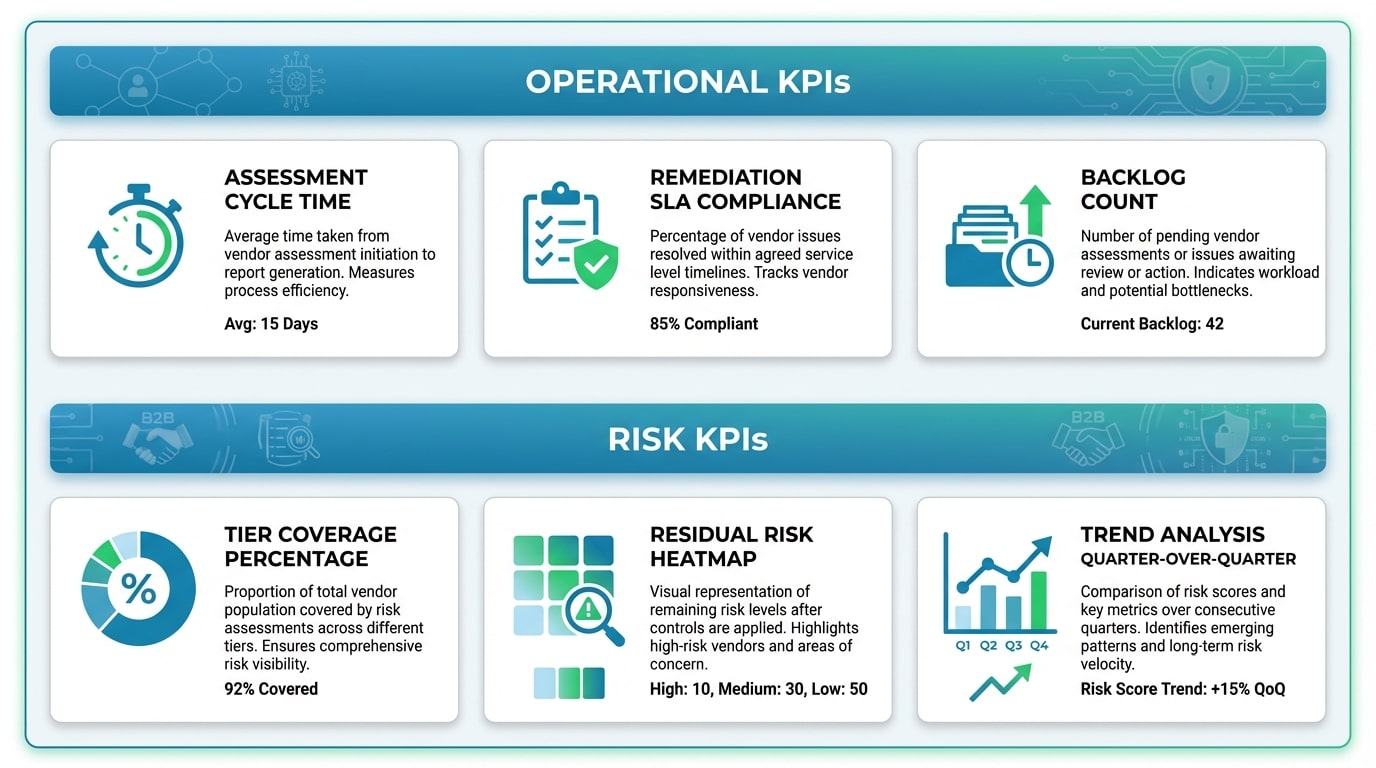
Operational KPIs
Assessment cycle time: Average days from vendor intake to completed assessment. A shrinking number indicates process efficiency. Remediation SLA compliance: Percentage of findings resolved within the agreed timeframe. Backlog: Number of vendors awaiting initial assessment or re-assessment — a growing backlog signals resource constraints.
Risk KPIs
Tier coverage: Percentage of high-tier vendors with a current, completed assessment. Anything below 100 percent is a red flag. Residual risk distribution: A heatmap showing how many vendors sit at each residual risk level. Trend analysis: Quarter-over-quarter movement in average residual risk — are your vendors getting safer, or are gaps accumulating?
Tip
Present board-level vendor risk reports as a one-page dashboard with three metrics: tier coverage percentage, average remediation SLA compliance, and residual risk trend direction. Executives respond to clear trend indicators, not detailed questionnaire data.
Measuring ROI: How to Justify the Investment
The cost of vendor risk management software is visible and predictable. The cost of not having it is hidden and potentially catastrophic. A single regulatory fine for inadequate third-party oversight, or a single payment fraud incident exploiting a vendor channel, can exceed years of platform subscription fees. The Israel National Cyber Directorate (CERT-IL) regularly reports on incidents where third-party access served as the attack vector — reinforcing that vendor-related threats are not theoretical.
Beyond risk avoidance, the operational savings are tangible. Teams that previously spent dozens of hours per week chasing vendor documents, re-sending questionnaires, and manually updating spreadsheets reclaim that time for higher-value analysis. Detelix complements this by providing real-time detection of external threats within ERP processes, ensuring that the financial control chain is protected even after the vendor has been approved and integrated.
Did You Know
CERT-IL reports consistently identify third-party access as one of the most common initial attack vectors in significant cyber incidents affecting Israeli organizations. The financial impact of a single vendor-related breach frequently exceeds multiple years of VRM platform costs.
How Long Does Implementation Take — and What Affects the Timeline?
Most deployments range from a few weeks for a focused pilot to several months for a full enterprise rollout. The primary variables are the number of vendors to onboard, the complexity of your questionnaire library, the depth of integration with existing systems (GRC, ITSM, procurement, ERP), and the maturity of your current risk taxonomy. Organizations that already have a clear tiering framework and documented assessment criteria move faster. Those starting from scratch should expect an initial phase of policy design before the technology can be configured effectively.
A practical approach is to begin with the top tier — your 20 to 50 most critical vendors — and expand from there. This delivers immediate visibility into the highest-risk relationships while your team refines workflows and templates for broader deployment.
Tip
Start your VRM rollout with a pilot group of 20 to 30 critical vendors. Use the pilot to refine questionnaire templates, test workflow automation, and train your team before expanding to the full vendor portfolio. This phased approach reduces implementation risk and builds internal confidence.
Does This Only Apply to Large Enterprises?
Not at all. Mid-market companies often face the same regulatory expectations as large enterprises but with smaller teams. In many ways, the need for automation is even more acute: a three-person security team cannot manually assess 150 vendors on a recurring basis. Cloud-based vendor risk management software with pre-built templates, standard questionnaire libraries, and guided workflows levels the playing field, enabling smaller organizations to run a credible program without building an internal department from scratch.
The key is selecting a platform that scales with your vendor portfolio and does not require dedicated IT resources for maintenance. Look for solutions that offer self-service vendor portals, configurable risk models, and out-of-the-box reporting that satisfies common compliance frameworks.
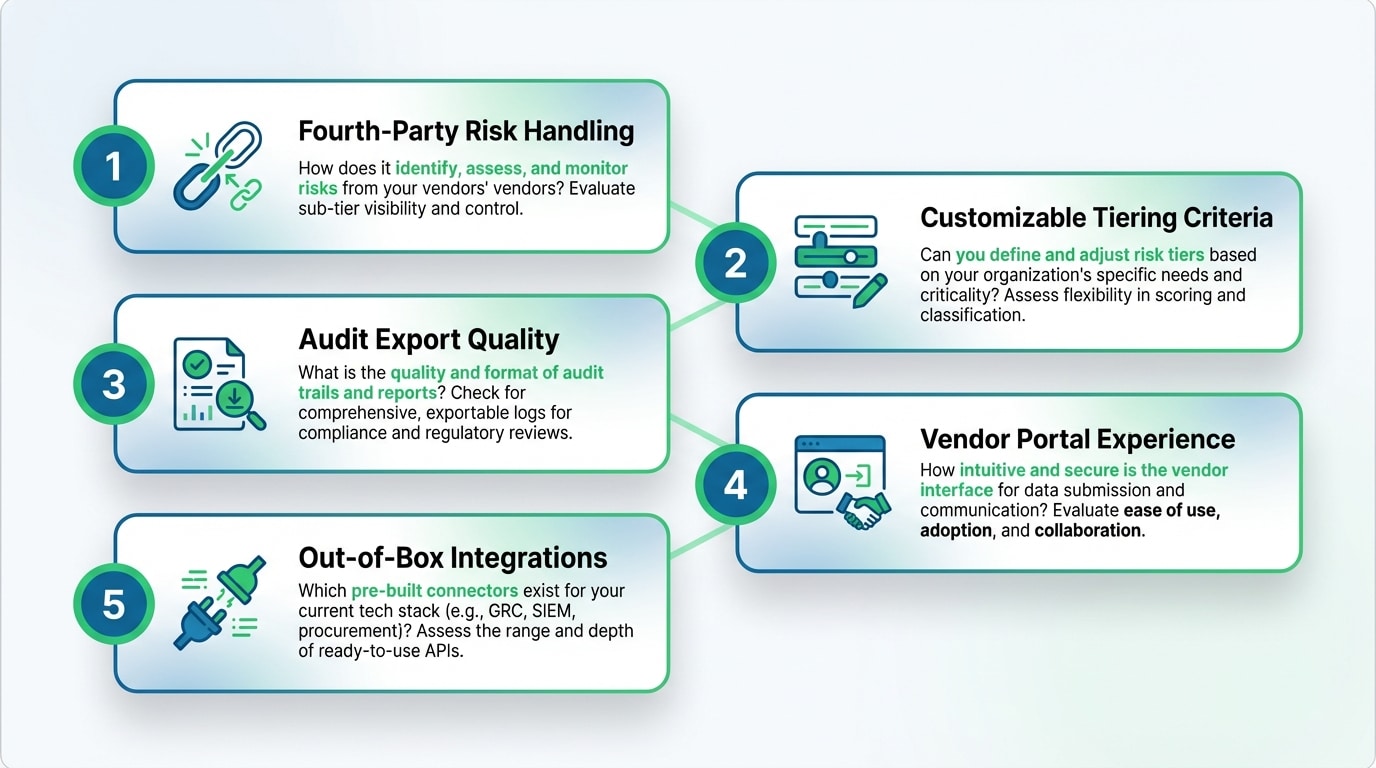
Five Questions to Ask During Every Vendor Software Demo
Does the platform handle fourth-party risk? Your vendors rely on their own suppliers. If the platform cannot map and monitor that extended chain, you have a blind spot that no questionnaire will close.
Can we customize tiering criteria without developer support? Business contexts change. If adjusting a risk factor requires a support ticket and a two-week wait, the platform will fall behind your risk landscape.
What does the audit export look like? Ask to see a sample evidence pack. If it is a raw data dump rather than a structured, timestamped narrative, your auditors will not be impressed.
How does the vendor portal experience work? A clunky portal means low vendor response rates, which means your team is back to sending emails. Request a vendor-side walkthrough.
What integrations are available out of the box? If you use an ERP system for procurement and payments, the VRM platform should be able to exchange data seamlessly — or at minimum via API — so that vendor onboarding decisions flow directly into operational controls.
Did You Know
Vendor portal usability directly impacts assessment completion rates. Organizations that provide vendors with an intuitive self-service portal report completion rates above 85%, compared to under 50% for those relying on email-based questionnaire distribution.
Detelix ERP Protection Solutions

Proactive Monitoring
Continuous scanning of ERP processes to detect anomalies, policy violations, and suspicious patterns before they escalate into incidents.

Real-Time Alerts
Instant notifications when critical changes occur in vendor data, payment routes, or approval workflows within your ERP environment.

GateKeeper
Automated enforcement of business rules and segregation of duties across vendor-related transactions, blocking unauthorized actions in real time.

Experience
Decades of domain expertise in ERP security, financial controls, and fraud prevention across regulated industries including banking, healthcare, and government.
See Detelix in Action
Frequently Asked Questions
What is the difference between vendor risk management software and a GRC platform?
A GRC (Governance, Risk, and Compliance) platform covers enterprise-wide risk domains — internal controls, policy management, regulatory tracking. Vendor risk management software is purpose-built for the third-party lifecycle: onboarding, assessment, monitoring, and remediation. Some GRC platforms include a VRM module, but dedicated tools typically offer deeper vendor-specific workflows, portal functionality, and questionnaire automation.
How often should vendors be reassessed?
Reassessment frequency should be driven by the vendor’s risk tier. High-tier vendors with access to sensitive data or critical systems warrant at least annual full reassessments, supplemented by continuous document and compliance monitoring. Lower-tier vendors may follow a biennial or trigger-based cycle, where reassessment occurs only when a material change — such as a contract renewal or security incident — is detected.
Can vendor risk management software prevent fraud?
VRM software reduces fraud risk by ensuring that vendors are vetted before they gain access to your systems and that their credentials and controls remain valid over time. However, it does not monitor real-time transactional behavior inside your ERP. For that operational layer — detecting suspicious payment changes, duplicate invoices, or unauthorized procurement actions — a complementary control system like Detelix is needed to cross-check every action as it happens.
What is fourth-party risk and why does it matter?
Fourth-party risk refers to the exposure created by your vendors’ own suppliers and sub-processors. If your cloud hosting vendor outsources database management to a third entity, that entity’s security failures can impact your data. Effective vendor risk management software maps these dependencies and monitors them, ensuring that risk is visible beyond the direct contractual relationship.
Is vendor risk management a regulatory requirement in Israel?
While there is no single law mandating VRM software specifically, multiple regulatory frameworks create an effective obligation. The Bank of Israel’s outsourcing directives, the Privacy Protection Authority’s data-handling requirements, and sector-specific cybersecurity guidelines all demand documented due diligence, ongoing oversight, and auditable evidence of vendor control. A dedicated platform is the most reliable way to meet these expectations consistently.
Ready to Move From Routine Oversight to Real Control?
If your vendor management still relies on manual follow-ups and aging spreadsheets, the risk is accumulating quietly. Discover how Detelix protects your financial processes at the operational layer.