Take Control of Your Vendor Master Data Before Fraud Takes Control of You
Detelix delivers real-time vendor master governance that stops unauthorized changes, eliminates duplicates, and protects every payment you make.
- What Does Vendor Master Data Governance Software Actually Do?
- Why Is Vendor Data the Primary Target for Payment Fraud?
- How Does Segregation of Duties Protect the Vendor Master File?
- A Practical Scenario: The Bank Account Change Request
- What Should Supplier Master Data Validation Include?
- Why Do Duplicate Vendors Keep Appearing Despite ERP Controls?
- Vendor Onboarding Risk Controls
- How Do You Measure Vendor Data Quality Over Time?
- Real-Time Monitoring Compared to Annual Audits
- Five Common Mistakes in Vendor Master Governance Programs
- How Detelix Strengthens Vendor Master Data Controls
- Governance vs. Master Data Management (MDM)
- How Should You Evaluate Vendor Master Data Governance Software?
- Frequently Asked Questions
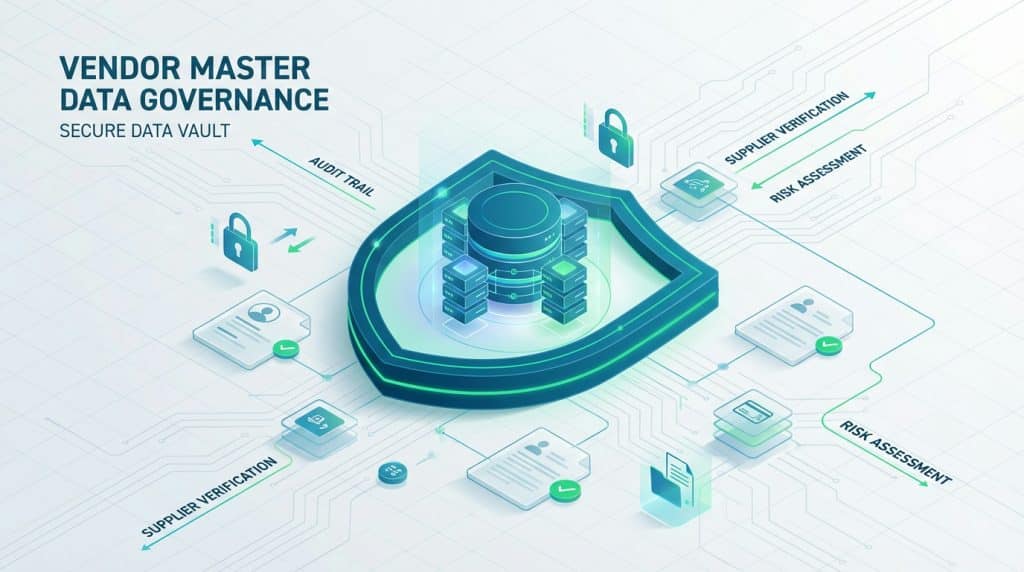
Every organization that pays suppliers trusts that the data behind those payments is accurate, complete, and legitimate. Yet the vendor master file—the single repository of supplier names, addresses, tax identifiers, and bank account details—remains one of the most vulnerable datasets in any ERP environment. When governance over this file is weak, the consequences range from duplicate payments and compliance failures to outright fraud. Vendor master data governance software closes that gap by replacing informal, manual routines with structured policies, automated validations, approval workflows, and continuous monitoring—ensuring every record is trustworthy before a single payment leaves the organization.
Key Takeaways
- Vendor master data governance software enforces structured rules around who can create, modify, or deactivate supplier records—and under what conditions—replacing ad hoc, error-prone manual processes.
- Bank account field changes are the single highest-risk modification in any vendor file, and real-time monitoring can flag unauthorized changes within seconds rather than waiting for the next quarterly audit.
- Segregation of duties, duplicate detection, and external validation against government registries are non-negotiable controls that purpose-built governance platforms automate far more effectively than native ERP features alone.
- Measuring vendor data quality through KPIs such as duplicate rate, incomplete records, and dormant vendor count transforms governance from a one-time cleanup into a continuous improvement discipline.
- Risk-tiered onboarding controls prevent bottlenecks for low-risk suppliers while maintaining enhanced due diligence for high-value or high-risk vendor relationships.
What Does Vendor Master Data Governance Software Actually Do?
At its core, this category of software enforces rules around who can create, change, or deactivate a supplier record—and under what conditions. Rather than treating the vendor master file as a passive address book, a governance layer turns it into a controlled, auditable process. Fields are classified by sensitivity: a company phone number carries lower risk than a bank account number, so each field type can have its own validation rule, approval requirement, and change-history log.
The concept of the “Golden Record” is central here. Instead of allowing five different departments to maintain their own supplier spreadsheets—each with slightly different spellings, outdated addresses, or conflicting tax IDs—governance software consolidates information into one authoritative version. That version becomes the single source of truth for accounts payable, procurement, and compliance teams alike.
Tip
Start your governance initiative by classifying every field in your vendor master file into sensitivity tiers—critical (bank details, tax ID), moderate (address, payment terms), and low (phone, contact name). This classification drives which fields require multi-level approval and which can be updated with lighter controls.
Without this governance layer, organizations often discover discrepancies only after a payment fails, an audit flags an exception, or worse, money reaches a fraudulent account. The reactive cost of remediation—forensic investigation, payment recovery attempts, regulatory reporting—far exceeds the proactive cost of implementing structured controls from the start.
Why Is Vendor Data the Primary Target for Payment Fraud?
Fraudsters understand that changing a single field—the bank account number—inside a trusted supplier record can redirect legitimate payments with almost no detection. Business Email Compromise (BEC) schemes exploit exactly this weakness. An attacker impersonates a known supplier, sends a convincing email requesting updated banking details, and if the change is entered without independent verification, every future payment flows to the wrong account. Israel’s National Insurance Institute has published formal warnings about phishing attempts designed to harvest bank account details—underscoring that the threat is real across sectors.
Did You Know
According to the FBI’s Internet Crime Complaint Center, Business Email Compromise losses exceeded $2.9 billion in a single recent reporting year. The majority of these attacks targeted vendor payment processes by manipulating bank account details in supplier records.
Duplicate vendors compound the problem from a different angle. When the same supplier exists twice under slightly different names, the organization may pay the same invoice through both records, lose visibility into total spend, and weaken its negotiating position. Recovering overpayments is expensive, time-consuming, and sometimes impossible. Real-time vendor data monitoring acts as a digital tripwire: the moment a sensitive field changes or a suspiciously similar record appears, the system flags it for review before any financial exposure materializes.
How Does Segregation of Duties Protect the Vendor Master File?
The “Four Eyes Principle” is one of the oldest controls in finance, yet it remains one of the most frequently bypassed in practice. In a well-governed environment, the person who creates or modifies a vendor record must never be the same person who approves payments to that vendor. This separation prevents a single actor from setting up a fictitious supplier and routing funds to it undetected. Official Israeli government finance department guidelines explicitly require segregation of authorities as a precondition for executing financial commitments—a principle that applies equally in the private sector.
Tip
Map your current vendor master workflow end-to-end and identify every point where a single user can both initiate and approve a change. These are your segregation-of-duties violations. Prioritize closing them for bank account and payment-term fields first, as these carry the highest financial risk.
Vendor master data controls enforce this principle automatically. Role-based access ensures that a procurement clerk can request a new vendor but cannot approve it; a finance manager can approve the record but cannot initiate the payment run. Every action is logged with a timestamp, user ID, and the previous value of the field—creating an audit trail that internal auditors and external regulators can examine at any point.
A Practical Scenario: The Bank Account Change Request That Almost Succeeded
Consider a mid-sized manufacturer that receives an email, apparently from its largest raw-material supplier, asking to update banking details due to a “corporate restructuring.” The email includes a letterhead, a contact name, and a new IBAN. In an organization without governance controls, a junior AP clerk might update the record directly in the ERP—and the next payment run sends a six-figure sum to a fraudulent account.
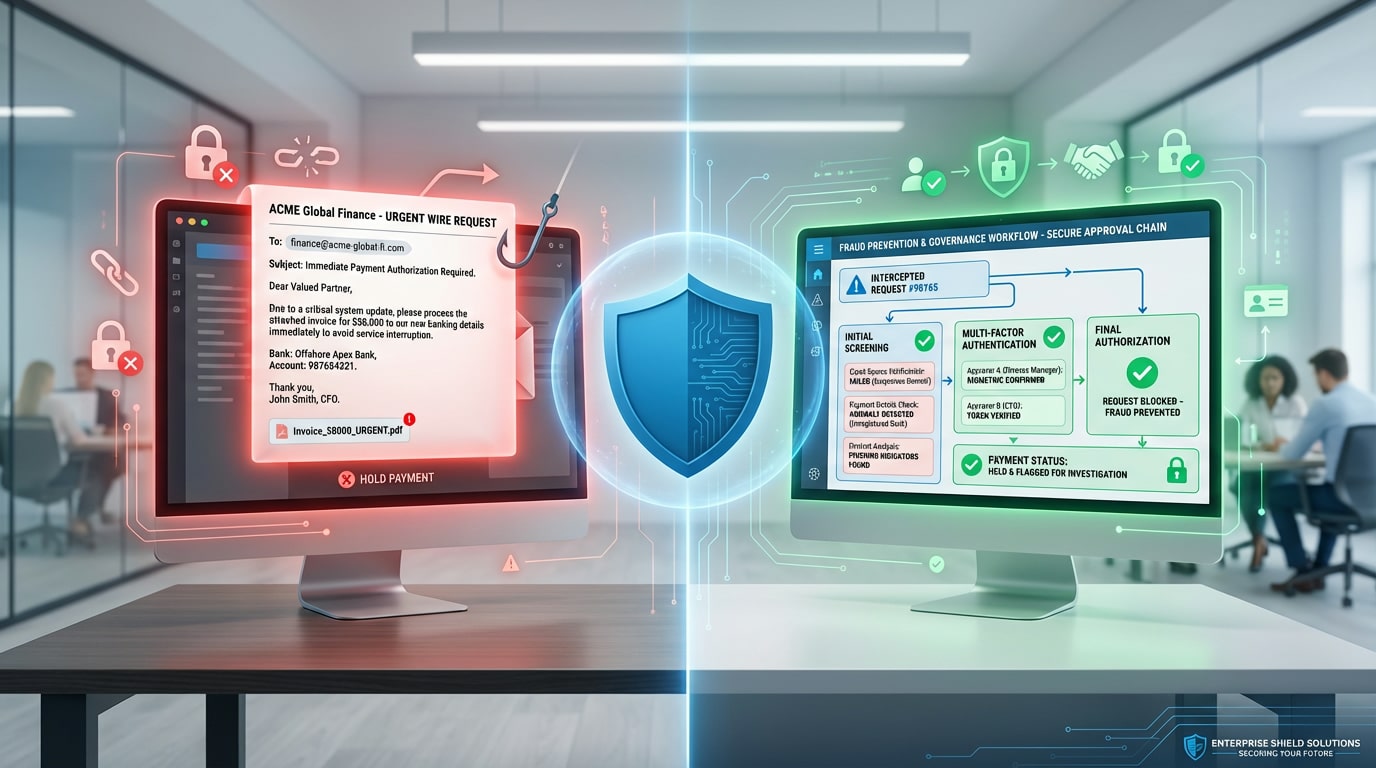
With vendor master data governance software in place, the outcome is different. The change request triggers a structured workflow: the clerk submits the request, the system automatically flags it as a sensitive-field modification, a second reviewer is assigned, and the bank details are verified through an independent channel—such as calling the supplier on a pre-registered phone number. Payment is placed on hold until verification is complete. The entire sequence is documented, creating a defensible record if the incident is later investigated.
Did You Know
Organizations that implement callback verification for bank account changes—contacting the supplier on a pre-registered phone number rather than the number provided in the change request—reduce successful payment redirection fraud by over 90%, according to industry benchmarks from the Association of Certified Fraud Examiners.
What Should Supplier Master Data Validation Include?
Validation happens at two levels: syntactic and business-rule. Syntactic validation checks format—does the tax ID have the correct number of digits, does the postal code match the country, is the IBAN structured correctly? Business-rule validation goes deeper—does this supplier already exist under a different name, is the tax ID active with the relevant authority, does the bank account belong to the legal entity named in the record?
Israel’s Tax Authority offers a government service for verifying vendor invoice information against officially reported data, designed to reduce fictitious invoicing. This kind of external truth-source check is precisely what strong supplier master data validation should incorporate: cross-referencing supplier-submitted data against independent, authoritative databases before the record becomes active in the ERP.
| Validation Type | What It Checks | When It Runs |
|---|---|---|
| Format / Syntactic | Field length, character type, country-specific patterns (IBAN, tax ID) | At data entry (real-time) |
| Completeness | All mandatory fields populated before record can be saved or submitted | At data entry (real-time) |
| Duplicate Detection | Fuzzy matching on name, address, tax ID, bank account | At creation and periodically (batch) |
| Business Rule | Tax ID active, entity not on sanctions list, bank account ownership verified | At creation, at change, and periodically |
| External Source | Cross-check against government registries, tax authority, bank verification services | At creation and at sensitive-field change |
Tip
Configure your governance platform to run external source validation not only at vendor creation but also whenever a bank account, tax ID, or legal entity name is modified. Many organizations validate only at onboarding and miss changes made months or years later—precisely when fraud risk peaks.
Why Do Duplicate Vendors Keep Appearing Despite ERP Controls?
Most ERP systems offer basic duplicate checking, but it is easily circumvented. A supplier registered as “ABC Ltd.” can be re-entered as “A.B.C. Limited” or “ABC Company”—and the system treats them as distinct entities. Acquisitions add complexity: a supplier with subsidiaries in multiple countries may appear under different names, tax IDs, and currencies. Without fuzzy matching and normalization logic, duplicates accumulate silently.
The most effective fields for duplicate detection are tax identification number, bank account number, and a normalized version of the legal entity name. When a potential duplicate is flagged, the system should route it to a data steward for manual review rather than blocking the request entirely—balancing control with operational speed. Over time, the duplicate rate becomes a key performance indicator for data health.
Did You Know
Research from audit firms consistently finds that organizations with more than 10,000 vendor records typically carry a duplicate rate between 3% and 8%. Each duplicate record increases the probability of overpayment, and recovering those overpayments costs an estimated 15 to 25 hours of staff time per case.
Your vendor master file is only as secure as the controls protecting it. Speak with Detelix to discover how real-time governance prevents payment fraud, eliminates duplicates, and strengthens audit readiness.
Vendor Onboarding Risk Controls: What Must Be Verified Before a Supplier Goes Active?
Onboarding is the moment of highest leverage: controls applied here prevent problems from ever entering the system. A “Know Your Vendor” (KYV) checklist typically includes tax ID validation, sanctions and denied-party screening, bank account ownership verification, insurance or certification checks (where applicable), and agreement to payment terms and compliance policies.
The level of scrutiny should match the risk profile. A low-value, domestic office-supplies vendor may require only basic identification and tax validation. A high-value international contractor handling sensitive data or operating in a sanctions-sensitive jurisdiction warrants enhanced due diligence, including corporate registry verification and beneficial-ownership disclosure. Defining these risk tiers upfront prevents the onboarding process from becoming a bottleneck for low-risk suppliers while maintaining rigor where it matters most.
The “Email-to-ERP” Pipeline and Why It Must Be Replaced
In many organizations, new vendor requests still arrive by email—an unstructured, unverified, and easily intercepted channel. A secure self-service portal replaces this pipeline: the supplier enters its own details, uploads supporting documents, and the system validates the data before it ever reaches a human reviewer. This eliminates transcription errors, creates an immediate audit trail, and ensures that no request bypasses the defined workflow.
Tip
When implementing a vendor self-service portal, require suppliers to authenticate using a verified business email domain and upload at least one supporting document (such as a W-9, incorporation certificate, or bank letter). This front-loads verification and dramatically reduces the volume of incomplete or fraudulent submissions that reach your review queue.
How Do You Measure Vendor Data Quality Over Time?
Governance is not a one-time project. Data decays: suppliers change addresses, merge with other companies, become inactive, or update their banking relationships. Without continuous monitoring, even a perfectly clean master file will degrade within months. The Israeli Ministry of Labor’s occupational standards reference data quality assessment as a structured process that uses specific metrics to identify issues and plan remediation—a discipline that applies directly to vendor data.
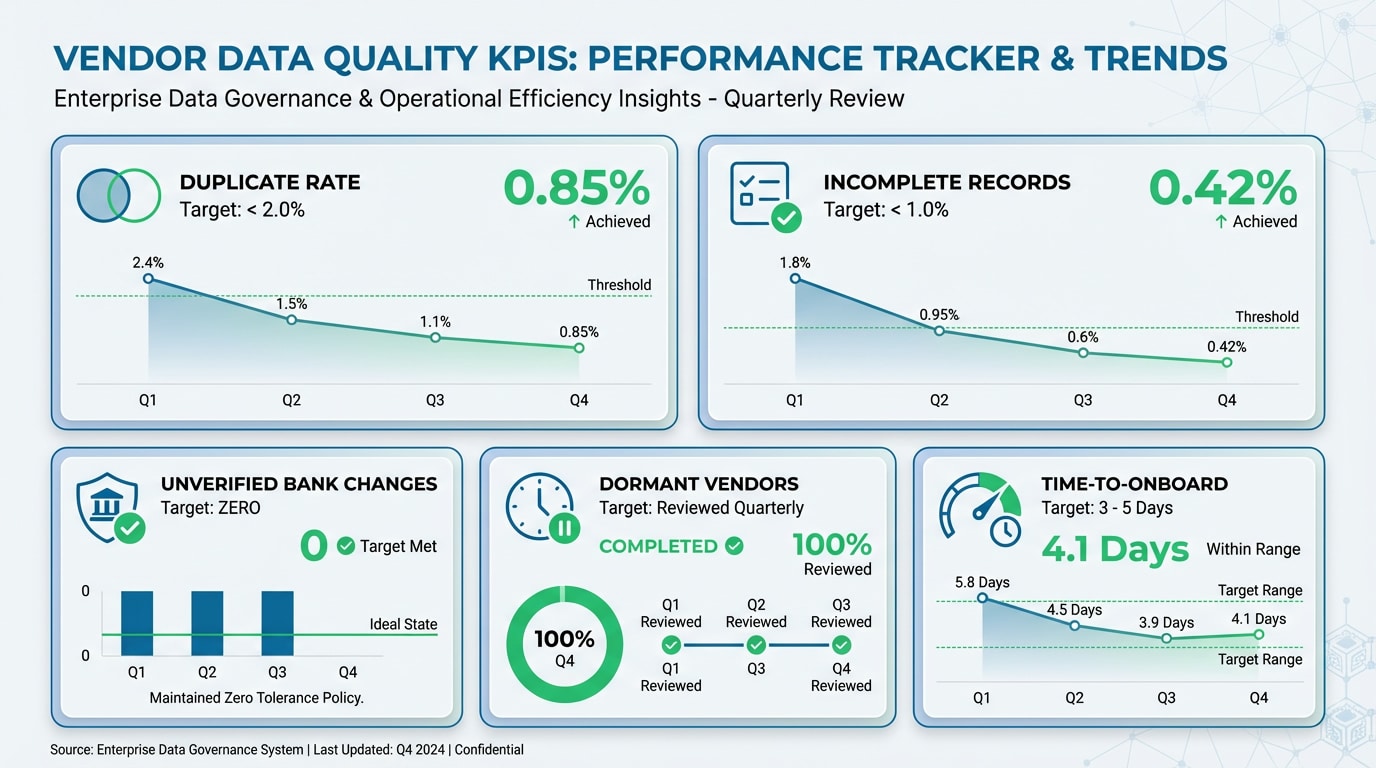
| KPI | What It Measures | Target Benchmark |
|---|---|---|
| Duplicate Rate | Percentage of vendor records that are potential or confirmed duplicates | Below 2% |
| Incomplete Records | Percentage of records missing one or more mandatory fields | Below 1% |
| Unverified Bank Changes | Number of bank account modifications not yet confirmed through independent verification | Zero at any given time |
| Dormant Vendors | Records with no transaction activity in the past 12–18 months | Reviewed and deactivated quarterly |
| Time-to-Onboard | Average business days from vendor request to active status | 3–5 days for standard risk |
Dormant vendors deserve special attention. An inactive record that remains “open” in the system is a backdoor: an insider with sufficient access could reactivate it, change the bank details, and route a fraudulent payment through a vendor no one is watching. Periodic review and deactivation of dormant records is a simple but powerful control.
Did You Know
A study by the Institute of Finance and Management found that the average enterprise has between 15% and 25% of its vendor records in a dormant state—no transactions in over 18 months. Each dormant record represents a potential pathway for insider fraud if left unmonitored and active in the ERP system.
Real-Time Monitoring Compared to Annual Audits: Which Approach Actually Prevents Losses?
Annual or quarterly data-cleansing exercises have their place, but they are inherently retrospective. If a fraudulent bank account change was made in January and the next audit runs in June, the organization has been exposed for five months. Real-time vendor data monitoring closes this window to seconds. Every creation, modification, or deletion event is evaluated against predefined rules the moment it occurs. Alerts are routed to the appropriate reviewer based on the type and severity of the change.
Tip
Calibrate your real-time alert thresholds carefully. Assign critical-priority alerts to bank account changes, payment-term modifications, and tax ID edits. Use lower-priority notifications for contact-name or phone-number updates. This risk-based approach prevents alert fatigue while ensuring high-impact events never slip through unreviewed.
The challenge with real-time monitoring is noise. If every minor address correction triggers an alert, reviewers quickly develop “alert fatigue” and begin ignoring notifications. Effective systems allow organizations to calibrate sensitivity: high-priority alerts for bank account changes, payment-term modifications, and tax ID edits; lower-priority notifications for phone number or contact-name updates. This risk-based approach keeps the signal-to-noise ratio manageable.
Five Common Mistakes in Vendor Master Governance Programs
Mistake 1: Treating governance as an IT project. Governance is a business-process discipline. Technology enables it, but ownership must sit with finance, procurement, or a dedicated data-governance function—not with the ERP administration team alone.
Mistake 2: Applying the same controls to every vendor. A one-size-fits-all approach either over-burdens low-risk onboarding or under-protects high-risk relationships. Risk-tiered controls are essential.
Mistake 3: Ignoring the “change” lifecycle. Most programs focus on vendor creation but neglect ongoing changes—address updates, bank account modifications, contact replacements—where the majority of fraud risk actually resides.
Did You Know
Forensic audit data shows that over 70% of vendor master fraud involves modifications to existing records rather than the creation of entirely new fictitious suppliers. Focusing governance controls exclusively on vendor creation leaves the majority of the attack surface unprotected.
Mistake 4: No clear ownership of data quality. Without a designated data steward or governance owner, exceptions pile up, duplicate requests are approved “just this once,” and standards erode.
Mistake 5: Relying solely on ERP-native controls. ERP systems provide foundational capabilities, but they are not purpose-built for governance. Dedicated vendor master data governance software adds the rule engine, workflow flexibility, external validations, and analytics layer that ERP configurations alone cannot deliver.
How Detelix Strengthens Vendor Master Data Controls in Practice
Organizations looking for real-time visibility into sensitive ERP processes can benefit from the approach that Detelix brings to vendor master governance. Rather than replacing the ERP, Detelix operates as an independent control layer that continuously scans vendor records for anomalies—flagging unauthorized changes, detecting segregation-of-duties violations, and identifying patterns that suggest duplicate or fictitious suppliers.
Three practical advantages stand out. First, Detelix provides automated cross-checking of sensitive field changes against predefined business rules, reducing the team’s dependence on manual review. Second, it maintains a complete, independent audit trail of every vendor-data event—useful for internal audits, regulatory inquiries, and forensic investigations. Third, because it operates outside the ERP’s permission model, it can detect risks that ERP-native controls miss, such as changes made by users with legitimately broad access who exploit that access inappropriately.
| Business Need | How the Platform Helps |
|---|---|
| Detect unauthorized bank account changes | Real-time alert on any modification to payment fields, with automatic hold recommendation until verification |
| Enforce segregation of duties | Continuous SoD monitoring across vendor creation, modification, and payment approval roles |
| Identify duplicate or fictitious vendors | Pattern-based detection comparing names, tax IDs, addresses, and bank details across the entire master file |
| Support audit readiness | Independent event log with timestamps, user attribution, and before/after field values |
| Reduce false positives | Risk-calibrated alerting that prioritizes high-impact events over routine changes |
Tip
When evaluating a vendor governance platform, request a proof-of-concept that connects to your live ERP environment. A controlled test using your actual vendor data will reveal detection accuracy, false-positive rates, and integration complexity far more reliably than any vendor demo using sample data.
What Is the Difference Between Governance and Master Data Management (MDM)?
These two disciplines overlap but serve different purposes. Master Data Management focuses on creating a unified, consistent “golden record” by merging and synchronizing supplier data across multiple systems—ERP, procurement platform, contract-management tool, and so on. Governance focuses on the policies, controls, and accountability structures that determine how data is created, changed, approved, and retired.
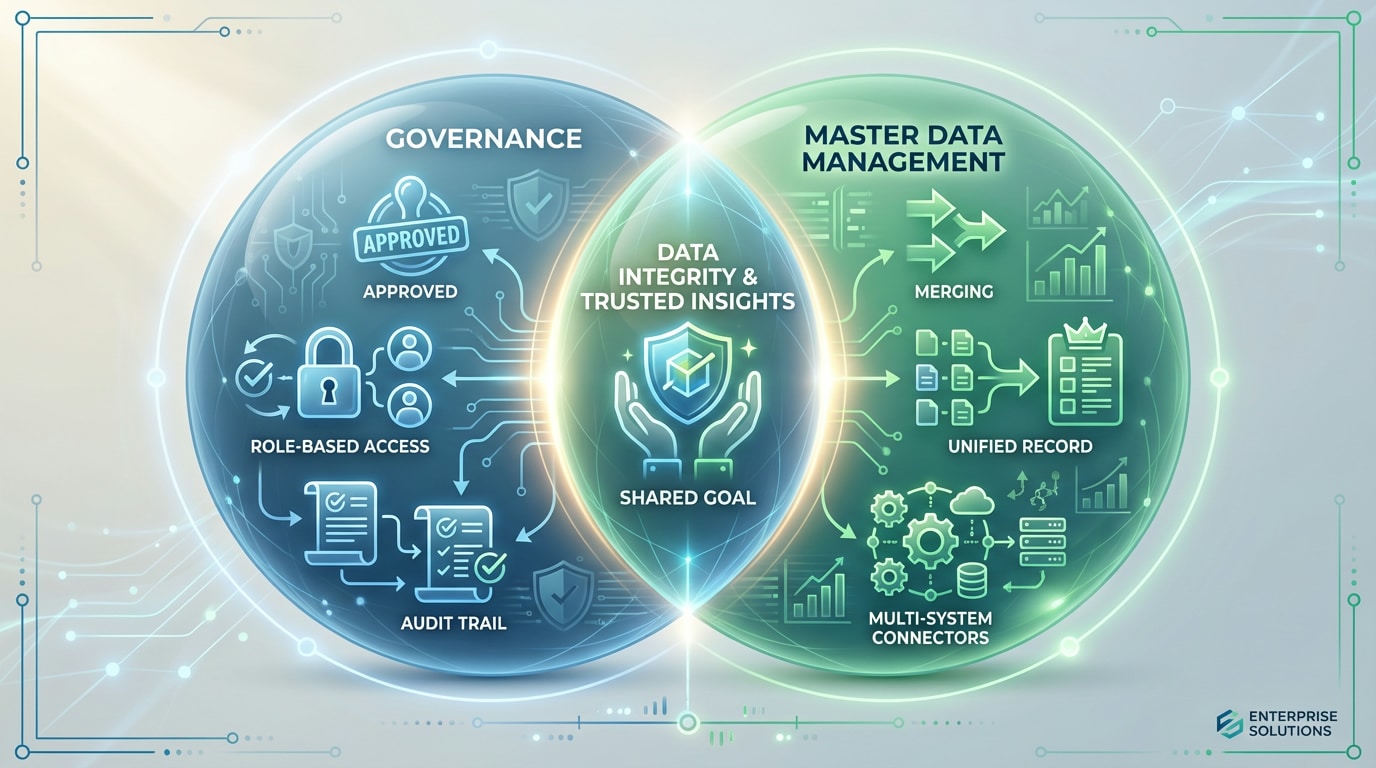
An organization with excellent MDM but weak governance will have clean, synchronized data that can still be manipulated by an insider. Conversely, strong governance without MDM may leave data fragmented across systems even though each individual change is well controlled.
Did You Know
Gartner research indicates that organizations implementing governance controls before or alongside MDM initiatives achieve measurable ROI 40% faster than those that deploy MDM technology first and attempt to layer governance on afterward. The policy framework provides the foundation that makes data consolidation sustainable.
For many mid-sized organizations, governance alone delivers the highest immediate ROI: it reduces fraud risk, improves audit outcomes, and strengthens payment accuracy without requiring a multi-year MDM integration project. Larger enterprises operating across multiple ERPs and geographies typically need both disciplines working together.
How Should You Evaluate Vendor Master Data Governance Software?
Selection criteria should reflect the priorities of both finance and procurement stakeholders. The system must integrate with your existing ERP environment—whether SAP, Oracle, NetSuite, Priority, or another platform—through bidirectional APIs that allow real-time data exchange without manual imports. It should offer configurable workflow builders so that approval routes can be tailored by vendor risk tier, change type, geography, or business unit.
Equally important is the ability to connect to external truth sources: tax-authority registries, sanctions lists, and bank-verification services. A system that validates data only against internal rules misses the external threats that governance is designed to catch. Finally, look for analytics and reporting capabilities that let you track your KPIs—duplicate rate, time-to-onboard, unverified changes—over time, demonstrating measurable improvement to leadership and auditors.
Detelix Vendor Governance and Fraud Prevention Solutions

Proactive Monitoring
Continuous scanning of vendor master records for unauthorized changes, policy violations, and anomalous patterns before they lead to financial loss.

Real-Time Alerts
Instant notifications when sensitive vendor fields are modified, with risk-calibrated severity levels that eliminate alert fatigue and prioritize genuine threats.

GateKeeper
Automated segregation-of-duties enforcement and approval workflow management that prevents unauthorized vendor record changes from reaching the payment pipeline.

Experience
Decades of domain expertise in ERP security, vendor governance, and financial controls across industries including healthcare, manufacturing, and government.
See Detelix Vendor Governance in Action
Frequently Asked Questions
Can vendor master data governance software work with multiple ERP systems simultaneously?
Yes. Purpose-built governance platforms are designed to sit above the ERP layer, connecting to multiple systems through APIs or middleware. This is especially valuable for organizations that have grown through acquisitions and operate on different ERP instances, because the governance layer enforces consistent policies across all of them.
How long does implementation typically take?
For a focused deployment covering vendor creation, sensitive-field changes, and basic duplicate detection, most organizations can go live within four to eight weeks. More complex deployments involving multi-system integration, custom risk-tiering models, and external-source connections may take three to six months. Phased rollouts—starting with the highest-risk controls—are generally recommended.
Is it possible to let suppliers update their own data without compromising security?
Self-service supplier portals allow vendors to submit updated information—new addresses, contact changes, even bank account details—through a secure, authenticated channel. However, the key safeguard is that submitted changes do not go live automatically. They enter a review and validation workflow, where sensitive fields undergo independent verification before the master record is updated.
What is the ROI of implementing vendor master governance?
ROI is driven by prevented losses rather than new revenue. Stopping a single fraudulent bank-account redirect can save tens or hundreds of thousands of dollars. Eliminating duplicate payments typically recovers between 0.1% and 0.5% of total supplier spend. Faster onboarding reduces procurement cycle times. And stronger audit outcomes lower the cost and disruption of both internal and external audits.
Does governance software replace internal audit?
No. Governance software automates preventive and detective controls, but it does not replace the judgment, risk assessment, and strategic oversight that internal audit provides. Instead, it gives auditors better data, cleaner trails, and real-time visibility—making their work more efficient and more impactful.
Ready to Put Your Vendor Master File Under Real Control?
Stop relying on annual cleanups and manual spot-checks. Detelix gives you continuous, automated vendor governance that prevents fraud, enforces compliance, and delivers audit-ready evidence on demand.