Automate Your Finance Controls with Detelix
Move from periodic sampling to continuous, full-population control testing across your ERP. Get expert guidance from our team.
- What Is Internal Audit Automation for Finance Controls?
- Why Are Finance Teams Moving Away from Manual Sampling?
- How Does Continuous Auditing Software Differ from Traditional Periodic Audits?
- What Are the Core Components of Audit Analytics for Finance?
- Which Finance Controls Are Best Suited for Automated Testing?
- How Does a Risk-Based Internal Audit Approach Prioritize Findings?
- A Comparison: Manual Testing vs. Automated Control Testing
- What Constitutes a Reliable Audit Trail in an Automated System?
- How to Maintain the Integrity of Automated Audit Evidence
- Common Mistakes When Implementing Audit Automation
- What Data Sources Does Automated Control Testing Require?
- Does Automation Replace the Internal Auditor?
- What Are the ROI Metrics for Implementing Audit Automation?
- What New Risks Emerge When You Automate Control Testing?
- How Do You Choose the Right Platform for Finance Control Automation?
- How Detelix Maps to Core Automation Needs
- A Step-by-Step Implementation Scenario
- Frequently Asked Questions
In many organizations, financial controls look strong on paper. Approval workflows exist, ERP permission matrices are documented, reconciliation procedures run on schedule, and quarterly review cycles happen without fail. Yet when a process depends too heavily on manual sampling, after-the-fact reporting, or spreadsheet-driven evidence collection, risk can still slip through unnoticed. A single undetected duplicate payment, an unauthorized vendor master change, or a segregation-of-duties violation can cascade into material misstatement or outright fraud. Internal audit automation for finance controls represents a fundamental shift: replacing fragmented, periodic checking with a continuous, data-driven layer of oversight that operates while your business runs.
Key Takeaways
- Internal audit automation replaces sample-based, periodic testing with full-population, continuous control monitoring across ERP-driven financial processes.
- Automated control testing delivers near-real-time detection of anomalies such as duplicate payments, SoD violations, and unauthorized vendor master changes.
- A governed, time-stamped audit trail produced by automation satisfies both internal governance requirements and external regulatory expectations including PCAOB AS 2201.
- Automation does not replace professional judgment; it frees auditors to focus on analysis, root-cause investigation, and advisory work instead of manual data gathering.
- Selecting the right platform requires native ERP integration, transparent rule logic, robust exception management, and strong governance over the automation itself.
What Is Internal Audit Automation for Finance Controls?
Internal audit automation for finance controls is the systematic use of rules, analytics, and structured workflows to perform control testing, evidence collection, and documentation on an ongoing, governed basis rather than relying on manual effort and sample-based inspection. It consolidates decentralized financial data from ERP modules, bank feeds, procurement systems, and payroll engines into one environment where automated tests run against every transaction.
The professional foundation for this approach is well established. PCAOB Auditing Standard AS 2201 sets out the requirements for evaluating Internal Control Over Financial Reporting (ICFR), including the nature, timing, and extent of evidence an auditor needs. When those requirements are translated into automated rule sets, organizations gain the ability to test controls continuously rather than only at year-end, and to produce evidence that satisfies both internal governance and external regulators.
Tip
Map your existing ICFR control matrix to specific data fields in your ERP before selecting an automation platform. This exercise reveals which controls can be expressed as deterministic rules and which still require human judgment, helping you prioritize your automation roadmap.
Why Are Finance Teams Moving Away from Manual Sampling?
Traditional auditing relies on selecting a small, statistically representative sample from a large population of transactions. The auditor reviews each item, documents findings, and extrapolates conclusions. This approach carries inherent limitations: sampling risk means material exceptions can exist in the untested portion; human error during manual review leads to missed anomalies; and the lag between transaction occurrence and testing means problems are discovered weeks or months late.
Automation changes that equation. Instead of testing 25 invoices out of 50,000, an automated control testing engine evaluates every single record against predefined rules. The result is full-population coverage, earlier detection, and dramatically less time spent on data gathering. Understanding the essentials of internal controls is the first step in recognizing why this shift matters: controls that are not tested consistently are controls that may not work at all. The COSO Integrated Framework explicitly identifies monitoring as a core component of effective internal control, reinforcing that ongoing oversight rather than periodic review is the standard organizations should aim for.
Did You Know
According to the Association of Certified Fraud Examiners (ACFE), organizations that implement proactive data monitoring and analysis detect fraud 52% faster than those relying solely on traditional audit methods, reducing the median loss per scheme by more than half.
How Does Continuous Auditing Software Differ from Traditional Periodic Audits?
A traditional audit cycle concentrates effort into a compressed window, often the final weeks of a quarter or fiscal year. Teams scramble to collect screenshots, reconcile data, and compile workpapers. Continuous auditing software replaces that marathon with a steady, automated flow. Tests execute daily, weekly, or on a trigger basis whenever a specific event occurs in the ERP, such as a new vendor creation or a payment above a threshold.
The Institute of Internal Auditors (IIA) defines continuous auditing as a technology-driven approach for ongoing risk and control assessment. Instead of discovering a control failure in March that occurred the previous September, your team is alerted within hours. This cadence allows finance leaders to remediate issues before they affect closing, reporting, or external audit readiness.
When Is Continuous Auditing Not Appropriate?
Not every control lends itself to automation. Where data quality is poor, ownership of controls is unclear, or a control requires deep professional judgment such as evaluating the reasonableness of an accounting estimate, human review remains essential. Continuous auditing works best when control logic can be expressed as deterministic rules applied to structured, reliable data.
Tip
Start your continuous auditing initiative with controls that have clearly defined pass/fail criteria and high transaction volumes. Accounts payable duplicate detection and three-way match verification are strong candidates because the logic is unambiguous and the payoff from full-population testing is immediate.
What Are the Core Components of Audit Analytics for Finance?
The engine behind effective internal audit automation for finance controls rests on three pillars. First, data normalization: raw ERP exports, bank files, and subsidiary ledger data are cleaned, mapped, and standardized so that tests produce comparable results across periods and entities. Second, pattern recognition: statistical and rule-based algorithms identify anomalies such as unusual journal entries, round-dollar payments, transactions posted outside business hours, or concentrations of activity with a single vendor.
Third, exception reporting: flagged items are routed to the responsible auditor or control owner with context, severity scoring, and a clear audit trail. Together, these components transform high-volume financial data from AP, AR, GL, and payroll into actionable findings. A Comprehensive Guide to Financial Controls helps illustrate the breadth of data types that analytics engines must process. Data-enabled auditing, as described by IIA practitioners, reduces time spent on evidence gathering and increases the proportion of effort directed toward analysis and remediation.
Did You Know
A Deloitte Global survey of Chief Audit Executives found that organizations using advanced analytics in their audit function identified 25% more high-risk findings compared to those relying exclusively on traditional manual testing methods.
Which Finance Controls Are Best Suited for Automated Testing?
Procure-to-Pay and Accounts Payable
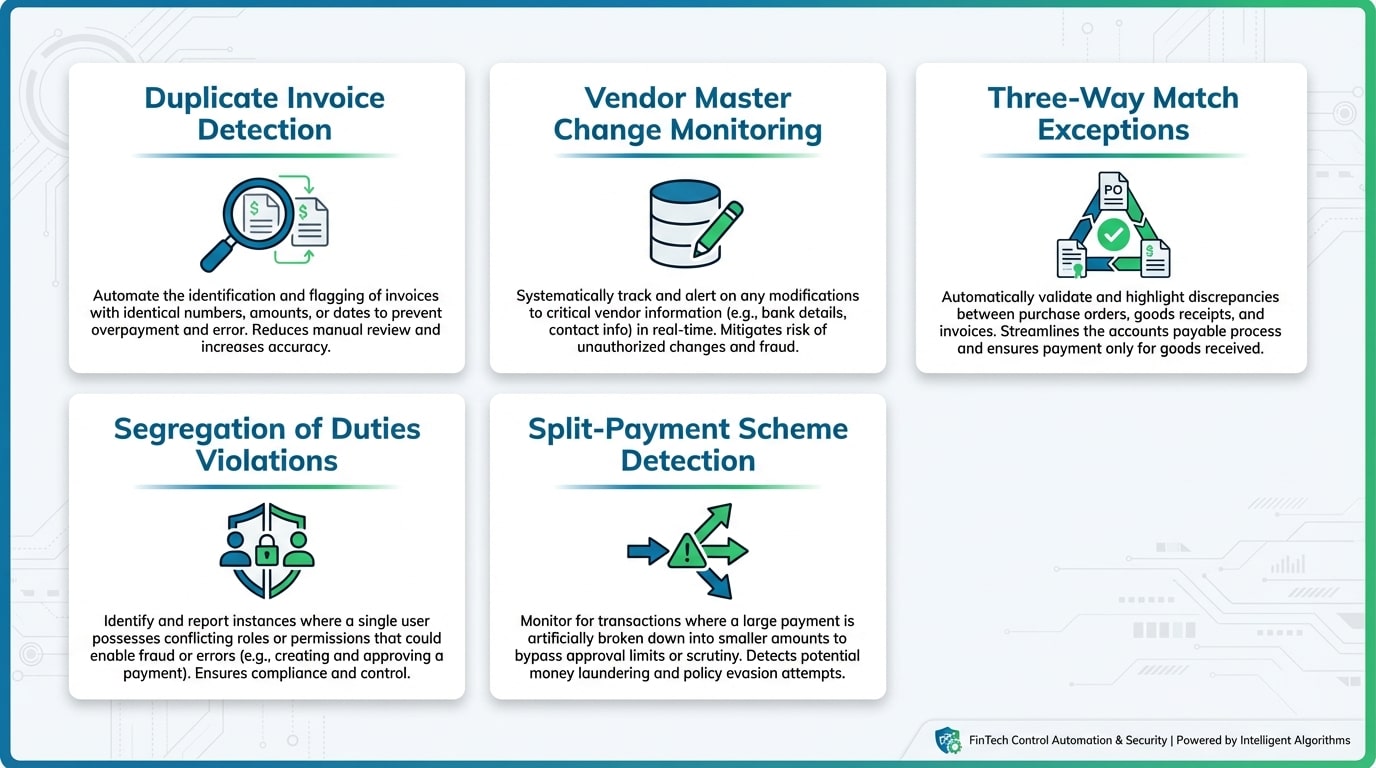
The P2P cycle is one of the highest-value targets for automated control testing because of its volume, complexity, and fraud exposure. Specific tests include duplicate invoice detection across vendors and periods, vendor master file change monitoring (especially bank account modifications), three-way match exceptions, Segregation of Duties violations in requisition-to-payment workflows, and split-payment schemes designed to circumvent approval thresholds. Reviewing established internal controls for accounts payable highlights the breadth of risks that automation can address systematically.
Beyond P2P, strong candidates for automation include bank reconciliation matching, journal entry testing for unusual patterns, payroll ghost-employee detection, customer refund outlier analysis, and access-rights reviews. The common thread is structured data, clear control objectives, and high transaction volume, which are conditions where automation delivers disproportionate value.
Tip
When automating vendor master change monitoring, configure your rules to flag not just bank account modifications but also changes to payment terms, tax IDs, and remittance addresses. Fraudsters often alter secondary fields first to test whether changes trigger alerts before targeting bank details.
How Does a Risk-Based Internal Audit Approach Prioritize Findings?
When an automated system flags thousands of exceptions, the real challenge shifts from detection to prioritization. A risk-based internal audit model applies materiality thresholds, process-risk weightings, and historical exception rates to rank findings. Instead of reviewing every flagged transaction, auditors focus on the outliers that matter most: high-dollar items, first-time vendor payments, changes made by users with elevated privileges, or patterns that recur across multiple periods.
This approach transforms the auditor’s role. Rather than spending days extracting data and performing tick-and-tie procedures, the team analyzes root causes, investigates high-risk clusters, and advises management on control improvements. Detelix supports this model by continuously scanning ERP-driven financial processes and surfacing the exceptions that warrant human attention, so your audit resources are deployed where they create the most value.
A Comparison: Manual Testing vs. Automated Control Testing
| Dimension | Manual / Sample-Based Testing | Automated Control Testing |
|---|---|---|
| Population coverage | Typically 5-30 items per control | 100% of transactions tested |
| Detection speed | Weeks to months after occurrence | Near real-time or daily |
| Evidence format | Screenshots, email threads, spreadsheets | System-generated logs with time stamps |
| Scalability | Requires proportional headcount | Scales with data volume, not staff |
| Consistency | Varies by auditor skill and workload | Same rules applied uniformly every cycle |
| Audit preparation time | Significant manual compilation | Reports generated on demand |
Did You Know
The IIA’s Global Internal Audit Survey reported that internal audit functions spend an average of 40% of their total hours on data gathering and documentation tasks that could be partially or fully automated, leaving less than a third of available time for actual analysis and advisory work.
Ready to eliminate manual sampling gaps and gain continuous visibility into your financial controls? Let Detelix show you how full-population testing works in practice.
What Constitutes a Reliable Audit Trail in an Automated System?
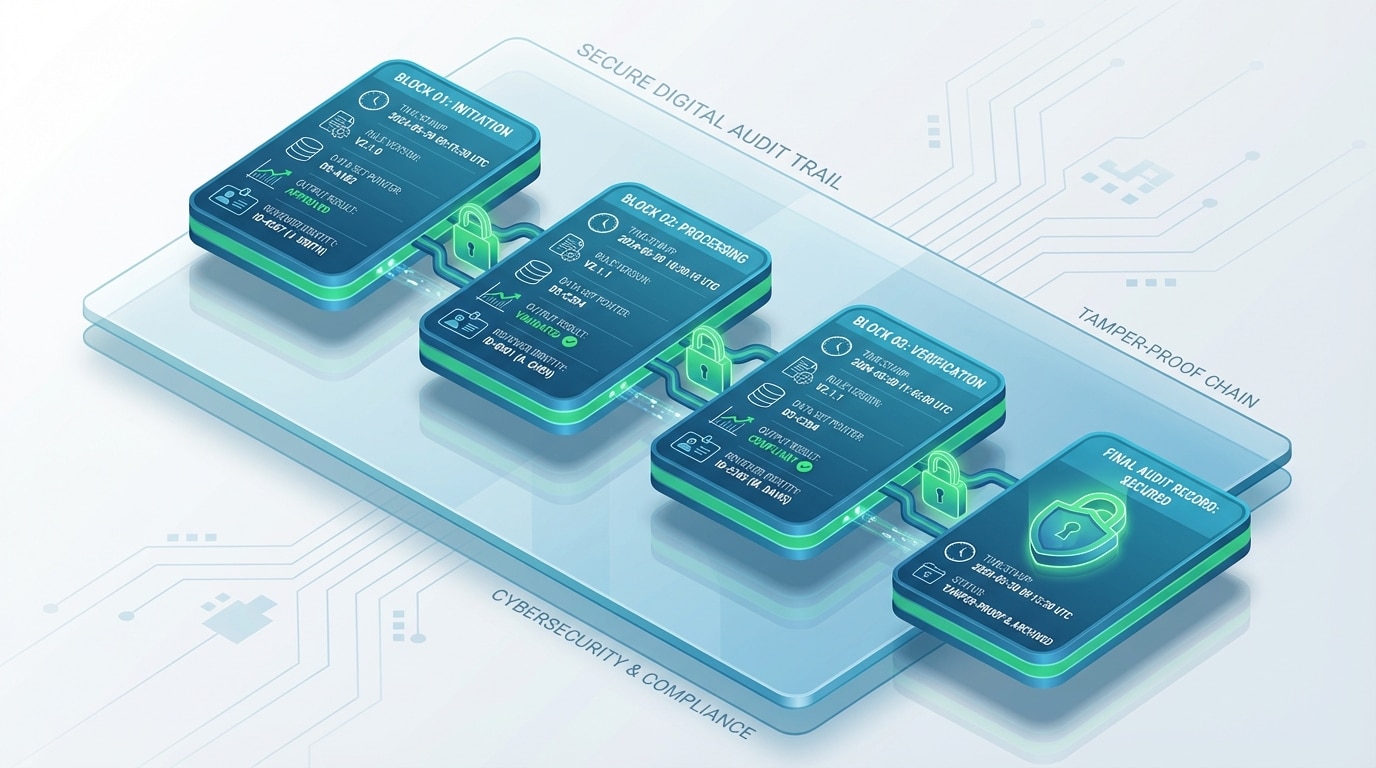
An audit trail in the context of internal audit automation is a complete, unalterable record of what was tested, when, against which data, using which rule version, and what the outcome was. PCAOB AS 1215, Appendix A establishes the reviewability principle: documentation must enable an experienced auditor to understand the work performed, who performed it, when it was completed, and what conclusions were reached without needing oral explanation.
For automated systems, this means every test execution must carry a time stamp, a reference to the exact rule version applied, the input data set (or a secure pointer to it), the output results, and the identity of anyone who reviewed or dispositioned an exception. Without these elements, automated evidence is no more reliable than a folder of unlabeled screenshots.
Tip
Require your automation platform to version-stamp every rule change and retain historical rule definitions alongside their corresponding test results. If a rule is modified mid-period, you need to demonstrate which version produced which results to satisfy both internal and external reviewers.
How to Maintain the Integrity of Automated Audit Evidence
One of the most common concerns about automation is the “black box” problem: if no one understands how a rule works or whether the data feeding it is complete, the results cannot be trusted. Maintaining integrity requires three disciplines.
First, rule calibration: every automated test should be periodically validated against known outcomes to confirm it still produces accurate pass/fail results. Second, data completeness checks: the system must verify that the full population was ingested because missing records mean missed exceptions. Third, access governance: only authorized personnel should be able to modify rules, suppress exceptions, or alter historical results. NIST SP 800-92 provides detailed guidance on securing and managing audit logs, including time-stamping standards and retention requirements that apply directly to automated audit evidence.
Common Mistakes When Implementing Audit Automation
Organizations often underestimate the governance required around the automation itself. A frequent error is deploying rules without a formal change-control process, meaning anyone with system access can quietly adjust thresholds or add suppression filters, weakening the control without an audit trail. Another mistake is assuming that automation eliminates the need for professional judgment; in reality, it amplifies the need for skilled auditors who can interpret results, investigate root causes, and distinguish genuine risk from noise.
A third pitfall is selecting overly complex processes for the initial pilot. High-judgment areas like revenue recognition or impairment testing are poor starting points. Instead, begin with high-volume, rule-based processes such as accounts payable or bank reconciliation where ROI is immediate and measurable.
Did You Know
A study published in the Journal of Accountancy found that 68% of failed audit automation implementations cited inadequate change-management governance as the primary contributing factor, not technology limitations or data quality issues.
What Data Sources Does Automated Control Testing Require?
Effective automation depends on consistent, structured data from multiple systems. The table below maps common control areas to their primary data sources.
| Control Area | Primary Data Sources | Key Fields |
|---|---|---|
| Accounts Payable | ERP AP module, vendor master, bank files | Invoice number, amount, vendor ID, bank account, approval stamp |
| General Ledger | ERP GL module, sub-ledger feeds | Journal entry ID, account, amount, posting user, date/time |
| Segregation of Duties | ERP user access logs, role assignments | User ID, role, transaction codes, date of assignment |
| Bank Reconciliation | Bank statements (MT940/BAI2), ERP cash module | Transaction reference, date, amount, matching status |
| Payroll | HR/Payroll system, bank payment files | Employee ID, salary amount, bank account, effective date |
What Happens When Data Is Incomplete or Unstructured?
When APIs are unavailable or data arrives in inconsistent formats, a normalization layer (ETL) becomes essential. This layer maps fields across systems, applies data-quality rules, and flags records that fail completeness checks. Without it, automation may process a partial population, creating a false sense of assurance that is arguably worse than no automation at all.
Tip
Build a data completeness check into every automated test run. Before processing begins, the system should compare the expected record count (from the source system’s transaction log) against the actual ingested count. If the delta exceeds a defined threshold, pause the test and alert the data steward rather than producing results based on incomplete data.
Does Automation Replace the Internal Auditor?
No. Automation replaces repetitive, manual tasks such as data extraction, spreadsheet manipulation, and evidence filing, but it does not replace professional judgment. Auditors are still needed to design the audit plan, evaluate the control environment, investigate flagged exceptions, validate that automated rules remain appropriate, and communicate findings to management and the audit committee. What changes is where auditors spend their time: less on collection, more on analysis and advisory.

Did You Know
The World Economic Forum’s Future of Jobs Report identifies data analysis, critical thinking, and technology literacy as the top three skills that internal auditors will need by 2027, reflecting the profession’s shift from manual testing toward technology-augmented advisory work.
What Are the ROI Metrics for Implementing Audit Automation?
Measuring the return on internal audit automation for finance controls requires both quantitative and qualitative metrics. On the quantitative side, organizations typically track hours saved on manual evidence collection per audit cycle, reduction in external audit fees due to better-prepared documentation, decrease in time-to-close for monthly and quarterly periods, and the number of recurring findings that decline after root-cause remediation driven by continuous monitoring.
Qualitatively, the benefits include reduced “audit fatigue” among finance staff who no longer face last-minute data requests, improved auditor morale as the work shifts toward higher-value activities, and stronger confidence from the audit committee that controls are functioning rather than simply existing at some point in the past.
Which KPIs Should You Present to the Board?
Effective board-level reporting focuses on coverage of critical controls (percentage monitored continuously), exception trend lines over time, SLA compliance for remediation, a red/amber/green status dashboard for key control areas, and leading risk indicators such as spikes in vendor master changes or unusual payment patterns.
Tip
Track your false-positive rate as a formal KPI alongside detection metrics. A declining false-positive trend demonstrates that your rule calibration process is working and that auditors are spending less time chasing noise, which directly translates into efficiency gains you can quantify for the board.
What New Risks Emerge When You Automate Control Testing?
Automation introduces its own risk layer. A misconfigured rule can generate false assurance, marking transactions as “passed” when they should have been flagged. Over-reliance on integrations means that if a data feed breaks silently, an entire control population goes untested. And excessive access to the automation platform itself can become a segregation-of-duties issue if the person who writes the rules is also the one dispositioning exceptions.
Mitigating these risks requires governance over the automation: formal approval workflows for rule changes, completeness monitoring on all data feeds, periodic independent testing of rule accuracy, and strict access controls within the platform itself. In essence, you need controls over your controls.
Did You Know
ISACA’s COBIT 2019 framework explicitly addresses the governance of automated controls under its “Monitor, Evaluate and Assess” domain, requiring organizations to establish separate oversight mechanisms for the tools used to perform control testing, not just for the controls themselves.
How Do You Choose the Right Platform for Finance Control Automation?
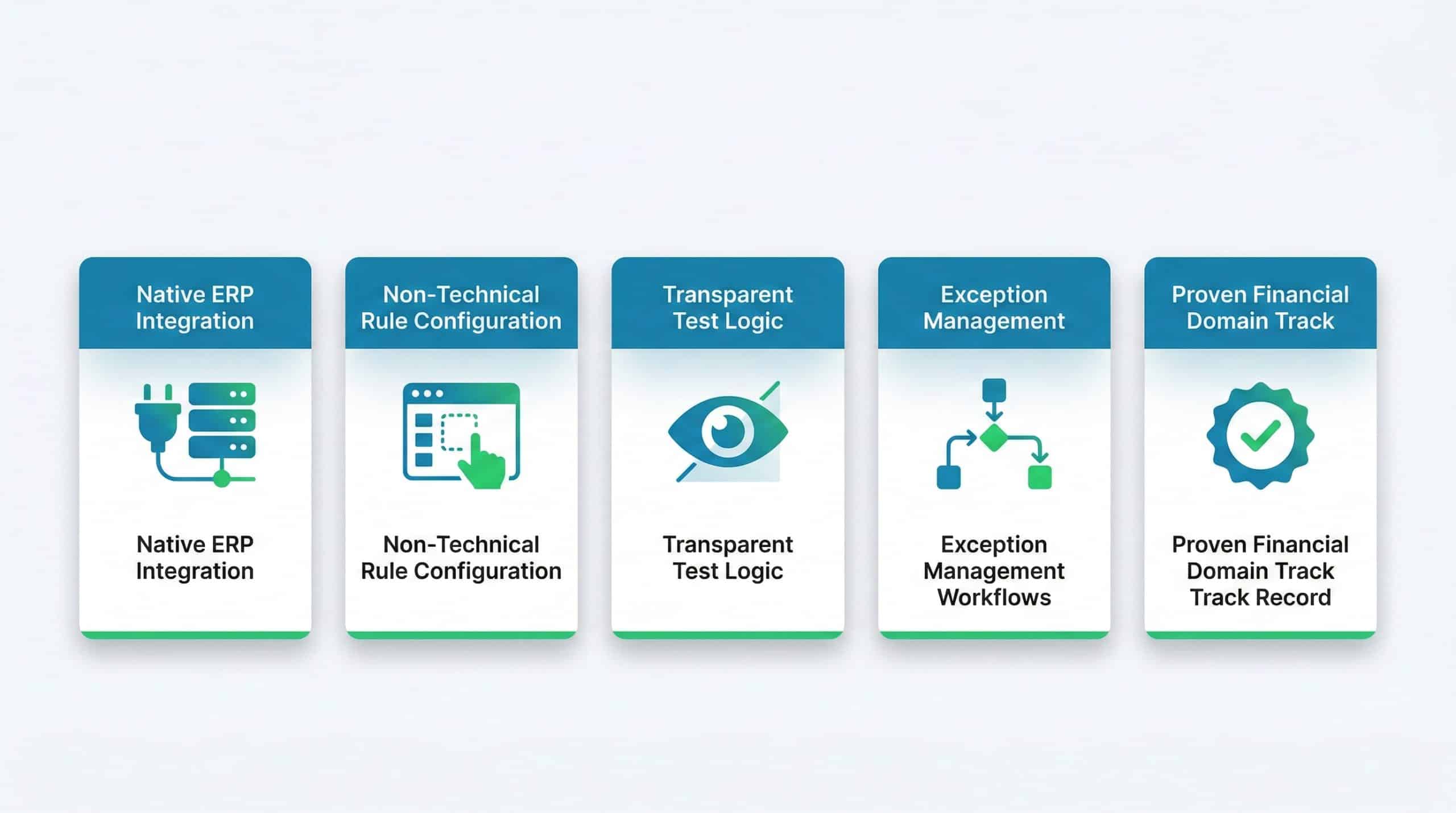
Selecting internal audit automation for finance controls is a business decision, not just a technology purchase. Decision-makers should evaluate candidates against criteria that reflect both current needs and future scalability. Key considerations include native integration with your ERP environment, the ability for non-technical auditors to configure and modify rules, transparent and explainable test logic (no opaque algorithms), robust exception management workflows, and a proven track record in financial process domains such as AP, AR, payroll, and bank reconciliation.
Detelix addresses these requirements by functioning as a real-time protection and control layer over ERP-driven financial processes. Rather than requiring your team to learn a new analytical language, it provides structured, pre-configured tests for sensitive business areas including supplier payments, vendor master changes, segregation of duties, bank reconciliation, and more, while generating the governed, time-stamped evidence trail that auditors and regulators expect.
How Detelix Maps to Core Automation Needs
| Business Need | How Detelix Helps in Practice |
|---|---|
| Real-time visibility into ERP transactions | Continuous scanning and cross-checking of financial actions as they occur, not after period-end |
| Reduced manual evidence collection | Automated capture and storage of test results, logs, and exception documentation |
| Risk-based prioritization | Severity scoring and threshold-based filtering so auditors focus on what matters most |
| Governance over audit rules | Versioned rule sets, change-control workflows, and access restrictions on rule modification |
| Faster response to anomalies | Alerts delivered to control owners and auditors when deviations are detected before damage occurs |
A Step-by-Step Implementation Scenario
Consider a mid-size manufacturing company that processes 40,000 vendor invoices per quarter. Their internal audit team currently samples 30 invoices per cycle and spends three weeks compiling evidence. By implementing automated control testing on the P2P cycle, they define rules for duplicate detection, three-way match exceptions, and vendor bank-account changes. Within the first month of parallel operation, the system identifies 14 duplicate invoices totaling over $85,000, none of which appeared in previous manual samples.
The team then expands to journal entry testing and SoD monitoring. Within two quarters, the external auditor reduces substantive testing scope because the continuous monitoring evidence satisfies documentation requirements under ICFR. The finance team reports a 60% reduction in time spent responding to audit requests, and the CFO gains a dashboard showing control health across all critical processes in real time.
Detelix ERP Protection Solutions

Proactive Monitoring
Continuous surveillance of ERP financial processes to detect anomalies, policy violations, and control gaps before they become material issues.
Learn More
Real-Time Alerts
Instant notifications to control owners and auditors when suspicious transactions, unauthorized changes, or threshold breaches are detected.
Learn More
Gatekeeper
Preventive control layer that blocks high-risk transactions at the point of execution, enforcing segregation of duties and approval policies in real time.
Learn More
Experience and Expertise
Decades of combined expertise in ERP security, financial controls, and internal audit automation across industries and regulatory frameworks.
Learn MoreSee Detelix in Action
Frequently Asked Questions
Can automation handle controls that require professional judgment?
Automation is most effective for controls with clear, rule-based logic such as matching, threshold checks, and access reviews. Controls requiring subjective assessment, like evaluating the adequacy of a reserve, still need human review. However, automation can flag the data that informs that judgment, making the human step faster and better supported.
How long does a typical implementation take?
A focused pilot on one or two processes (e.g., AP and journal entries) can be operational within 4 to 8 weeks, depending on data readiness and ERP complexity. Full deployment across multiple control areas typically takes 3 to 6 months with phased rollouts.
Is internal audit automation only relevant for SOX-regulated companies?
No. While SOX compliance creates a clear mandate, any organization that wants stronger financial controls, earlier detection of errors or fraud, and more efficient audit cycles benefits from automation regardless of regulatory regime.
What happens if an automated rule produces too many false positives?
High false-positive rates are usually a sign that thresholds need refinement or that known, accepted exceptions require suppression rules. A well-governed system includes a calibration process: review false-positive rates monthly, adjust parameters with documented approval, and track the trend to ensure noise decreases over time.
How does automation affect the relationship with external auditors?
External auditors generally welcome well-documented, continuous monitoring evidence because it reduces the scope of substantive testing they need to perform. Better-prepared documentation, consistent evidence formats, and full-population test results strengthen the auditor’s confidence in the control environment, often leading to fewer findings and lower fees.
Ready to Transform Your Financial Control Testing?
Stop relying on periodic samples and start monitoring every transaction in real time. Discover how Detelix delivers continuous, governed control over your most sensitive ERP processes.