Eliminate Month-End Close Errors Before They Reach Your Financial Statements
Detelix delivers real-time automated controls over journal entries, reconciliations, and close workflows — so your finance team catches problems as they happen, not months later.
- What Makes the Month-End Close So Prone to Errors?
- Five Categories of Close Risk That Automation Should Address
- Why Is Journal Entry Risk Monitoring Critical During the Close?
- A Common Scenario: When a Clean Checklist Hides a Dirty Close
- How Does Close Governance Software Go Beyond a Checklist?
- How Does Close Process Anomaly Detection Work in Practice?
- Mapping the Close Process: Where Should Automation Start?
- Does Automation Hurt the Flexibility of the Finance Team?
- How Segregation of Duties Becomes Enforceable Rather Than Theoretical
- Measuring Success: Which KPIs Indicate Genuine Risk Reduction?
- Can Automation Enable a Continuous Close Without Increasing Risk?
- What Real-Time Visibility Actually Looks Like for a CFO
- The Difference Between Monitoring Transactions and Actually Controlling Them
- Frequently Asked Questions
From the outside, most month-end close processes appear buttoned-up: checklists get completed, reconciliations get signed, and the books get finalized on schedule. Beneath that surface, finance teams routinely navigate a minefield of tight deadlines, fragmented data sources, manual adjustments, and last-minute entries that create real exposure to errors, misstatements, and fraud. Month-end close risk reduction automation addresses this gap head-on by replacing reactive, spreadsheet-driven oversight with a structured, continuous control layer that detects problems as they emerge — not weeks after the financial statements have been published. Platforms such as Detelix represent the next generation of this approach, offering real-time protection across sensitive ERP-driven financial processes so that CFOs, controllers, and internal auditors can move from the illusion of control to actual control.
Key Takeaways
- The month-end close concentrates dozens of high-risk activities into a compressed window, making it one of the most error-prone periods in financial operations.
- Journal entries — especially manual, late-period, and management-override entries — are the primary vehicle for both accidental errors and intentional manipulation.
- Automated close governance shifts controls from documented intentions to system-enforced realities, including segregation of duties, anomaly detection, and mandatory documentation.
- Combining rules-based validation with statistical anomaly detection catches both known risk patterns and unexpected deviations that no one anticipated.
- A continuous close model, supported by automation, transforms the period-end process from a frantic compilation effort into a streamlined confirmation step.
What Makes the Month-End Close So Prone to Errors?
The month-end close is not a single task — it is a compressed sequence of dozens of interconnected activities executed under deadline pressure. Data flows in from multiple sub-ledgers, currencies, and business units. Manual journal entries are posted to correct timing differences, allocate costs, or reverse accruals. Reconciliations must be completed, reviewed, and signed off. Each handoff between people, systems, and spreadsheets introduces the possibility of a mistake that compounds downstream.
Tip
Map every handoff point in your close process — where data moves from one person, spreadsheet, or system to another. These transition points are where the majority of close errors originate, and they represent your highest-value targets for automation.
What elevates the risk further is that many of the most consequential changes happen in the final hours of the close window. Late adjustments are frequently made by senior staff who may operate outside normal approval workflows — a phenomenon regulators refer to as “Management Override.” According to PCAOB Auditing Standard AS 2401, end-of-period journal entries and unusual adjustments are explicitly identified as primary fraud risk indicators that auditors must evaluate. The same logic applies to the finance team itself: if your close process lacks automated detection of these patterns, your organization is exposed.
Did You Know
PCAOB inspection findings consistently rank journal entry testing deficiencies among the most common audit failures — meaning that even trained external auditors struggle with this area without systematic, automated support.
Five Categories of Close Risk That Automation Should Address
Before selecting tools or designing workflows, it helps to categorize the specific risks embedded in the close process. Each category demands a different type of automated control, and overlooking any one of them leaves a gap that manual processes are unlikely to close consistently.
| Risk Category | What Can Go Wrong | How Automation Helps |
|---|---|---|
| Accuracy (errors) | Transposition mistakes, wrong account mapping, duplicate postings | Automated validation rules flag mismatches before posting |
| Completeness (missing postings) | Accruals not recorded, intercompany eliminations skipped | Task orchestration ensures every required step is tracked and enforced |
| Authorization and SoD | Same person creates and approves a journal entry | System-enforced role separation with full audit trail |
| Documentation (audit readiness) | Missing support, unsigned reconciliations, unversioned files | Mandatory attachment rules, digital sign-off, locked archives |
| Timeliness | Bottlenecks in approvals delay the entire close cycle | Workflow automation with escalation alerts and real-time status dashboards |
Understanding these categories is the starting point for any meaningful automation initiative. Rather than automating everything at once, effective programs target the intersections where risk is highest and manual effort is greatest.
Tip
Score each close task against these five risk categories on a simple 1-to-5 scale. Tasks that score high across multiple categories — for example, manual journal entries that carry accuracy, authorization, and documentation risk simultaneously — should be your first automation candidates.
Why Is Journal Entry Risk Monitoring Critical During the Close?
Journal entries are the single most common vehicle for both accidental errors and intentional manipulation of financial statements. Every restatement, every reclassification, every allocation ultimately flows through a journal entry. When those entries are created manually — especially under time pressure — the probability of mistakes rises sharply. And when someone intends to manipulate results, journal entries are almost always the tool of choice.
The PCAOB Audit Focus publication on Journal Entries highlights that audit deficiencies related to journal entry testing remain among the most frequently identified issues in inspection findings. This means that even professional auditors struggle with this area — so internal finance teams without automated support face an even steeper challenge.
What Red Flags Should Automated Monitoring Detect?
Effective journal entry risk monitoring scans for specific behavioral and transactional patterns: entries posted by users who do not normally post, entries in round amounts that suggest estimation rather than calculation, entries posted outside business hours or on the final day of the period, entries that reverse within a short window, and entries to accounts rarely used during regular operations. When these signals are flagged in real time, the finance team can investigate immediately rather than discovering the issue during an audit months later.
Did You Know
Research into corporate fraud cases shows that the vast majority of fraudulent financial reporting involves manipulation through manual journal entries — often posted to seldom-used accounts during the final days of the reporting period, precisely when oversight is weakest.
A Common Scenario: When a Clean Checklist Hides a Dirty Close
Consider a mid-sized organization that completes its month-end close using a well-maintained spreadsheet checklist. Every task is marked complete. Every reconciliation is signed. The controller confirms the numbers and the close is declared final. Three months later, external auditors identify a pattern of manual journal entries — small enough to fall below review thresholds individually, but collectively material — posted by a single staff member to an infrequently used accrual account. The entries had no supporting documentation and were never reviewed because the checklist only required sign-off on “top accounts.”

This is not a hypothetical edge case. It is the exact pattern that close governance software is designed to prevent. A rules-based system would have flagged the entries for review based on account frequency, user behavior, and missing attachments. An anomaly detection layer would have identified the statistical deviation from normal posting patterns. Neither control was in place because the organization relied on a process that looked complete but lacked enforceable, automated guardrails.
Tip
Audit your own close checklist critically: does completing every line item actually mean every risk has been addressed, or does your checklist only cover “routine” items while leaving non-routine entries, infrequent accounts, and ad-hoc adjustments unmonitored?
How Does Close Governance Software Go Beyond a Checklist?
Close governance software replaces the static nature of manual tracking with a living, enforced workflow. Instead of a row in a spreadsheet that someone marks as “done,” each task in the close has defined ownership, required inputs, approval routing, deadline enforcement, and an immutable audit trail. When a reconciliation is completed, the system captures who performed it, when, what the variance was, and whether it passed or failed the control threshold. When a journal entry is submitted, the system verifies that the preparer and approver are different individuals, that required documentation is attached, and that the entry does not trigger any anomaly rules.
This shift from “tracking” to “enforcing” is what separates governance from administration. It aligns directly with the expectations outlined in the SEC Staff Statement on Internal Control Over Financial Reporting, which emphasizes that management must maintain documented, operational controls — not just policies — over the financial reporting process.
Did You Know
The SEC has explicitly stated that internal controls must be “operational” — meaning they must actively function and produce evidence of their operation. A policy document or checklist that is not enforced by systems does not meet this standard.
How Does Close Process Anomaly Detection Work in Practice?
Anomaly detection in the context of the financial close operates on two complementary layers. The first is rules-based: the system applies predefined thresholds and conditions, such as “flag any journal entry above a certain amount to an account classified as non-routine” or “alert if a reconciliation variance exceeds the materiality threshold for three consecutive months.” These rules encode institutional knowledge and regulatory requirements into automated checks.
The second layer is statistical. The system analyzes historical patterns — normal posting volumes, typical account balances at close, expected accrual ranges — and identifies entries or balances that deviate significantly from the established baseline. This is where the concept of exception-based closing becomes powerful: instead of reviewing every line item, the finance team focuses only on items that the system has identified as requiring human judgment.
Reducing False Positives Without Reducing Vigilance
One of the most common concerns about automated anomaly detection is alert fatigue. If the system flags too many items, the team starts ignoring alerts — which defeats the purpose entirely. Effective systems address this through configurable materiality thresholds, contextual scoring that weighs multiple risk factors together, and feedback loops that allow the team to refine detection rules based on investigation outcomes. The goal is precision: fewer alerts, but each one meaningful and actionable.
Your month-end close deserves more than spreadsheets and hope. Discover how Detelix automates journal entry monitoring, close governance, and anomaly detection across your ERP environment.
Mapping the Close Process: Where Should Automation Start?
Not every close activity benefits equally from automation. The highest-impact starting points share three characteristics: they are highly repetitive, they carry meaningful risk of error, and they consume disproportionate staff time. Common candidates include bank reconciliations, recurring accrual calculations, intercompany eliminations, data collection from sub-systems, and the assembly of supporting documentation for material accounts.
| Prioritization Factor | Low Priority | High Priority |
|---|---|---|
| Repetitiveness | One-off analysis performed quarterly | Same reconciliation performed every month across 20 accounts |
| Error Frequency | Tasks rarely requiring correction | Processes with recurring rework or post-close adjustments |
| Time Consumption | Tasks completed in minutes | Tasks that create bottlenecks and delay downstream activities |
| Regulatory Sensitivity | Internal management reporting only | Balances subject to external audit or SOX testing |
Starting with a focused pilot — automating controls and monitoring for a defined set of high-risk, high-frequency tasks — delivers measurable results quickly and builds organizational confidence before scaling.
Tip
Identify the three tasks that consistently cause your close to run late. These bottleneck activities are almost always the best candidates for your first automation pilot because they offer both risk reduction and immediately visible time savings.
Does Automation Hurt the Flexibility of the Finance Team?
This is a legitimate concern, and the answer depends entirely on implementation. Poorly designed automation creates rigid workflows that frustrate experienced accountants who need to exercise professional judgment. Well-designed automation does the opposite: it handles the standardized, repetitive work automatically and routes only the exceptions to humans for review and decision-making.

The key design principle is controlled override capability. When a legitimate business reason requires deviating from a standard rule — for instance, posting a non-routine adjustment above the normal threshold — the system should allow it, but with mandatory documentation of the reason, an additional approval step, and a full version history. This preserves flexibility while maintaining accountability and an auditable record.
Did You Know
Organizations that implement well-designed close automation consistently report that their finance teams spend significantly less time on data gathering and reconciliation mechanics, freeing up capacity for analysis, judgment calls, and strategic work that actually requires human expertise.
How Segregation of Duties Becomes Enforceable Rather Than Theoretical
In many organizations, Segregation of Duties exists as a policy documented in a procedures manual. In practice, however, ERP permissions may be broader than intended, compensating controls may be inconsistently applied, and during the pressure of the close, shortcuts happen. Automation transforms SoD from a documented intention into a system-enforced reality. Role definitions are configured so that the person who prepares a journal entry cannot also approve it. Approval routing adapts dynamically based on the amount, account type, or risk classification of the transaction.
Detelix strengthens this layer by continuously monitoring for SoD violations across ERP processes — not only during the close window but throughout the month. This means that if permissions drift or if a workaround is used, the deviation is flagged immediately rather than discovered during the next internal audit cycle. The result is a control environment that operates in real time, not retrospectively.
Tip
Review your ERP user permissions quarterly — not just annually. Permission creep is one of the most common causes of SoD violations, and it accelerates when staff change roles, temporary access is granted during the close, or system upgrades modify default role configurations.
Measuring Success: Which KPIs Indicate Genuine Risk Reduction?
Speed alone is not a sufficient measure of a successful close. Closing faster while introducing more post-close adjustments simply shifts the risk to a later period. Meaningful measurement combines efficiency metrics with quality indicators.
Recommended KPIs include the number of post-close journal entries or reclassifications (fewer is better), the percentage of reconciliations completed and reviewed before the close deadline, the average time to investigate and resolve flagged anomalies, the number of audit findings related to the close process year over year, and the reduction in manual journal entries as a proportion of total entries. Tracking these metrics over multiple close cycles reveals whether the automation program is genuinely reducing risk or simply accelerating a flawed process.
Did You Know
Organizations that track both close speed and post-close adjustment volume often discover an inverse relationship in early automation stages: the close initially takes the same amount of time, but the number of post-close corrections drops sharply — a far more meaningful indicator of quality improvement.
Can Automation Enable a Continuous Close Without Increasing Risk?
The concept of a “continuous close” has gained significant traction: instead of concentrating all reconciliation, review, and control activity into a narrow window at period-end, organizations spread these activities throughout the month. Reconciliations are performed weekly or even daily. Anomaly detection runs continuously. Accruals are updated as transactions occur rather than estimated in bulk at month-end.
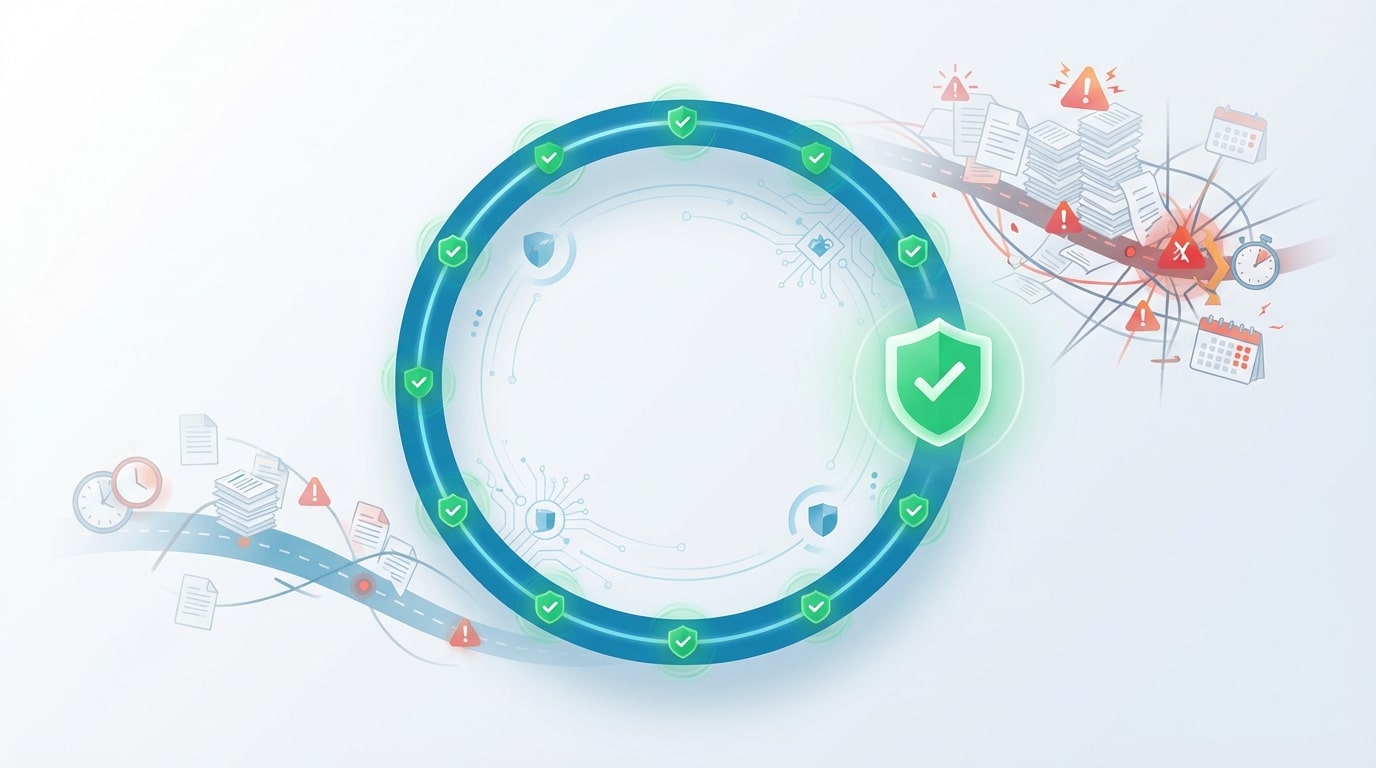
This approach fundamentally changes the risk profile of the close. When controls operate continuously, errors are caught closer to the point of occurrence, which reduces the cost and complexity of correction. The month-end close itself becomes a confirmation step — a final verification that all controls have operated as expected — rather than a frantic effort to compile, reconcile, and review an entire month of activity in a few days.
Tip
Start your continuous close journey by moving just one high-volume reconciliation — such as bank reconciliation or AP subledger reconciliation — to a weekly cadence. This single change reduces month-end workload meaningfully and demonstrates the concept to stakeholders before a broader rollout.
What Real-Time Visibility Actually Looks Like for a CFO
For a CFO or controller, the practical value of month-end close risk reduction automation is not abstract. It means opening a dashboard on day two of the close and seeing exactly which tasks are complete, which are behind schedule, and which have triggered control exceptions. It means receiving an alert when a journal entry is posted to an unusual account by a user who does not normally interact with that account — while there is still time to investigate before the books are finalized.
Detelix delivers this kind of visibility by connecting directly to the organization’s ERP environment and cross-checking every action against defined rules and historical patterns. The platform does not replace the finance team’s judgment; it ensures that judgment is applied where it matters most — on the exceptions and anomalies that automated controls have surfaced in real time.
Did You Know
CFOs who have moved from retrospective close reporting to real-time close dashboards consistently describe the shift as moving from “hoping the numbers are right” to “knowing the controls are working” — a fundamentally different level of confidence in reported results.
The Difference Between Monitoring Transactions and Actually Controlling Them
Many organizations monitor their financial close through reports generated after the period ends. These reports reveal what happened, but they cannot prevent what already occurred. The distinction between monitoring and controlling is the distinction between reviewing a report that shows an unauthorized journal entry was posted last Tuesday and receiving an alert the moment that entry is submitted — before it reaches the general ledger.
This shift from retrospective analysis to proactive intervention is at the core of what effective close automation delivers. It does not eliminate the need for skilled finance professionals. It amplifies their effectiveness by ensuring they are working on the right issues at the right time, supported by a system that never misses a transaction, never forgets a rule, and never takes a shortcut under deadline pressure.
Detelix Financial Close Protection Solutions

Proactive Monitoring
Continuous surveillance of ERP transactions and close activities, detecting anomalies and policy violations before they impact financial statements.

Real-Time Alerts
Instant notifications when journal entries, reconciliations, or approval workflows trigger risk rules — enabling immediate investigation and resolution.

GateKeeper
Automated enforcement of segregation of duties, approval hierarchies, and access controls across your entire ERP environment.

Experience
Decades of domain expertise in financial controls, ERP security, and regulatory compliance — built into every detection rule and workflow.
See Detelix in Action
Frequently Asked Questions
Does month-end close automation replace internal controls or strengthen them?
Automation strengthens existing controls by making them enforceable, consistent, and auditable. It does not replace the need for well-designed control frameworks; it ensures those frameworks operate as intended every single period, without reliance on manual discipline alone.
How long does it take to implement close automation that delivers measurable risk reduction?
A focused pilot covering high-risk areas such as journal entry monitoring and key account reconciliations can typically be operational within a few weeks. Broader rollout across multiple entities, currencies, and control types generally takes two to four months, with full maturity measured over two to three close cycles.
Can close anomaly detection work across multiple ERP systems?
Yes. Modern platforms are designed to ingest data from multiple source systems — whether the organization runs a single ERP instance or maintains separate systems across business units. The anomaly detection logic operates on the consolidated data set, which means cross-system inconsistencies are also surfaced automatically.
What is the difference between rules-based controls and anomaly detection?
Rules-based controls apply predefined conditions — for example, “flag any entry above a set amount without documentation.” Anomaly detection identifies statistical deviations from historical patterns, catching issues that no one thought to write a rule for. The most effective close automation programs combine both approaches for comprehensive coverage.
How does automation help with audit readiness?
Every action taken during the close — task completion, reconciliation review, journal entry approval, exception resolution — is timestamped, attributed to a specific user, and stored in an immutable log. When auditors request documentation, the evidence package is already assembled, reducing audit preparation time and the risk of missing records.
Ready to Move from Routine Monitoring to Real Control?
Stop discovering close errors after the damage is done. See how Detelix delivers continuous, automated oversight that protects your financial statements in real time.