
Stop AP Fraud Before It Drains Your Bottom Line
Detelix monitors every ERP transaction in real time, catching payment fraud that manual audits miss. Get a free risk assessment today.
- Why AP Fraud Prevention is the Invisible Shield for Your Bottom Line
- Decoding the Anatomy of Vendor Payment Fraud
- Most Common AP Fraud Schemes Finance Teams Face
- Red Flags That Signal Something Is Wrong in Your AP Cycle
- The Pillars of Effective Accounts Payable Fraud Prevention
- Why Manual Controls Fail at Scale
- What to Look for in AP Fraud Protection Software
- How AI and Anomaly Detection Elevate AP Fraud Detection
- A Practical Mistake: Treating Vendor Onboarding as Administrative
- Segregation of Duties in Practice
- Measuring Whether Your Prevention Program Works
- When a Fraud Event Happens: Response Steps
- Comparing Reactive Audit vs. Continuous Monitoring
- Frequently Asked Questions
In many organizations, accounts payable processes appear well-controlled on the surface. Approval workflows exist, ERP permissions are configured, reconciliation routines run on schedule, and periodic audits produce reassuring reports. Yet beneath that layer of apparent order, payment fraud continues to inflict significant financial damage across industries and company sizes. The reason is straightforward: most traditional controls were designed for a slower, paper-based era, while today’s threats operate at digital speed. Understanding where the real vulnerabilities lie, and how to close them before money leaves the company, is the starting point for every CFO, controller, and finance leader who wants to move from the illusion of control to actual control.
Key Takeaways
- Accounts payable fraud prevention requires continuous, real-time monitoring that covers 100% of transactions rather than periodic sampling of 3-10%.
- Ghost vendors, Business Email Compromise, and duplicate invoicing are the three most common AP fraud schemes, and each demands specific countermeasures.
- Segregation of duties, 3-way matching, and vendor master file hygiene form the foundational pillars of any effective AP fraud prevention program.
- AI-driven anomaly detection catches fraud patterns that static, rule-based controls miss, particularly low-value schemes designed to stay under approval thresholds.
- Measurable KPIs such as payments stopped before execution and alert resolution time are essential to confirm your prevention program is working.
Why Accounts Payable Fraud Prevention is the Invisible Shield for Your Bottom Line
Accounts payable fraud prevention is a holistic strategy that combines procedural safeguards, technological barriers, and continuous monitoring to stop illegitimate payments before they are executed. It covers the full lifecycle of a vendor payment, from the moment a supplier is created in the master file, through invoice receipt and approval, all the way to fund disbursement and bank reconciliation. When any single link in that chain is weak, the entire process becomes exploitable.
Tip
Map your entire payment lifecycle end-to-end and identify every point where a single person can both initiate and approve a transaction. These single-control points are the highest-risk areas for fraud.
The financial stakes are substantial. Industry research consistently shows that organizations lose a measurable percentage of annual revenue to occupational fraud, with AP schemes among the most common vectors. Beyond direct monetary loss, a successful fraud event triggers investigation costs, strained vendor relationships, potential regulatory scrutiny, and reputational damage that can take years to repair. For finance leaders, the question is not whether fraud attempts will occur, they will, but whether the organization has the visibility and controls to catch them in time.
Did You Know
According to the Association of Certified Fraud Examiners, the median duration of a fraud scheme before detection is 12 months. Organizations with proactive monitoring cut that detection time nearly in half compared to those relying solely on periodic audits.
Decoding the Anatomy of Vendor Payment Fraud
Not every incorrect payment is fraud. Accidental errors, duplicate data entry, mismatched purchase orders, or currency mistakes, are operational failures that cost money but lack criminal intent. Vendor payment fraud, by contrast, is a deliberate act designed to divert funds to an unauthorized recipient. The distinction matters because the controls needed to prevent each overlap but are not identical.
Intentional fraud follows predictable patterns. External attackers often use social engineering techniques such as Business Email Compromise (BEC) to impersonate a trusted vendor or executive. They send an email requesting an urgent change to bank details, and if the AP team complies without independent verification, the payment lands in the attacker’s account. Internally, employees with excessive access rights may create fictitious vendors, approve their own invoices, or manipulate payment files. Traditional manual audits, which typically sample only a small fraction of transactions, simply cannot keep pace with the volume and sophistication of these schemes.
Tip
Establish a clear, documented distinction between error correction workflows and fraud investigation protocols. Treating every discrepancy as a potential fraud case wastes resources, but treating every anomaly as a simple error lets real fraud slip through.
What Are the Most Common AP Fraud Schemes Finance Teams Face?
Ghost Vendors and Fictitious Entities
A ghost vendor is a supplier record that exists in the ERP system but has no legitimate business relationship with the organization. An employee, or an external accomplice, creates the vendor, submits invoices for services never rendered, approves them, and collects the payments. Because the invoices describe vague services such as “consulting” or “maintenance,” they can pass cursory review. Detecting ghost vendors requires cross-referencing vendor addresses, bank accounts, and tax IDs against employee records and against one another. Where those checks are absent, the scheme can persist for years.
Did You Know
Ghost vendor schemes are among the longest-running fraud types. Some cases have persisted for over five years before discovery, with cumulative losses reaching millions. Automated cross-referencing of vendor data against employee records can flag these schemes within days of the first fraudulent payment.
Business Email Compromise and Impersonation Attacks
BEC attacks exploit trust rather than technology. An attacker registers a domain that closely resembles a legitimate vendor’s domain, perhaps changing a single character, and sends an email requesting updated bank details. The Israel National Insurance Institute has issued formal warnings about phishing attempts that seek to harvest bank account information through impersonation. In the AP context, the same tactic targets finance teams who process dozens of vendor communications daily and may not scrutinize every sender address.
Duplicate and Look-Alike Invoicing
Duplicate payments arise when the same invoice is entered twice, sometimes with a slightly altered invoice number, date, or formatting. Fraudsters exploit this by resubmitting invoices that have already been paid, counting on the volume of transactions to mask the repetition. Without automated duplicate-detection rules that compare combinations of vendor ID, invoice number, amount, and date, these payments slip through. Modern AP fraud detection powered by hundreds of algorithms ensures every action in the ERP system is cross-checked against historical patterns, flagging anomalies that human reviewers would miss in high-volume environments.
Tip
Configure your duplicate detection to use fuzzy matching logic, not just exact matches. Fraudsters deliberately alter one digit of an invoice number or shift a date by one day to bypass rigid matching rules.
Red Flags That Signal Something Is Wrong in Your AP Cycle
Effective AP fraud detection starts with knowing what to look for. Transactional red flags include invoices with rounded amounts that repeat at regular intervals, payments that consistently fall just below a managerial approval threshold, and vendors whose invoices spike suddenly without a corresponding increase in purchase orders. A vendor whose bank details change shortly after onboarding, or more than once in a twelve-month period, warrants immediate scrutiny.
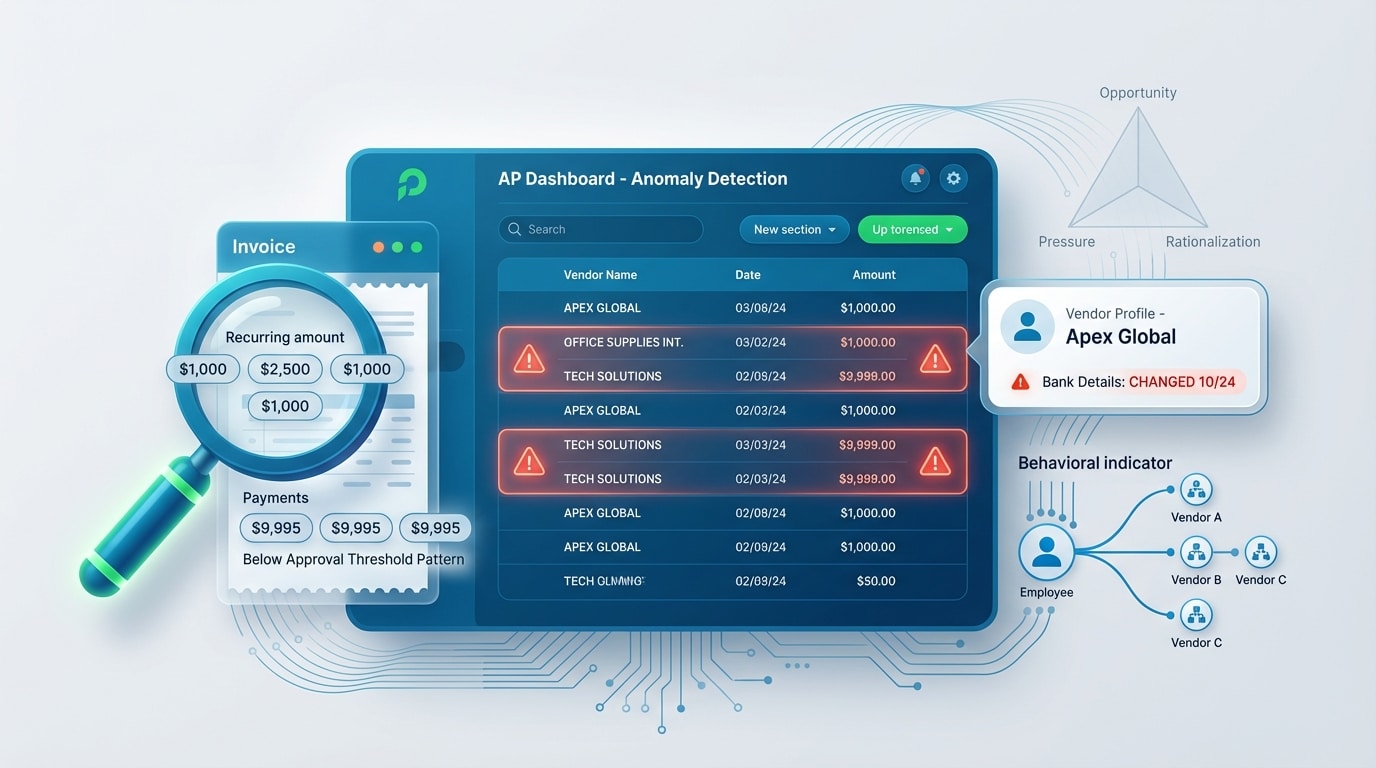
Behavioral indicators are equally important. An employee who insists on handling a specific vendor exclusively, resists cross-training, or never takes consecutive vacation days may be protecting an ongoing scheme. The well-known “Fraud Triangle” framework, opportunity, pressure, and rationalization, reminds us that even trusted employees can become perpetrators when the right conditions align. Automated monitoring tools reduce reliance on subjective observation by continuously scanning for statistical outliers across all transactions, not just the ones that happen to be sampled.
Did You Know
Mandatory consecutive vacation policies are one of the most effective low-tech fraud deterrents. Many long-running schemes are discovered when the perpetrator is forced to be away from their desk for two or more consecutive weeks and a colleague handles their transactions.
The Pillars of Effective Accounts Payable Fraud Prevention
Building a resilient AP environment rests on three foundational controls. First, Segregation of Duties (SoD) ensures that no single individual can create a vendor, enter an invoice, approve a payment, and execute a bank transfer. When these roles are split across different people and enforced by the ERP’s permission structure, collusion becomes the only path to fraud, which is significantly harder to execute and sustain. Even in smaller organizations with limited headcount, compensating controls such as managerial review logs and periodic rotation can reduce the risk.
Second, the 3-Way Match between purchase order, goods receipt, and invoice acts as a gatekeeper that blocks payment for items never ordered or never delivered. This control is highly effective for goods-based procurement. In service industries, where a physical “receipt” may not exist, organizations should require an equivalent, such as a signed delivery confirmation, a timesheet, or a service-completion certificate, before approving the invoice.
Third, Vendor Master File hygiene is the often-neglected foundation. Dormant vendors, duplicate entries, and records with incomplete tax identifiers create hiding spots for fictitious entities. Regular cleanup, combined with automated alerts when new vendors share an address, phone number, or bank account with existing records or with employees, is essential for maintaining data integrity.
Tip
Schedule a quarterly vendor master file review and deactivate any vendor that has had zero transactions in the past 18 months. Dormant vendor records are a common hiding spot for ghost vendor schemes because they attract less scrutiny than newly created entries.
A Scenario That Illustrates Why Manual Controls Fail at Scale
Consider an organization that processes 4,000 invoices per month. Its internal audit team performs quarterly reviews, sampling roughly 5% of transactions. That means approximately 11,400 invoices go unreviewed each quarter. If a fraudulent invoice appears once a month for a modest amount, say, the equivalent of a routine IT maintenance charge, it has a strong statistical chance of avoiding detection for an entire fiscal year. The cumulative loss may reach tens of thousands before anyone notices.
This is not a hypothetical edge case; it reflects the operational reality of many mid-to-large enterprises. AP fraud protection software changes the equation by examining 100% of transactions in real time, applying rule-based checks and behavioral analytics simultaneously. Instead of hoping a sample catches the anomaly, the system flags every deviation as it occurs, before the payment file is sent to the bank.
Your AP team processes thousands of transactions monthly. How many go unreviewed? Detelix monitors every single one in real time.
What Should You Look for in AP Fraud Protection Software?
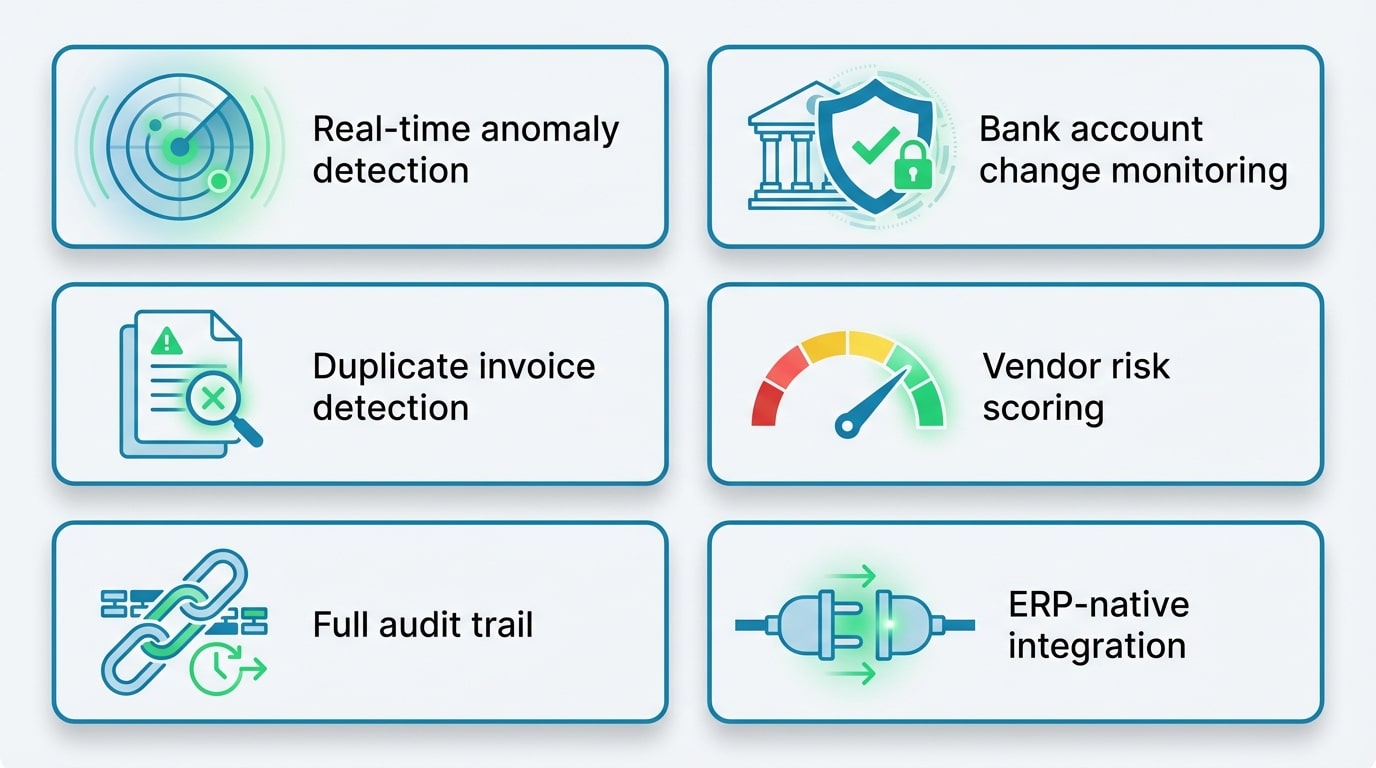
| Capability | Why It Matters | What to Verify Before Purchase |
|---|---|---|
| Real-time anomaly detection | Catches deviations as they happen, not in next month’s report | Ask for a live demo with your own data patterns |
| Bank account change monitoring | Stops the most damaging single-event fraud vector | Confirm it triggers multi-step verification automatically |
| Duplicate invoice detection | Prevents both accidental and intentional overpayments | Check matching logic flexibility (fuzzy match, partial match) |
| Vendor risk scoring | Prioritizes review effort on highest-risk transactions | Ensure scoring adapts to your industry and vendor mix |
| Full audit trail | Supports investigation, compliance, and deterrence | Verify tamper-proof logging with timestamps and user IDs |
| ERP-native integration | Avoids data gaps and manual exports | Confirm compatibility with your specific ERP version |
Detelix addresses these requirements by operating as a continuous control layer over existing ERP processes. Rather than requiring a full system replacement, it connects to the ERP environment, applies hundreds of cross-checking algorithms, and delivers actionable alerts to the right stakeholders in real time. This approach means that finance teams gain deeper visibility without disrupting established workflows, a practical advantage for organizations that need stronger controls but cannot afford lengthy implementation cycles.
Did You Know
Organizations that implement continuous transaction monitoring recover an average of three times more from fraud attempts than those relying on periodic audits alone. The speed of detection directly correlates with the amount of money that can be recovered or prevented from leaving the organization.
How AI and Anomaly Detection Elevate AP Fraud Detection Beyond Static Rules
Rule-based controls are necessary but insufficient. A rule that flags every payment above a certain threshold will catch large one-time fraud but miss a series of smaller payments designed to stay under the radar. AI-driven anomaly detection adds a dynamic layer: it learns the normal behavior of each vendor, each cost center, and each approver, then identifies deviations relative to that baseline. A vendor that typically invoices monthly for a consistent amount suddenly submitting two invoices in one week, each for a slightly different amount, would trigger a review, even though neither invoice individually violates any static rule.
The Bank of Israel recently conducted a system-wide cyber exercise that included third-party supply-chain scenarios and the potential use of AI by attackers. This signals that regulators recognize the evolving threat landscape. Organizations that integrate AI-powered fraud detection into their AP processes position themselves ahead of both the threat curve and regulatory expectations.
Tip
When evaluating AI-based AP fraud detection tools, ask the vendor how the model handles seasonality. Invoice volumes and amounts fluctuate around fiscal year-end, holiday periods, and contract renewal cycles. A well-tuned model accounts for these patterns and avoids flooding your team with false positives during predictable volume spikes.
A Practical Mistake: Treating Vendor Onboarding as an Administrative Task
Many fraud schemes succeed because the vendor was never properly vetted at the point of entry. When onboarding is treated as a clerical task, fill in the form, attach a W-9 or equivalent, and activate the record, there is no barrier to a fictitious entity entering the system. A secure onboarding process treats every new vendor request as a risk event and applies structured verification steps.
These steps include confirming the vendor’s legal registration through official databases such as the Israel Companies Registrar search service, independently verifying bank account ownership, checking for duplicates in the master file, and documenting who requested and who approved the new record. For bank detail changes on existing vendors, a “call-back” procedure is essential: the AP team contacts the vendor using a phone number already stored in the system, never the number provided in the change request, to confirm the instruction is genuine.
Did You Know
Over 60% of successful BEC attacks that target vendor bank detail changes succeed because the AP team used the contact information provided in the fraudulent request itself rather than independently verifying through a previously stored phone number. A single call-back step can prevent the majority of these losses.
Segregation of Duties in Practice: A Permission Matrix That Works
| Process Step | Role A (Procurement) | Role B (AP Clerk) | Role C (AP Manager) | Role D (Treasury) |
|---|---|---|---|---|
| Create vendor record | Request | Enter | Approve | — |
| Change bank details | — | Enter after call-back | Approve | Verify |
| Enter invoice | — | Enter | — | — |
| Approve invoice | — | — | Approve | — |
| Execute payment | — | — | — | Execute |
| Reconcile bank | — | — | Review | Reconcile |
In smaller organizations where one person may need to cover multiple steps, Detelix provides a compensating control by monitoring every action and alerting a designated reviewer whenever a single user touches more than one step in the same transaction chain. This real-time oversight makes it practical to enforce SoD principles even when headcount constraints make strict role separation difficult.
Tip
Print or publish your SoD permission matrix and review it with your team quarterly. Staff turnover and role changes frequently create permission drift where users accumulate access rights beyond their current responsibilities. Periodic permission audits catch this drift before it becomes an exploitable gap.
Measuring Whether Your Prevention Program Actually Works
A fraud prevention program without measurable outcomes is a program running on faith. Key performance indicators should capture both prevention effectiveness and process quality. Track the number of payments stopped or flagged before execution, the average time between alert and resolution, the rate of false positives (which indicates whether the system is tuned correctly), and the percentage of vendor master changes that completed the full verification protocol. Over time, trending these metrics reveals whether control improvements are taking hold or whether new gaps are emerging.
Detelix supports this measurement approach by providing dashboards that aggregate exception data across all monitored processes. Finance leaders can see at a glance how many anomalies were detected this month, how they were resolved, and where the highest-risk concentrations lie, turning raw data into actionable governance intelligence.
When a Fraud Event Happens: Response Steps That Limit Damage
Even the strongest prevention framework cannot guarantee zero incidents. When a suspected fraud event is identified, the response protocol determines how much damage the organization ultimately absorbs. Immediate steps include freezing the affected payment or vendor record, preserving all digital evidence (emails, ERP logs, approval records), and notifying senior management and legal counsel. If the event involves a cyber-enabled attack such as BEC, organizations in Israel can report to the National Cyber Directorate for incident support and guidance.
Post-incident, the organization should conduct a root-cause analysis that identifies exactly which control failed or was bypassed, update procedures accordingly, and communicate lessons learned to the broader finance team. This feedback loop, detect, respond, learn, strengthen, is what transforms a single negative event into a permanent improvement in organizational resilience.
Did You Know
Organizations that have a documented incident response plan recover from fraud events 40% faster and recover significantly more funds than those without one. The first 24 hours after discovery are critical, as the chances of recovering diverted funds drop sharply with each passing day.
Comparing Prevention Approaches: Reactive Audit vs. Continuous Monitoring
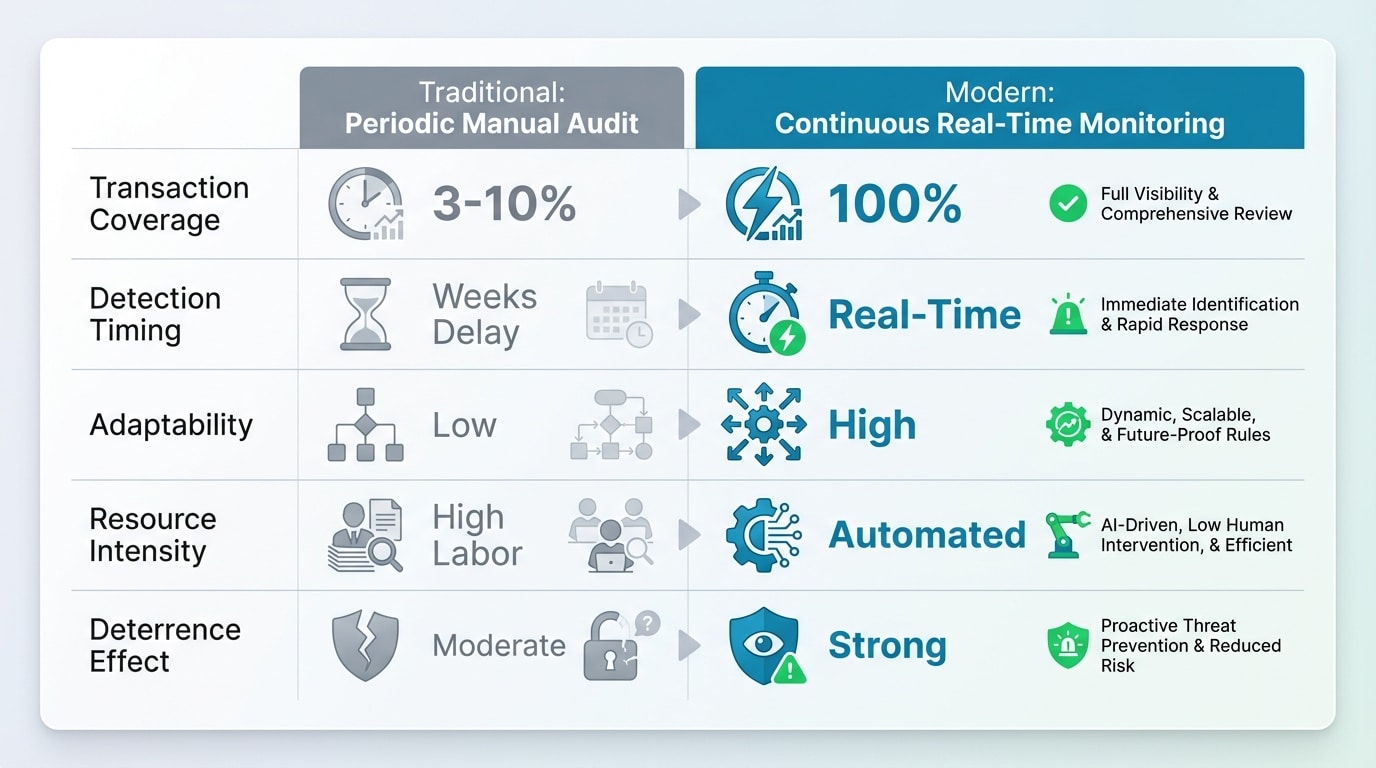
| Dimension | Periodic Manual Audit | Continuous Real-Time Monitoring |
|---|---|---|
| Transaction coverage | 3-10% sample | 100% of transactions |
| Detection timing | Weeks or months after event | Before or during payment execution |
| Adaptability to new schemes | Low, relies on last audit’s scope | High, rules and models update continuously |
| Resource intensity | High labor cost per review cycle | Automated with human review for exceptions only |
| Deterrence effect | Moderate, employees know audits are infrequent | Strong, every action is visible in real time |
The table above illustrates a fundamental shift in control philosophy. Organizations that rely solely on periodic audits accept a structural blind spot between review cycles. Continuous monitoring closes that gap, not by eliminating audits, but by ensuring that the audit function focuses on strategic risk analysis rather than transaction-level detective work.
Detelix ERP Security and Fraud Prevention Solutions

Proactive Monitoring
Continuous oversight of every ERP transaction with hundreds of cross-checking algorithms that detect anomalies before payments are executed.

Real-Time Alerts
Instant notifications to the right stakeholders when suspicious activity is detected, enabling rapid response before funds leave the organization.

GateKeeper
Automated pre-payment verification that blocks high-risk transactions and enforces segregation of duties across your ERP environment.

Industry Experience
Deep domain expertise across healthcare, finance, manufacturing, and government sectors, with controls tailored to each industry’s unique risk profile.
See Detelix in Action
Frequently Asked Questions
Can accounts payable fraud prevention be effective without replacing the existing ERP?
Yes. The most practical approach is to add a dedicated control layer that integrates with the current ERP rather than replacing it. This layer reads transaction data in real time, applies detection logic, and sends alerts without altering the core system. Detelix is designed specifically for this integration model, allowing organizations to strengthen controls without a multi-year IT project.
How quickly can a bank detail change scam be detected with the right controls?
With automated monitoring and a mandatory call-back verification step, a fraudulent bank detail change can be flagged within minutes of the change request entering the system, well before any payment is executed against the new account. The key is that the alert triggers an out-of-band verification workflow, not just a notification email that can be ignored.
Is segregation of duties realistic for organizations with small finance teams?
Strict role separation may not always be feasible with fewer than four or five team members. In those cases, compensating controls, such as real-time alerts when a single user performs multiple steps, mandatory management sign-off on high-risk actions, and automated audit trails, provide equivalent protection. The goal is to ensure that no action goes unreviewed, even if the same person initiates it.
What is the difference between AP fraud detection and AP fraud prevention?
Detection identifies fraud after it has occurred or is in progress. Prevention stops fraud before a payment is made. The strongest programs combine both: prevention controls block known fraud patterns at the point of entry, while detection analytics identify emerging patterns that have not yet been codified into rules. Together, they create a closed-loop defense.
How does AI-based anomaly detection avoid generating too many false positives?
Effective AI models are trained on the organization’s own transaction history, which means the baseline reflects actual vendor behavior rather than generic industry benchmarks. Over time, as the system processes feedback on which alerts were true positives and which were not, the model’s precision improves. Configurable risk thresholds allow finance teams to balance sensitivity with operational efficiency.
Ready to Close the Gaps in Your Accounts Payable Controls?
If your current AP controls leave thousands of transactions unreviewed each quarter, it is time to see what continuous, real-time monitoring looks like. Talk to the Detelix team today.