Stop Scrambling Before Every Audit
Detelix helps organizations achieve continuous audit readiness with real-time control monitoring and automated evidence collection. Talk to our experts today.
- What Does Audit Readiness and Automation Actually Mean?
- Why Do Organizations Fail to Stay Audit-Ready?
- The Point-in-Time Trap vs. Continuous Readiness
- How Does Automated Audit Preparation Change the Process?
- A Common Scenario: Evidence That Looks Good but Fails
- How to Automate Audit Workflows Without Creating Chaos
- What Makes Evidence Good Enough for an Auditor?
- Can You Really Be Always Audit-Ready?
- Five Mistakes That Derail Audit Automation Projects
- Which KPIs Prove That Automation Improves Readiness?
- Managing Fraud Risk as a Byproduct of Audit Readiness
- A 90-Day Roadmap to Becoming Audit Ready
- Frequently Asked Questions
In many organizations, audit preparation still feels like a seasonal emergency. Teams scramble to gather evidence, chase approvals, reconcile conflicting document versions, and assemble control narratives under the pressure of a looming auditor visit. The result is predictable: stress, incomplete files, last-minute workarounds, and findings that could have been prevented months earlier. The shift toward audit readiness and automation changes this dynamic fundamentally. Instead of treating the audit as a disruptive event, forward-thinking finance and control leaders are building systems that generate, capture, and validate evidence continuously so that when the auditor arrives, the organization is already prepared.
Key Takeaways
- Audit readiness means embedding automated evidence collection into daily operations, not assembling proof retroactively before an auditor visit.
- Continuous readiness distributes workload evenly across the year and dramatically reduces the risk of gaps, missing logs, and repeat findings.
- Automation platforms like Detelix connect directly to ERP and financial systems, capturing every action with full context, timestamps, and user identification.
- The five most common mistakes in audit automation projects stem from starting with the tool before defining the process, evidence standards, and ownership model.
- A structured 90-day roadmap can move an organization from reactive preparation to genuine continuous readiness with measurable KPI improvements.
What Does Audit Readiness and Automation Actually Mean?
Audit readiness and automation is the practice of embedding digital tools and structured workflows into an organization’s internal control framework so that compliance evidence is produced and stored as part of daily operations rather than assembled retroactively. An audit-ready organization does not view audits as interruptions. It treats each audit cycle as a routine validation of processes that are already running correctly, documented properly, and monitored in real time.
This goes far beyond digitizing a checklist. It means connecting control activities directly to their sources of truth such as ERP systems, financial platforms, and HR databases, then creating an automated chain from trigger to task to evidence to approval. When this chain works, readiness is a byproduct of normal operations rather than a standalone project.
Tip
Start by mapping the evidence chain for your five most time-consuming controls. Identify where evidence originates, who touches it, and where it gets stored. This map becomes the blueprint for your automation workflow.
Why Do Organizations Fail to Stay Audit-Ready Until the Auditor Arrives?
The core problem is structural. Most preparation processes depend on manual effort, institutional knowledge held by a few individuals, and evidence scattered across emails, shared drives, and spreadsheets with no version control. When the audit notice arrives, teams realize that critical logs are missing, approval records are incomplete, or policy documents have been updated without tracking who changed what and when.
According to official audit methodology guides such as the State Audit Guide published by the Office of the State Comptroller, auditors evaluate evidence based on completeness, traceability, and relevance. A screenshot saved without a timestamp, or an approval email forwarded without context, rarely meets that standard. The gap between what organizations think they have and what auditors actually accept is where findings are born.
Did You Know
Studies of recurring audit findings consistently show that the majority of repeat observations stem from evidence quality failures rather than actual control breakdowns. The control was working, but nobody captured proof in a format the auditor could accept.
The Point-in-Time Trap vs. Continuous Readiness
| Dimension | Point-in-Time Preparation | Continuous Readiness |
|---|---|---|
| Timing | Evidence gathered weeks before audit | Evidence generated as controls execute |
| Workload Pattern | Spike of effort before each audit cycle | Steady, low-intensity effort year-round |
| Risk of Gaps | High — retroactive collection misses data | Low — gaps flagged immediately via alerts |
| Version Control | Inconsistent, often manual | Automatic with audit trail |
| Ownership Clarity | Often unclear until the last minute | Defined per control with SLA |
| Auditor Confidence | Lower — evidence feels assembled | Higher — evidence is systematic and traceable |
Point-in-time preparation focuses on proving compliance for a specific period just before an audit. Continuous readiness builds a mechanism that produces evidence and metrics all the time. The first approach creates peak stress and significant risk of gaps; the second distributes the workload but requires ongoing monitoring and process maintenance. Organizations that remain trapped in point-in-time mode often discover that the cost of a single repeat finding far exceeds the investment in a continuous approach.
Tip
Calculate the fully loaded cost of your last audit preparation cycle, including overtime hours, consultant fees, and delayed project work. Compare that against the annual cost of a continuous monitoring tool. The business case often writes itself.
How Does Automated Audit Preparation Change the Process?
Detelix exemplifies how a real-time protection and control platform can serve as the backbone of automated audit preparation. Instead of asking teams to produce a screenshot, the system connects directly to ERP and financial processes, pulls relevant data at defined intervals, and stores it in a structured, version-controlled repository. Every action is logged with a user identifier, timestamp, and context, which is exactly what auditors look for.
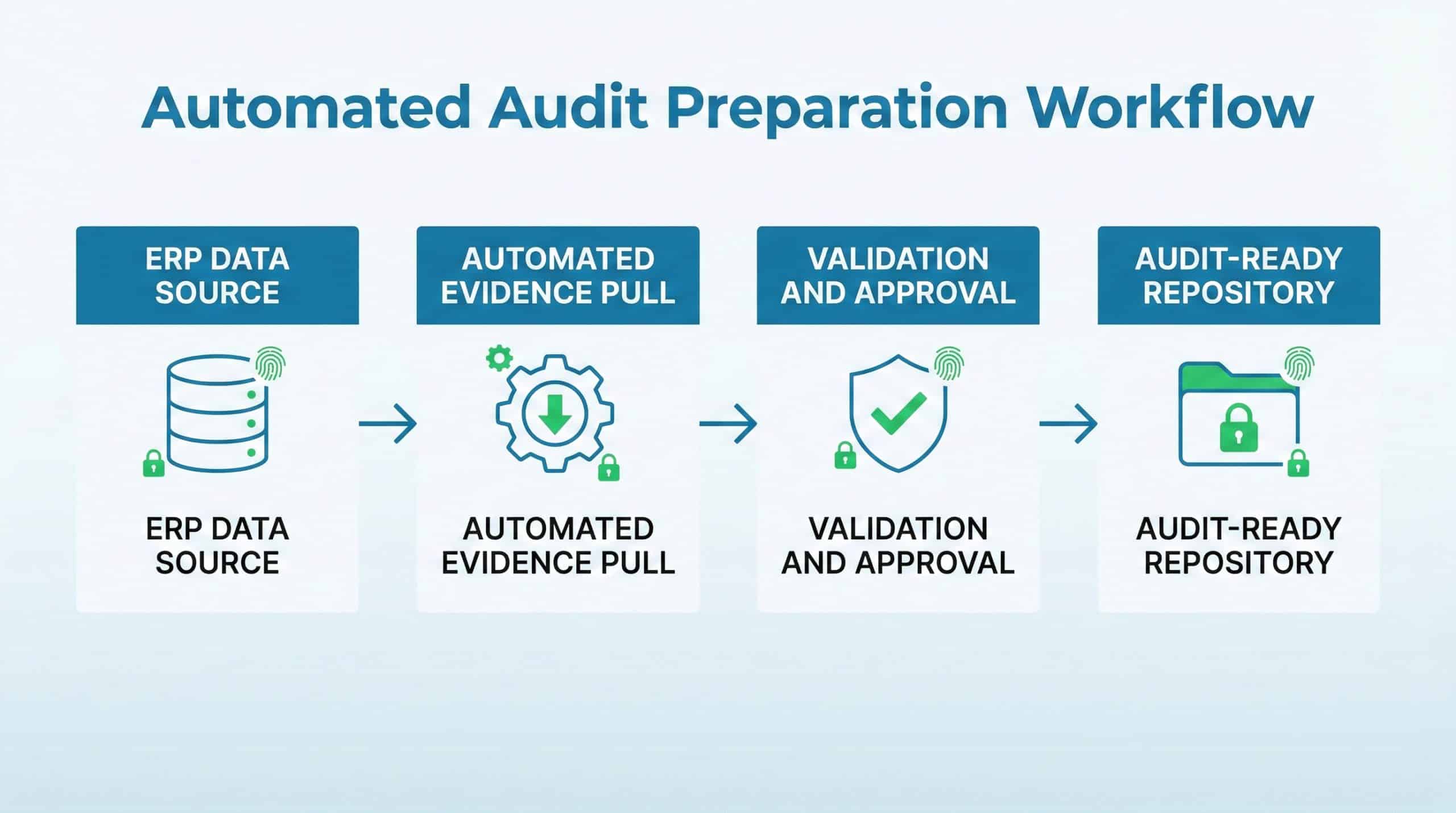
Automated audit preparation shifts the focus from manual collection to system management. You define what counts as evidence, where it originates, who approves it, and what happens when something is missing or fails validation. The human role moves from data-gathering to exception management and professional judgment, areas where human expertise is irreplaceable.
Which Parts of the Process Benefit Most from Automation?
Repetitive evidence collection such as monthly reconciliations, access reviews, and policy attestations benefit enormously. So do automated reminders and escalations, digital approval chains, status reporting dashboards, and finding remediation tracking. These tasks consume the majority of preparation time when done manually, yet they follow predictable patterns that are ideal for automation.
Did You Know
Organizations that automate evidence collection for recurring controls typically reduce their audit preparation cycle time by 40 to 60 percent within the first year, freeing compliance teams to focus on risk assessment and strategic improvements.
A Common Scenario: Evidence That Looks Good but Fails the Auditor’s Test
Consider a finance team that exports a bank reconciliation report from the ERP every month and saves it in a shared folder. On the surface, this looks like solid evidence. But the auditor asks: who performed the reconciliation? When was it reviewed? Was there a discrepancy, and if so, how was it resolved? The file alone answers none of these questions. Without an audit trail that connects the report to a specific user action, a review timestamp, and a resolution log, the evidence is incomplete.
This is precisely the kind of gap that automated workflows prevent. When a control is triggered automatically, the system captures not just the output but the entire lifecycle: initiation, execution, review, approval, and any exceptions encountered along the way. As the Ministry of Justice’s internal audit guidance emphasizes, effective audit readiness depends on clear ownership, documented processes, and systematic follow-up on findings, elements that manual methods consistently struggle to deliver.
Tip
For every control, ask yourself the auditor’s follow-up questions before the auditor does. If you cannot demonstrate who, when, and how from the evidence alone, your documentation needs to be strengthened.
How to Automate Audit Workflows Without Creating Automated Chaos
Automation without structure simply accelerates disorder. Before deploying any tool, map your controls and define the inputs and outputs for each one. Every workflow should answer six questions: Who executes? What triggers the task? What is the expected output? Where is it stored? Who approves? What constitutes a failure?
A Recommended Workflow Template for a Single Control
Trigger (frequency-based or event-based) leads to task owner receiving a notification. Evidence is then requested or auto-pulled from the source system. Validation rules check completeness and format. The approver reviews and signs off. A full audit trail is recorded. If any step fails, an exception handling protocol activates. This template ensures that every control, no matter how routine, produces traceable, auditor-grade evidence.
Did You Know
The six-question workflow template described above aligns directly with the COSO Internal Control Framework’s principle of designing control activities that operate through defined processes. Mapping these questions before automation prevents building fast but fragile systems.
Your audit evidence should generate itself. Detelix connects to your ERP and financial systems to capture, validate, and store compliance evidence automatically.
What Makes Evidence Good Enough for an Auditor?
Auditors evaluate evidence across four dimensions: completeness (does it cover the full control period?), traceability (can you link it back to the source action?), consistency (does it match other data points?), and context (does it clearly relate to the control requirement it supports?). A system-generated report with a timestamp, user ID, and reconciliation status meets all four. A manually saved PDF without metadata meets almost none.
Detelix addresses this by cross-checking actions across ERP processes in real time. When a payment is approved, a vendor record is changed, or a reconciliation is completed, the platform captures the action with full context. This means that when an auditor requests evidence for a specific control, the organization can produce a complete, verifiable record rather than a reconstructed narrative assembled under pressure.
Tip
Create an evidence quality checklist with four columns: Completeness, Traceability, Consistency, and Context. Before storing any evidence artifact, verify it passes all four checks. Automate these checks wherever your platform allows.
Can You Really Be Always Audit-Ready, or Is That a Myth?
It is achievable, but it requires operational discipline, not just technology. The biggest threat to continuous readiness is what practitioners call control drift: a process that was properly designed starts to degrade because people change roles, system configurations are updated, or new exceptions emerge without being documented. Without continuous monitoring, these drifts accumulate silently until the next audit reveals them as findings.
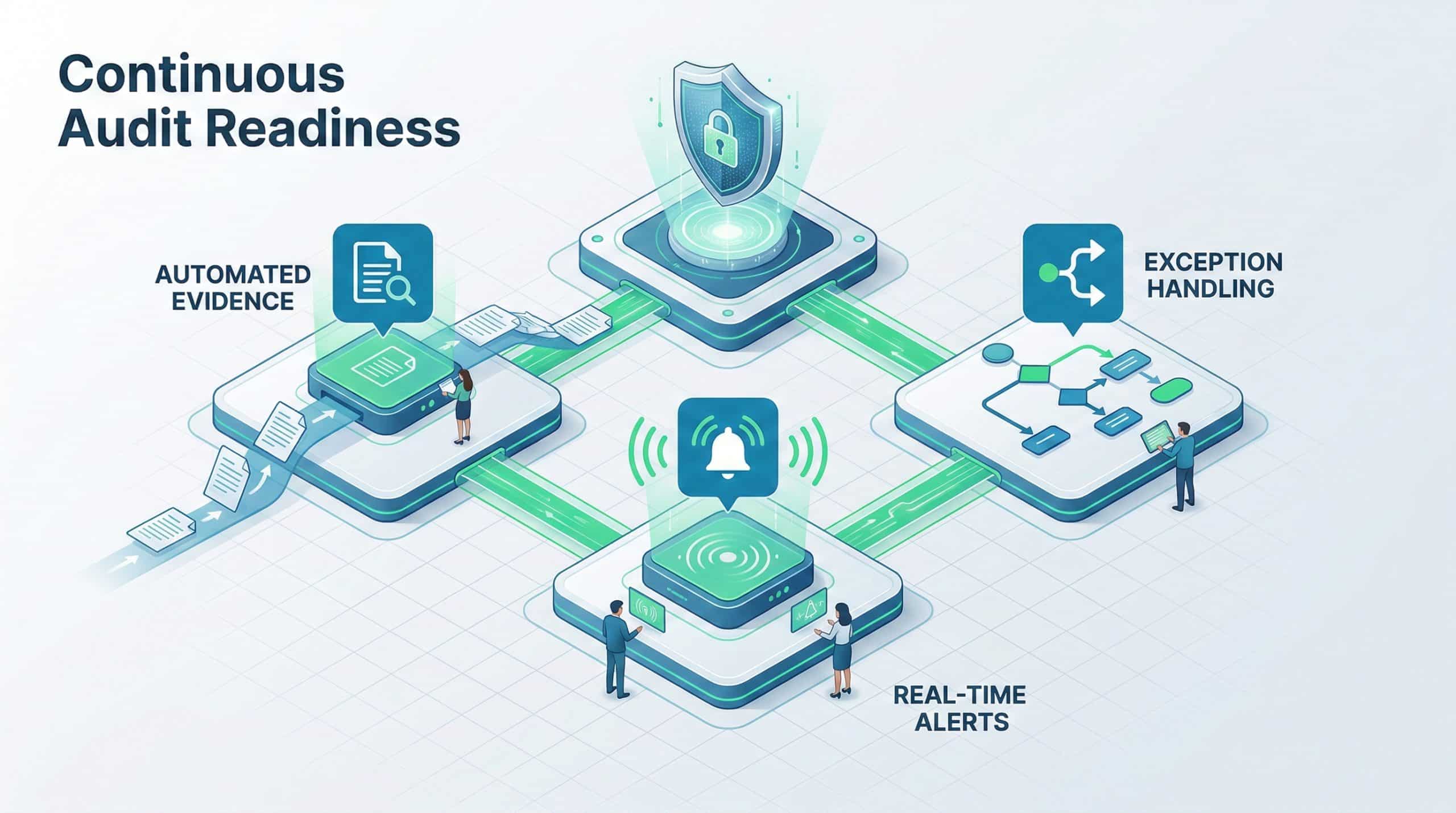
Organizations that successfully maintain an always-ready posture combine three elements: automated evidence collection, real-time deviation alerts, and a defined process for handling exceptions quickly. Official reports on deficiency examination and remediation confirm that organizations with structured follow-up mechanisms consistently perform better in subsequent audits than those that treat each finding as an isolated event.
Did You Know
Control drift is the single largest contributor to repeat audit findings. A control can be perfectly designed on paper, but without ongoing monitoring, small deviations compound over time until the control is effectively ineffective.
Five Mistakes That Derail Audit Automation Projects
The most damaging error is starting with the tool instead of the process. Organizations that purchase automation platforms before defining their control inventory, evidence standards, and ownership model end up with expensive systems that nobody trusts. Here are the other common pitfalls:
Collecting evidence without defining what qualifies as evidence. Files accumulate, but none of them meet the auditor’s standard for completeness or traceability.
No designated control owner. When nobody is explicitly responsible for a control’s execution and evidence quality, accountability disappears.
Ignoring exception management. An exception is not a failure if it is documented, justified, approved, and linked to corrective action. Without a built-in process, exceptions become untracked risks.
Dashboards that show green despite open issues. Readiness scores that exclude overdue remediation items or unresolved exceptions create a false sense of security.
No version control for policies and procedures. If the auditor sees a policy dated six months ago but the control was tested against a newer version, the evidence loses credibility.
Tip
Before launching any automation project, hold a one-day workshop with control owners, IT, and compliance to agree on three things: the control inventory, the evidence standard per control, and the named owner for each. Skip this step and you will spend months fixing misalignment later.
Which KPIs Actually Prove That Automation Improves Readiness?
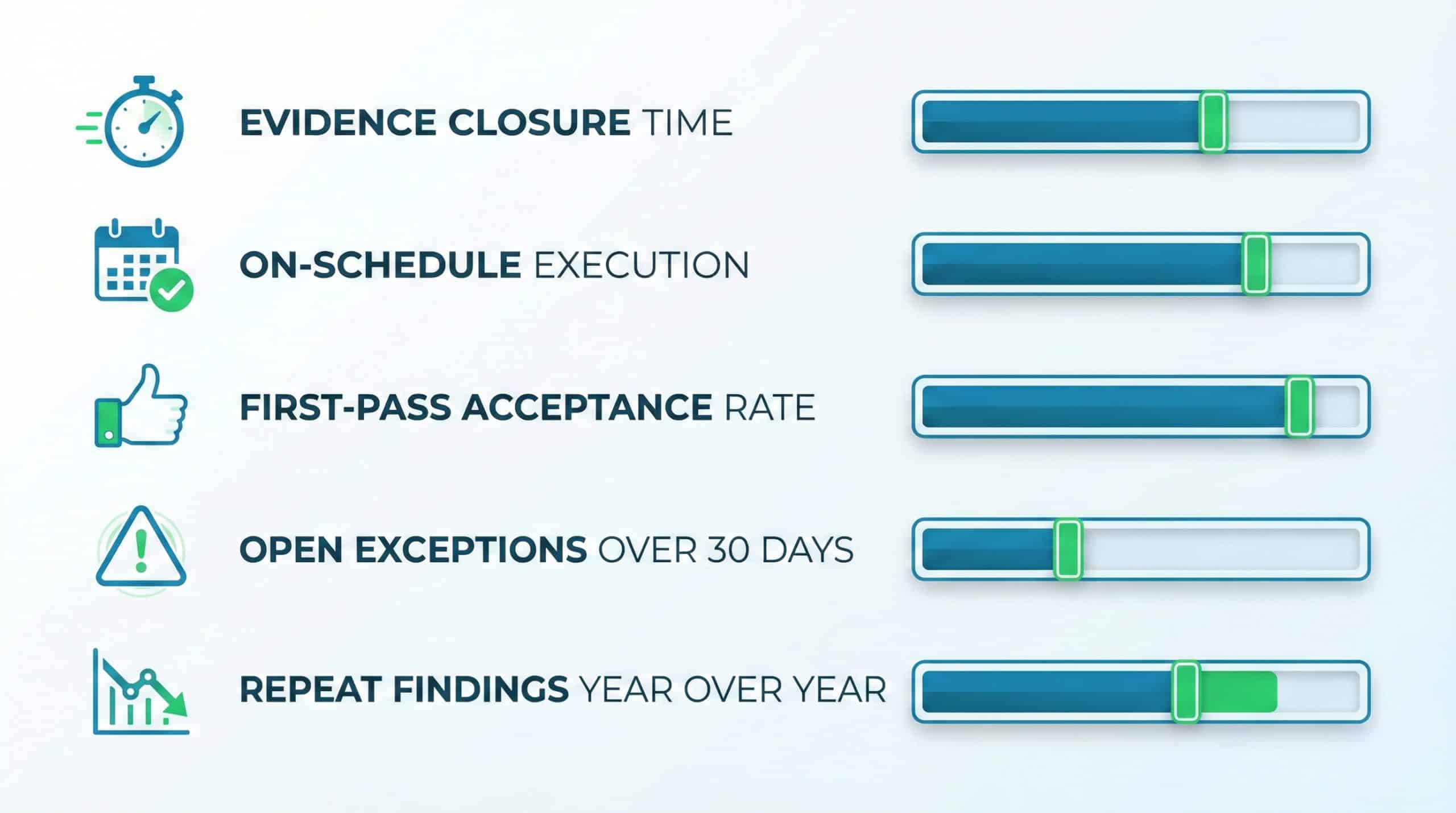
| KPI | What It Measures | Why It Matters |
|---|---|---|
| Average evidence request closure time | Speed of response to evidence needs | Shorter times indicate smoother, more automated collection |
| Percentage of controls executed on schedule | Operational discipline | High rates prove the system is running, not just installed |
| First-pass evidence acceptance rate | Evidence quality | High rates mean fewer auditor rejections and rework |
| Open exceptions older than 30 days | Remediation responsiveness | Low counts indicate active management, not neglect |
| Repeat findings year over year | Systemic improvement | Declining repeat findings confirm root-cause resolution |
A meaningful readiness score gives heavy weight to on-time control execution and exception closure, moderate weight to evidence quality metrics, and minimal weight to sheer document volume. The goal is to measure operational reality, not bureaucratic output.
Did You Know
Organizations that track first-pass evidence acceptance rate as a primary KPI typically see it climb from below 60 percent to above 90 percent within two audit cycles after implementing automated evidence collection.
Managing Fraud Risk as a Byproduct of Audit Readiness
A well-designed audit readiness framework does more than satisfy auditors. It serves as a preventative shield against fraud, human error, and policy deviation. When controls are monitored continuously and evidence is generated automatically, anomalies surface faster. A payment to an unapproved vendor, a sudden change in bank account details, or an unusual segregation-of-duties override becomes visible in real time rather than months later during an annual review.
Detelix operates precisely in this space: continuously scanning sensitive ERP-driven processes including supplier payments, bank account changes, procurement workflows, and payroll adjustments, then flagging deviations as they happen. This means that audit readiness and fraud prevention converge into a single operational layer, reducing both compliance risk and financial exposure simultaneously.
Tip
When designing your control monitoring rules, include fraud-specific scenarios alongside compliance checks. A single monitoring layer that watches for both unauthorized changes and missing evidence delivers twice the protection for roughly the same effort.
A 90-Day Roadmap to Becoming an Audit Ready Organization
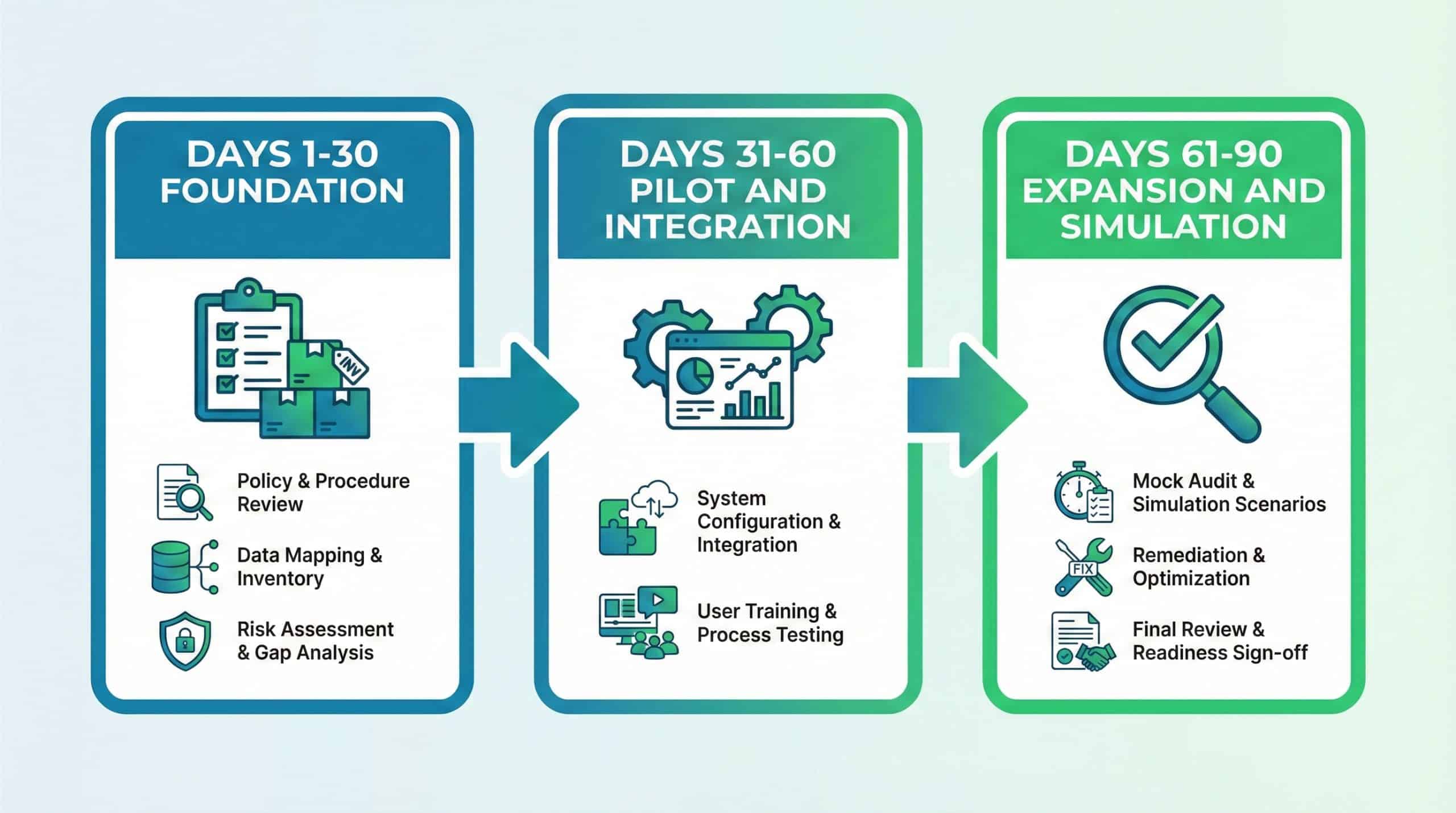
Days 1 to 30: Foundation
Inventory all controls currently in scope. For each control, document the owner, frequency, expected evidence type, and source system. Establish an evidence standard that defines what good looks like. Identify the five highest-risk or most time-consuming controls for the pilot phase.
Days 31 to 60: Pilot and Integration
Connect the automation platform to your primary source-of-truth systems including ERP, financial applications, and access management tools. Automate evidence collection for the five pilot controls. Launch a status dashboard and begin tracking the KPIs described above. Test the exception-handling workflow with at least two realistic scenarios.
Days 61 to 90: Expansion and Simulation
Extend automation to additional controls and departments. Refine evidence quality based on pilot learnings. Conduct an internal audit simulation where a team member plays the auditor role, requests evidence, and evaluates the response. Use the results to identify remaining gaps before the real audit cycle begins. The target outcome: reducing audit cycle preparation time significantly while improving evidence acceptance rates.
Did You Know
Organizations that conduct internal audit simulations before the real audit consistently report fewer findings and faster auditor completion times. The simulation exposes gaps that are invisible to the team handling the controls daily.
Detelix Real-Time Protection Solutions

Proactive Monitoring
Continuous surveillance of ERP processes to detect anomalies, policy violations, and control failures before they escalate into audit findings or financial losses.

Real-Time Alerts
Instant notifications when suspicious activities or deviations from defined rules are detected across payments, procurement, payroll, and other sensitive processes.

GateKeeper
Preventive control layer that blocks unauthorized transactions and enforces segregation of duties at the point of action, not after the fact.

Industry Experience
Deep domain expertise across healthcare, government, finance, and enterprise organizations with tailored control frameworks for each sector.
See Detelix in Action
Frequently Asked Questions
Does automation replace the compliance team?
No. Automation handles repetitive data collection, reminders, and status tracking. The compliance team’s role shifts to higher-value activities: professional judgment, risk assessment, policy design, complex exception resolution, and direct communication with auditors about scope and context.
How long before we see measurable improvement?
Most organizations observe meaningful improvements within four to eight weeks of a focused pilot. Broader rollout typically takes three to six months depending on the number of frameworks, the maturity of existing documentation, and the number of system integrations required.
What happens if automated evidence collection produces an error?
A well-designed system includes validation rules that flag incomplete or inconsistent evidence before it is stored. If an automated pull fails or returns unexpected data, the exception-handling workflow alerts the control owner immediately so the issue can be investigated and resolved rather than discovered by the auditor weeks later.
Is continuous readiness realistic for mid-sized organizations with limited resources?
Yes, precisely because automation reduces the resource burden. Mid-sized organizations often benefit the most because they cannot afford dedicated teams for each control area. By automating evidence collection and monitoring, a smaller team can maintain a broader control environment without sacrificing quality.
How does Detelix specifically support audit readiness across ERP processes?
Detelix connects to ERP-driven business processes including payments, procurement, inventory, payroll, and bank reconciliation, monitoring them continuously. It cross-checks every action against defined rules, flags anomalies in real time, and maintains a full audit trail. This means that evidence of control effectiveness is generated automatically as part of normal operations, and deviations are caught before they become audit findings or financial losses.
Ready to Move From Reactive Preparation to Continuous Readiness?
Discover how Detelix transforms audit readiness from a seasonal scramble into an automated, always-on process. Speak with our team and see the platform in action.