Eliminate Pre-Audit Panic with Automated Readiness
Detelix helps organizations build continuous, verifiable audit readiness across every ERP process. Stop scrambling and start proving compliance in real time.
- What Does Audit Readiness and Automation Actually Mean?
- Why Do Organizations Still Panic Before Audits?
- Manual “Pull” vs. Automated “Push” Evidence Collection
- How to Identify Which Audit Tasks to Automate First
- Building an Audit-Ready Organization: Culture Before Technology
- Point-in-Time vs. Continuous Readiness
- Automating Audit Workflows Without New Complexity
- Which Types of Evidence Can Be Collected Automatically?
- What Makes Automated Evidence “Admissible”?
- Measuring Audit Readiness with Quantifiable KPIs
- Five Mistakes That Undermine Automated Audit Preparation
- When Should You Start Automating?
- A Practical 90-Day Roadmap to Audit Readiness
- Does Audit Readiness Automation Work for Smaller Organizations?
- Frequently Asked Questions
In many organizations, the weeks leading up to an audit feel like an emergency drill. Finance teams scramble to locate screenshots, chase email approvals, and compile spreadsheets that should have been organized months ago. Policies exist, approval flows are documented, and ERP permissions are configured — yet the actual evidence needed to prove that controls worked consistently over time is often fragmented, outdated, or missing entirely. This gap between “what should happen” and “what can be proven” is the core challenge that audit readiness and automation addresses. When organizations shift from reactive scrambling to proactive, continuous evidence collection, the audit itself becomes a routine checkpoint rather than a crisis.
Key Takeaways
- Audit readiness is not about having policies — it is about maintaining a verifiable, timestamped evidence trail that proves controls operated consistently throughout the audit period.
- Automated “push” evidence collection eliminates the manual scramble by depositing logs, reports, and change records into a centralized repository continuously.
- A practical 90-day roadmap — mapping, automating, then monitoring — transforms audit preparation from a crisis project into an always-on operational capability.
- Quantifiable KPIs such as evidence freshness, control pass rate, and exception aging provide an objective readiness score at any point in time.
- Detelix provides continuous monitoring of sensitive ERP processes, generating structured, auditable evidence without requiring large internal compliance teams.
What Does Audit Readiness and Automation Actually Mean?
Audit readiness and automation is a proactive business strategy that combines process design, digital controls, and automated evidence collection to ensure an organization can present verifiable proof of compliance at any given moment — not only during a scheduled audit window. The goal is to eliminate the “compliance tax”: the enormous manual effort teams invest in gathering documents, reconciling data, and formatting reports every time an auditor requests information.
An audit-ready organization maintains a living environment where controls, data, and documentation are synchronized and verifiable in near-real-time. According to the NIST SP 800-137 framework for Information Security Continuous Monitoring, automated oversight provides ongoing awareness of information security posture and organizational risk, forming the foundation for this kind of readiness. Rather than treating compliance as a periodic project, the audit-ready state treats it as an always-on feature of daily operations.
Tip
Start by asking a simple question for each control: “If an auditor walked in right now, could we produce evidence for this control within 30 minutes?” Any control where the answer is “no” is a candidate for automation.
Why Do Organizations Still Panic Before Audits Despite Having Procedures?
The “Pre-Audit Panic” phenomenon is surprisingly common even in well-structured organizations. Having policies on paper does not translate into being prepared for inspection. The root cause is what can be called the “Evidence Gap” — the discrepancy between what a policy says should happen and what the digital footprint actually proves over time. A policy might require quarterly access reviews, but if the only proof is a single email from nine months ago, the control is effectively unverifiable.
Human-dependent processes make this worse. Evidence lives in personal inboxes, on local drives, or in the memory of employees who may have already left the company. The U.S. GAO’s Standards for Internal Control (Green Book) emphasizes that management must establish and maintain documentation to provide evidence of both the design and operating effectiveness of controls. When that documentation depends on individuals remembering to save files manually, the entire control framework becomes fragile.
Did You Know
According to industry surveys, compliance teams spend an average of 40% of their working hours on evidence gathering and documentation tasks during audit preparation periods — time that could be redirected to risk analysis and process improvement if evidence collection were automated.
The Difference Between Manual “Pull” and Automated “Push” Evidence Collection
Traditional audit preparation follows a “pull” model: someone sends an email requesting a report, a colleague extracts it from the ERP, and a third person uploads it to a shared folder. This chain introduces delays, version conflicts, and human error at every step. Automated audit preparation reverses this model entirely. Systems automatically deposit logs, reports, and change records into a centralized repository on a scheduled basis — or in real-time when a triggering event occurs.
The result is a “Single Source of Truth” where every piece of evidence is timestamped, tagged with its originating system, and linked to the specific control it supports. To transition from reactive folders to a real-time evidence environment, firms must find ways to automate and manage legacy integrations so that data flows seamlessly into audit logs without requiring manual intervention at each step.
Tip
When designing your automated evidence flow, always include a validation step that checks completeness before archiving. An automated report that runs but returns zero rows due to a broken query is worse than no evidence at all — it creates a false sense of compliance.
How to Identify Which Audit Tasks Should Be Automated First
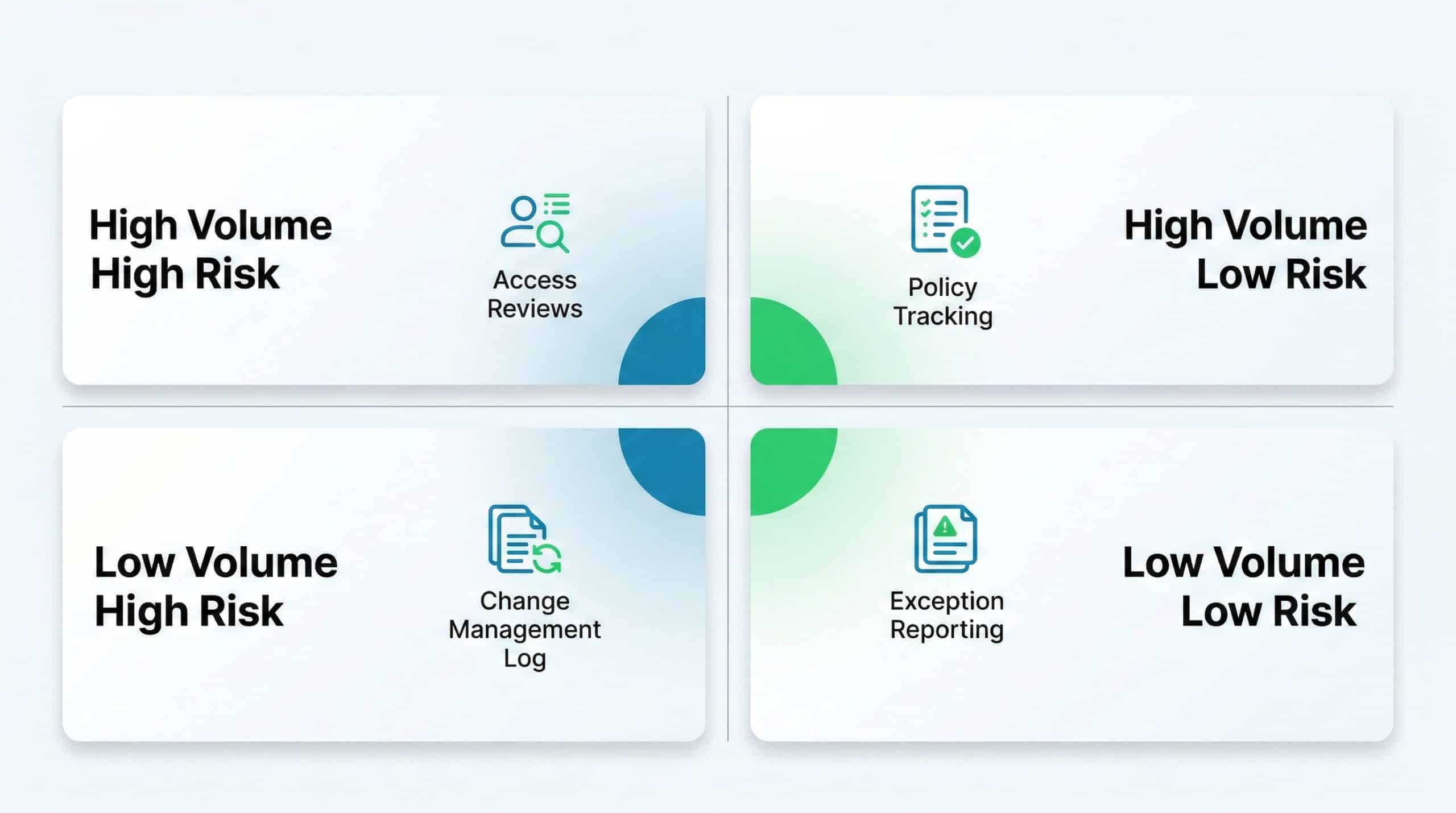
Not every audit-related task needs automation on day one. The practical approach is to map every regulatory or internal audit requirement to a repeatable “unit of work,” then rank those units by volume, frequency, risk level, and current manual effort. High-volume, repetitive tasks are natural candidates: periodic access reviews, change management log collection, policy acknowledgment tracking, and exception reporting.
Control-to-Requirement Mapping
The technique involves building a matrix that connects each compliance requirement to a specific control, its owner, the expected frequency, and the type of evidence that proves it operated. The NIST SP 800-53 Rev. 5 control catalog provides a structured blueprint for this mapping, particularly through its Audit and Accountability (AU) family, which defines exactly what should be captured, retained, and reviewed. Organizations that invest time in this mapping upfront discover that many controls share overlapping evidence, which reduces collection effort significantly.
Did You Know
Organizations that complete a thorough control-to-requirement mapping before automating typically discover that 30-40% of their evidence collection efforts are duplicated across different audit frameworks — meaning a single automated collection can satisfy multiple compliance obligations simultaneously.
Building an Audit-Ready Organization: Culture Before Technology
Technology alone does not create audit readiness. The cultural shift is equally important: moving from “compliance as a department” to “compliance as a feature embedded in every workflow.” This means every process owner understands that the way they execute a task must leave a traceable, verifiable footprint — not because an auditor demands it, but because the organization’s operating model depends on it.
In an automated environment, the RACI model becomes essential. Someone owns the control design, someone monitors the automation to ensure it is functioning correctly, and someone acts on exceptions when they arise. As AI continues to revolutionize risk assessment across the financial sector, audit-ready organizations are leveraging these capabilities to flag control drifts in real-time rather than discovering them during the audit itself.
Tip
Assign a “control champion” within each department — not necessarily a compliance specialist, but someone who understands the day-to-day process and can validate that automated evidence accurately reflects what actually happens on the ground.
Point-in-Time Readiness vs. Continuous Readiness: A Scenario Comparison
Consider two organizations preparing for the same SOC 2 audit. Organization A begins preparation eight weeks before the auditor arrives, assigning a project manager to collect evidence from twelve different teams. Organization B has automated evidence collection running throughout the year, with a dashboard that shows real-time control status. When the audit date arrives, Organization A is still reconciling conflicting spreadsheet versions. Organization B opens a portal and shares pre-organized, timestamped evidence with the auditor within hours.
| Dimension | Point-in-Time Readiness | Continuous Readiness |
|---|---|---|
| Evidence Collection | Manual sprint before each audit | Automated, ongoing, always current |
| Gap Discovery Timing | Often during the audit itself | Flagged in real-time as gaps emerge |
| Staff Burden | High — pulls people from core duties | Low — exceptions-only involvement |
| Control Drift Risk | High — months may pass unmonitored | Low — continuous validation catches drift |
| Evidence Reuse Across Frameworks | Rare — each audit restarts from scratch | Standard — same evidence mapped to multiple requirements |
Did You Know
Organizations operating with continuous readiness report audit completion times that are 60-70% shorter than those relying on point-in-time preparation, according to GRC industry benchmarks. The reduction comes primarily from eliminating evidence-gathering delays and version reconciliation conflicts.
Struggling with fragmented audit evidence and manual collection processes? Detelix continuously monitors your ERP processes and generates structured, timestamped evidence automatically.
Automating Audit Workflows Without Creating New Complexity
One of the most common mistakes is automating individual tasks without connecting them into an end-to-end flow. The result is “partial automation” — some evidence is collected automatically, but the verification, approval, and archiving steps still depend on manual handoffs. This creates gaps in the audit trail that are harder to explain than a fully manual process.
A Recommended Workflow Template for Periodic Controls
The clean approach follows a consistent sequence: a scheduled trigger initiates the evidence collection, the system fetches the relevant log or report, an automated check validates completeness, a human reviewer confirms accuracy, and the approved evidence is locked and archived with full metadata. Every step is logged. According to the NIST SP 800-92 Guide to Computer Security Log Management, this lifecycle — from log generation through analysis and archiving — is precisely what creates a defensible evidence chain.
Handling Exceptions as Part of the Flow
In a well-designed system, exceptions do not disappear. When a control check fails or evidence cannot be collected, the system opens a documented exception with an assigned owner, a root cause field, a remediation deadline, and a follow-up verification. This is where platforms like Detelix add practical value: by continuously scanning ERP-driven processes and flagging deviations as they occur, exception management becomes a structured, auditable process rather than an informal conversation.
Tip
Design your exception handling workflow to require a documented root cause before closure. Auditors pay close attention to whether exceptions are genuinely resolved or simply marked as “done” — a root cause field forces accountability and creates a stronger audit narrative.
Which Types of Evidence Can Be Collected Automatically?
The range of automatically collectible evidence is broader than many teams realize. Any system that generates structured logs or reports can feed into an automated evidence repository. Common examples include access control reports showing who has permissions to what, change history logs documenting every modification to master data, vulnerability scan results, policy acknowledgment records, training completion certificates, and approval chain records from ERP workflows.
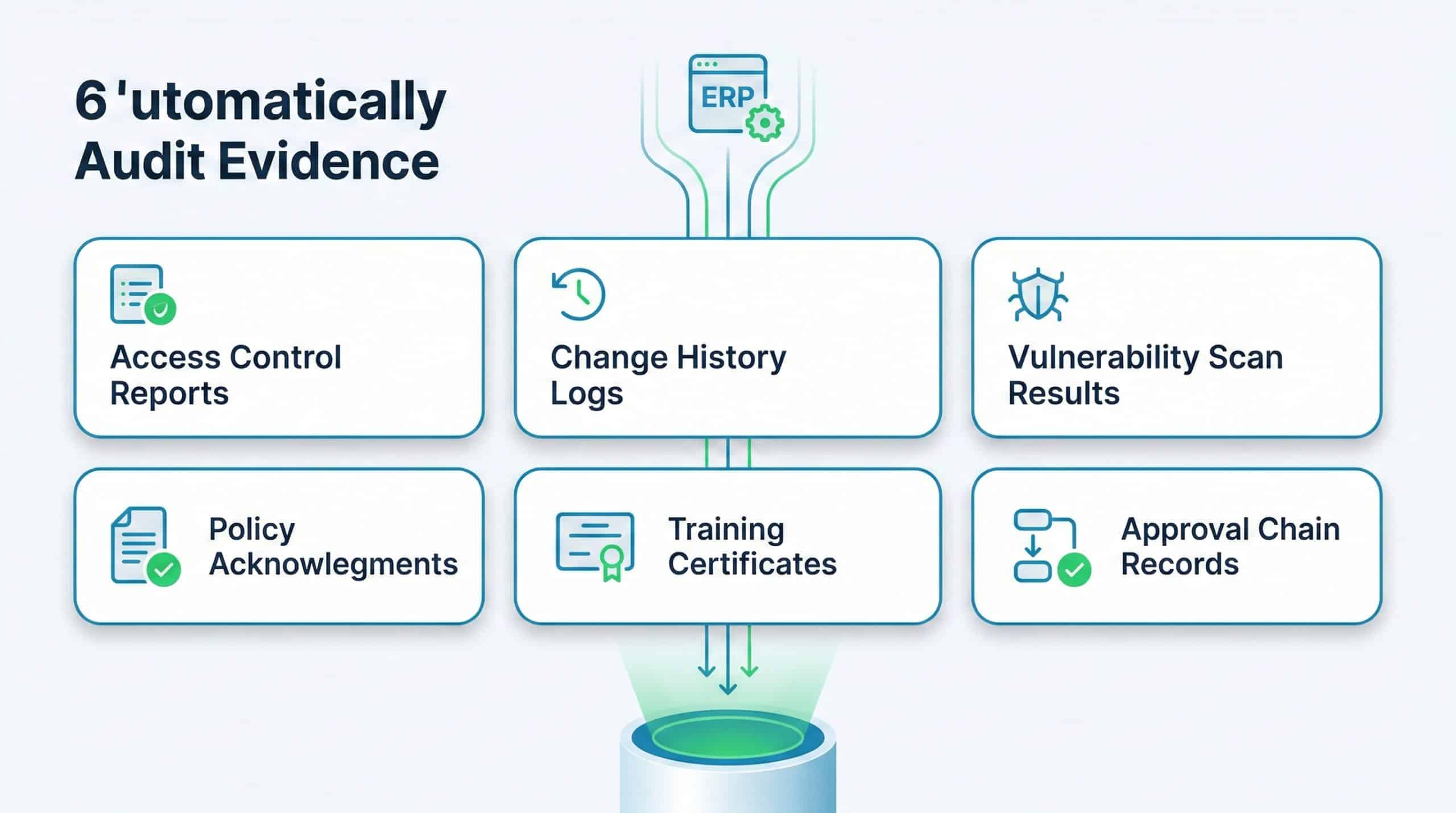
The key requirement is a reliable data source. If the originating system can export data via an API, a scheduled report, or a direct database query, that evidence can be automated. Organizations using Detelix benefit from its ability to cross-check actions across ERP processes — such as supplier payment changes, bank account modifications, and procurement approvals — providing a continuous stream of verified evidence without manual extraction.
What Makes Automated Evidence “Admissible” Rather Than Just “Available”?
Collecting evidence is not the same as collecting useful evidence. Auditors evaluate whether evidence is sufficient and appropriate — meaning it must be relevant to the specific control, reliable in its source, and complete in its coverage of the audit period. The PCAOB AS 1105 standard on Audit Evidence makes clear that the relevance and reliability of evidence are influenced by its source and the circumstances under which it was obtained.
| Quality Criterion | What It Means in Practice | Common Failure |
|---|---|---|
| Source Integrity | Evidence comes directly from the system of record, not a copied file | Screenshots saved to personal drives with no metadata |
| Time Coverage | Evidence spans the full audit period without gaps | Reports covering only the last month of a 12-month period |
| Completeness | All relevant transactions or events are included | Filtered exports that exclude “exceptions” |
| Immutability | Evidence cannot be altered after collection | Editable spreadsheets with no version control |
| Contextual Link | Evidence is explicitly connected to the control it supports | A folder of logs with no mapping to requirements |
Did You Know
The PCAOB found in recent inspection cycles that one of the most frequent audit deficiencies involves insufficient evaluation of the reliability of evidence obtained from company systems — reinforcing why source integrity and immutability are non-negotiable requirements for automated evidence.
Measuring Audit Readiness with Quantifiable KPIs
If you cannot measure readiness, you cannot improve it. Mature organizations track specific metrics that provide an objective “readiness score” at any point in time. These metrics also serve as early warning signals: when a KPI trends in the wrong direction, the team can intervene before the gap becomes an audit finding.
Recommended KPIs for Compliance and Audit Teams
Evidence Freshness measures the average age of the most recent evidence for each control — stale evidence signals a broken collection process. Control Pass Rate tracks the percentage of automated checks that pass without human intervention. Exception Aging monitors how long a failed control remains open before remediation. Cycle Time compares the hours required to produce a complete evidence package now versus the previous audit period. Together, these metrics transform audit readiness from a subjective judgment into a data-driven assessment.
Tip
Set up a weekly automated email that reports your top four readiness KPIs to the CFO and compliance lead. Visibility drives accountability — when leadership sees evidence freshness declining, the issue gets addressed before it becomes an audit finding.
Five Mistakes That Undermine Automated Audit Preparation
Transitioning to automation introduces its own risks when done carelessly. The first mistake is automating without ownership — when no one is responsible for validating that the automation is still running correctly, failures go unnoticed for months. The second is data dumping: collecting every available log without filtering for relevance, which buries the auditor in noise and slows down the review.
Third, organizations often skip version control, leaving multiple copies of the same evidence in different states. Fourth, some teams confuse frequency — collecting evidence monthly for a control that operates daily, creating coverage gaps. Fifth, there is a tendency to treat automation as a one-time project rather than a living process that requires periodic recalibration as systems, regulations, and business processes evolve.
Did You Know
A common but overlooked cause of audit findings is “stale automation” — automated evidence collection jobs that were configured correctly at launch but broke silently after a system update, password change, or API deprecation. Regular health checks on automated jobs are just as important as the automation itself.
When Should You Start Automating If the Audit Is Already Approaching?
If an audit is weeks away, a full automation overhaul is unrealistic. The pragmatic approach is to stabilize first: centralize existing evidence into a single repository, create consistent naming and tagging conventions, assign clear ownership for every open gap, and document the “as-is” state honestly. This reduces surprises during the audit even without deep automation.
After the audit concludes, the organization can shift to optimization: implementing data connectors, building automated workflows, and establishing continuous monitoring. This two-phase approach — stabilize, then automate — prevents the common trap of trying to build infrastructure during a crisis, which typically creates more confusion than it resolves.
Tip
Even during a last-minute stabilization phase, implement one quick win: set up automated collection for your single highest-volume control. This demonstrates the value of automation to stakeholders and creates momentum for the post-audit optimization phase.
A Practical 90-Day Roadmap to Audit Readiness
The phased approach recommended by frameworks such as the ENISA self-assessment guidelines breaks the journey into manageable stages with clear deliverables at each milestone.
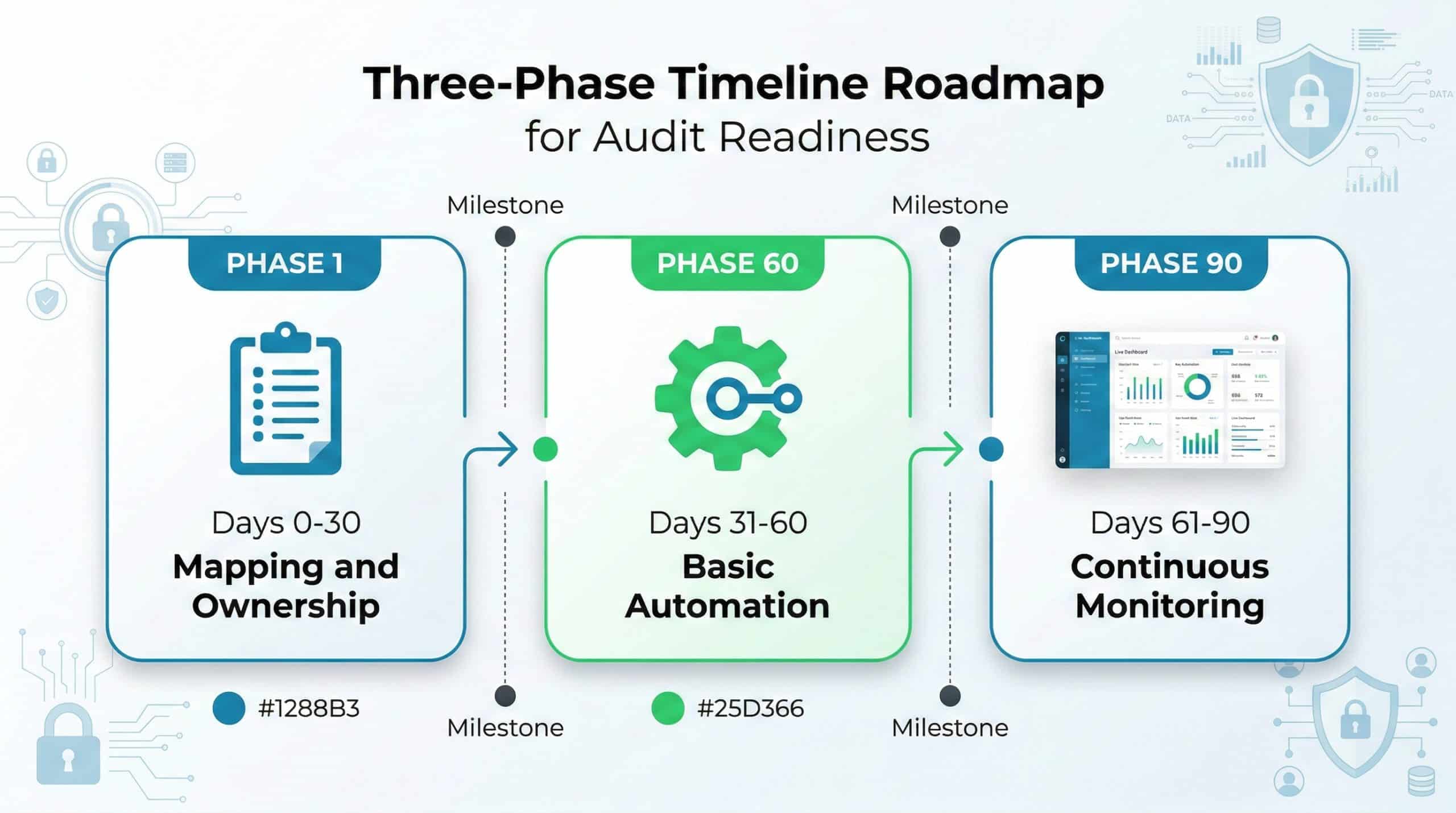
Days 0-30: Mapping, Standardization, and Ownership
Begin by inventorying every control that an auditor will examine. Assign a RACI for each one. Define what constitutes “acceptable evidence” — format, source, time range, and approval requirements. Prioritize the 20% of controls that generate 80% of the manual workload. The deliverable at the end of this phase is a completed controls-to-requirements matrix with ownership confirmed.
Days 31-60: Basic Automation and Evidence Organization
Implement data connectors for the top five highest-effort controls. Set up automated scheduling so evidence is collected without manual triggers. Establish a central repository with consistent folder structure and metadata tagging. Test the flow end-to-end for each automated control and confirm that the archived evidence meets the quality criteria defined in phase one.
Days 61-90: Continuous Monitoring and Improvement
Activate alerts for control failures and evidence gaps. Build a KPI dashboard tracking evidence freshness, pass rates, and exception aging. Conduct a mock audit using only the automated system to identify remaining weaknesses. Document lessons learned and create a backlog for the next improvement cycle. This is where Detelix’s continuous monitoring capability becomes particularly valuable — its real-time scanning of ERP processes provides an ongoing verification layer that catches deviations before they accumulate into audit findings.
Did You Know
Organizations that conduct a mock audit at the end of their automation implementation phase identify an average of 15-20% more gaps than those that skip this step — and they resolve those gaps before the real auditor arrives, turning potential findings into documented improvements.
Does Audit Readiness Automation Work for Smaller Organizations?
Yes — and in some ways, smaller organizations benefit even more because they typically lack dedicated compliance teams. The key is to avoid overengineering. A small firm does not need to automate fifty controls simultaneously. Starting with the five most critical controls — those that carry the highest regulatory risk or consume the most staff hours — delivers immediate value. Evidence reuse is another advantage: a single access review report can serve as evidence for multiple compliance requirements, reducing duplication.
Detelix is designed to serve organizations across different scales, providing real-time protection over sensitive ERP processes like supplier payments, payroll changes, and bank account modifications without requiring a large internal team to manage the platform. The focus is on actionable alerts and structured evidence, not on adding operational complexity.
Detelix Continuous Monitoring Solutions

Proactive Monitoring
Continuous oversight of sensitive ERP processes including supplier payments, bank account changes, and procurement approvals — generating audit-ready evidence automatically.

Real-Time Alerts
Instant notifications when control deviations or suspicious activities are detected, enabling immediate response and creating a documented exception trail for auditors.

GateKeeper
Preventive control layer that blocks unauthorized changes to critical master data before they execute, providing both protection and verifiable evidence of control enforcement.

Industry Experience
Deep domain expertise across healthcare, finance, manufacturing, and government sectors — ensuring monitoring rules align with your specific regulatory and audit requirements.
See Detelix in Action
Frequently Asked Questions
Can automation replace the auditor entirely?
No. Automation replaces the manual effort of gathering, organizing, and verifying evidence. The auditor still exercises professional judgment to evaluate whether controls are designed and operating effectively. What changes is the speed, completeness, and reliability of the information the auditor receives.
How do you handle evidence for controls that require human judgment?
Automation captures the context around the human decision: who made it, when, what data they reviewed, and what outcome they selected. The judgment itself remains human, but the documentation of that judgment becomes systematic and tamper-resistant.
What happens when an automated control fails?
The system generates a documented exception that includes the failure details, assigns an owner, sets a remediation deadline, and tracks the resolution. This exception record itself becomes audit evidence, demonstrating that the organization has a functioning process for identifying and correcting control weaknesses.
Is it possible to implement automation without replacing existing ERP systems?
Absolutely. Most automation platforms — including Detelix — operate as an overlay that connects to existing systems via APIs, database queries, or log exports. The goal is to enhance visibility and control over your current environment, not to introduce a disruptive migration project.
How frequently should automated evidence collection run?
The frequency should match the control’s operating cadence. A daily transaction control requires daily evidence collection. A quarterly access review needs quarterly evidence. Misalignment between control frequency and evidence frequency is one of the most common audit findings, and it is entirely preventable through proper scheduling configuration.
Ready to Transform Your Next Audit from Crisis to Checkpoint?
Move from pre-audit scrambling to continuous, verifiable readiness. Detelix gives you real-time visibility into sensitive business processes and the confidence that your controls are working right now.