
Stop ERP Fraud Before the Payment Leaves Your Bank
Detelix adds a real-time control layer over your ERP — detecting suspicious payments, vendor changes, and privilege misuse before damage is done.
- Why ERP Systems Create Hidden Exposure
- What Is ERP Fraud Prevention Software
- How Modern Solutions Operate
- The Danger Zone: Procure-to-Pay and Vendor Master Data
- Scenario: The Payment That Almost Left the Company
- Native ERP Controls vs. Purpose-Built Monitoring
- Key Features of the Best Detection Tools
- Common Mistakes to Avoid
- Segregation of Duties Beyond Policy
- Signals to Monitor Across ERP Processes
- Measuring ROI
- How Detelix Supports Real Control
- Implementation and Tuning
- Frequently Asked Questions
In many organizations, financial controls look strong on paper. There are approval flows, ERP permissions, reconciliations, and periodic reviews. Yet when sensitive business processes depend on routine, manual checks, or after-the-fact reporting, risk can still slip through unnoticed. Modern ERP systems concentrate enormous volumes of financial, procurement, payroll, and vendor data in one place — and that concentration creates blind spots that traditional audits rarely catch in time. This is where ERP fraud prevention software becomes a business-critical layer of defense: a continuous, real-time control system that detects human errors, policy deviations, and fraudulent activity before money leaves the organization.
Key Takeaways
- ERP systems concentrate high-value data, creating control gaps that periodic audits cannot close in time.
- Real-time monitoring of vendor master data, payments, and privileged activity prevents fraud before funds leave the bank.
- Native ERP controls handle workflow, but rarely offer continuous anomaly detection or cross-module correlation.
- Procure-to-pay, master data changes, and segregation of duties conflicts deliver the fastest ROI when monitored.
- Effective fraud prevention requires tuned alerts with business context — not raw notifications that fuel alert fatigue.
Why ERP Systems Create Hidden Exposure for Finance Leaders
As companies scale, ERP environments grow in complexity. New suppliers are added, users receive broader permissions, approval chains stretch across departments, and master data changes happen daily. Each of those touchpoints is a potential control gap. The ACFE’s global study of occupational fraud cases shows that control weaknesses and override of existing controls remain leading contributors to significant financial losses, which is why continuous anti-fraud monitoring is no longer optional for finance teams. You can review the global findings in the Occupational Fraud 2024: A Report to the Nations. The IRS also notes that many fraud cases involve poor or nonexistent internal controls and little or no separation of duties, reinforcing why ERP-specific oversight matters.
Did You Know
According to the ACFE, organizations that deploy proactive data monitoring and analysis detect fraud roughly twice as fast and experience significantly smaller losses than those relying on manual reviews alone.
What Is ERP Fraud Prevention Software, Really?
ERP fraud prevention software is a protective layer that connects to your ERP, monitors transactions, master data, permissions, and user behavior, and flags anomalies in real time. Unlike a reporting dashboard or a traditional audit tool, it does not wait for month-end to surface issues. It continuously cross-checks activity against business rules, historical patterns, and risk scoring logic. The goal is not only detection — it is prevention. The system is designed to alert, block, or escalate suspicious actions before a payment is released, a vendor record is altered, or a privileged change is committed.
Tip
Before evaluating any platform, map the three or four ERP scenarios that would cause the largest financial damage if exploited. Use those scenarios — not a generic checklist — as the basis for vendor comparison.
How Modern ERP Fraud Solutions Operate Behind the Scenes
Modern ERP fraud solutions ingest data from transactional tables, master data files, system logs, and user activity records. They combine rule-based controls with behavioral analytics to detect unusual patterns — a new supplier sharing bank details with an existing one, an after-hours payment, or a user who both creates and approves an invoice. The NIST guidance on privileged account management explains why administrative activity must be monitored continuously, since privileged users can silently alter financial records, bypass approval logic, or adjust master data. Detelix offers various ERP fraud solutions that replace slow, manual business process checks with continuous, automated verification across sensitive workflows.
Which data sources are continuously scanned?
Vendor and customer master files, payment batches, invoices, journal entries, user roles, permission changes, and system logs of sensitive field modifications are all monitored in parallel. The system treats each source as part of a single control picture, not isolated silos.
How is an alert generated?
When a control rule or anomaly model is triggered — for example, a supplier bank account change shortly before a large payment — the system produces a contextual alert that explains what happened, which records are involved, and why the activity deviates from expected behavior. That context is what transforms a notification into an actionable investigation.
The Danger Zone: Procure-to-Pay and Vendor Master Data
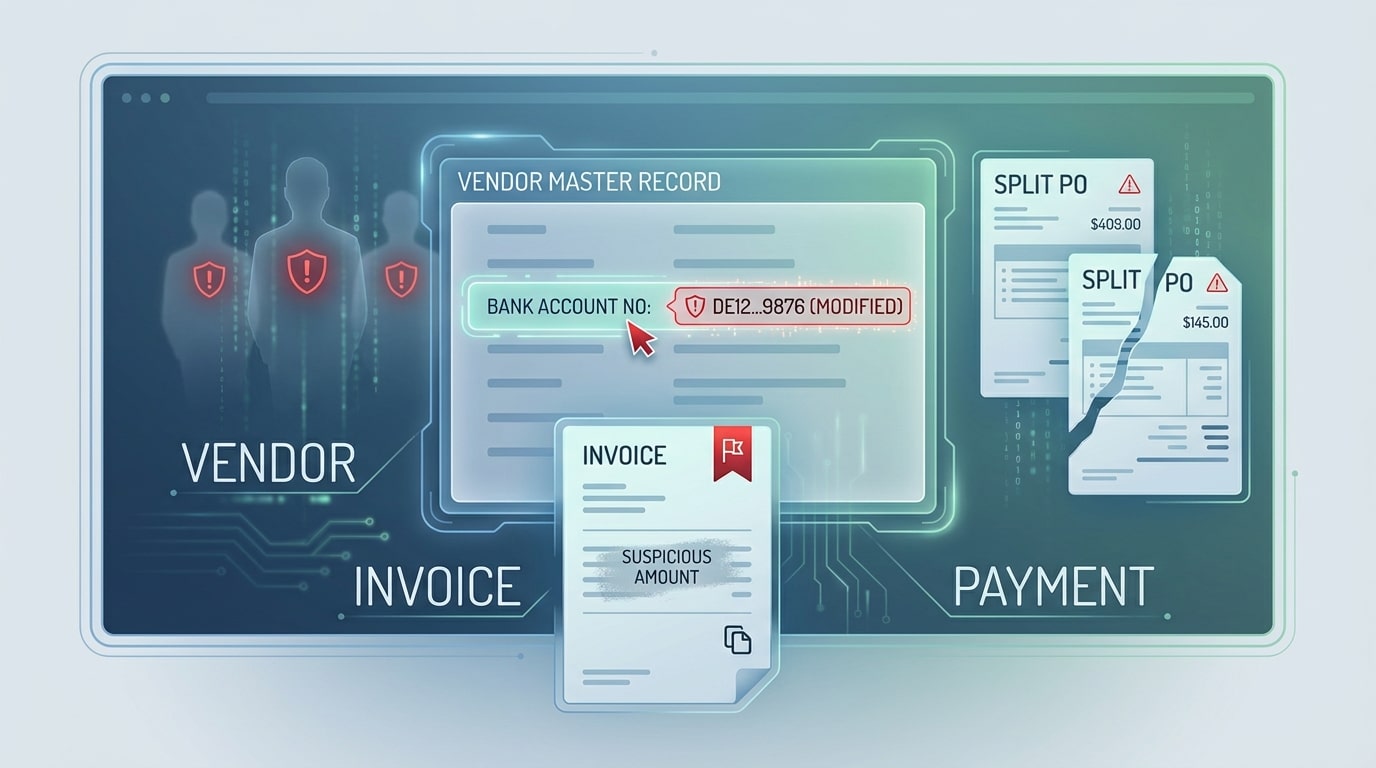
Procure-to-pay is one of the most exposed areas in any ERP. Ghost vendors, duplicate invoices, overpriced contracts, and split purchase orders designed to bypass approval thresholds are classic attack vectors. The World Bank’s warning signs of fraud and corruption in procurement describe recurring red flags that every finance team should monitor — including suspicious bidders, unusual pricing, and frequent contract changes. Vendor master data manipulation is particularly dangerous because a single unauthorized change can redirect legitimate payments to a fraudulent account.
Tip
Treat every vendor bank detail change as a privileged event. Require a cross-channel verification step (phone callback to a previously known number) before any payment is released to the updated account.
A Scenario: The Payment That Almost Left the Company
A finance clerk receives what appears to be a routine email from a long-standing supplier requesting an update to their wire instructions. The clerk updates the vendor record in the ERP. Two days later, a scheduled payment is prepared for release. Without continuous monitoring, this payment would likely go through. With an ERP fraud prevention layer in place, the bank detail change triggers an alert, cross-references the new account against known patterns, and halts the payment for verification. This is exactly the type of vendor-payment manipulation described in public advisories on fraudulent requests to change wire instructions.
Did You Know
Business Email Compromise attacks targeting vendor payment workflows are one of the most financially damaging fraud categories globally, with single incidents often costing organizations six- or seven-figure losses.
Comparison: Native ERP Controls vs. Purpose-Built Fraud Monitoring
A recurring question in fraud monitoring software comparison discussions is whether native ERP controls are enough. The short answer: rarely. Native controls handle workflow and permissions, but they typically lack continuous anomaly detection, contextual scoring, and investigation tools.
| Capability | Native ERP Controls | Purpose-Built Fraud Prevention |
|---|---|---|
| Real-time anomaly detection | Limited or absent | Continuous and contextual |
| Cross-module correlation | Rarely supported | Built-in across processes |
| Master data change monitoring | Log-based, manual review | Automated alerts with context |
| Investigation workflow | Not included | Case management and audit trail |
| Time to value | Long customization cycles | Deployed around prioritized use cases |
Your ERP already holds the data. The question is whether something is watching it in real time. Detelix delivers that layer — independently, continuously, and in context.
Key Features of the Best ERP Fraud Detection Tools
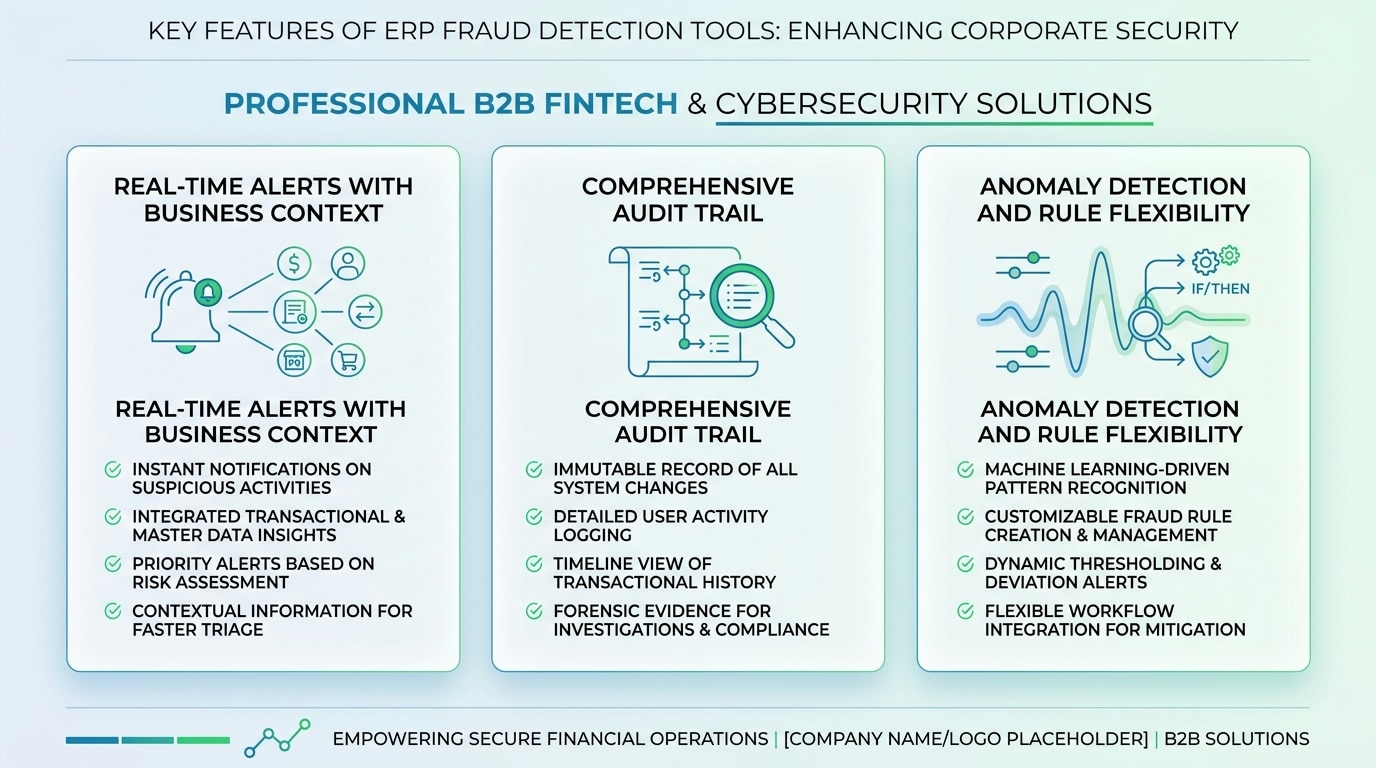
When evaluating the best ERP fraud detection tools, decision-makers should focus less on marketing checklists and more on operational outcomes. The right platform should reduce manual workload, surface real risk, and integrate naturally with existing finance processes.
Real-time alerts with business context
Alerts must explain what happened, why it matters, and who is responsible — not just trigger raw notifications. Context is what turns a flagged transaction into a decision the finance team can act on immediately.
Comprehensive audit trail
A strong security audit trail, as defined by NIST, is essential for investigations, internal reviews, and evidentiary support during disputes. Every sensitive action should be logged with who, what, when, and from where.
Anomaly detection and rule flexibility
Combining behavioral analytics with configurable rules allows teams to cover both known fraud patterns and emerging ones. Rigid systems quickly go stale; flexible ones adapt as the business changes.
Tip
Insist on a case management workflow inside the fraud platform itself. Moving alerts manually into spreadsheets or email breaks the audit trail and slows investigations when it matters most.
Common Mistakes Organizations Make With ERP Fraud Prevention
Many finance leaders assume that approval workflows alone prevent fraud. They do not. Approvals can be bypassed when the same user controls multiple stages, when approvers rubber-stamp requests, or when master data is altered before an approved transaction is executed. Another frequent mistake is relying on periodic audits to catch issues that should have been caught in real time. By the time an annual or quarterly review surfaces a problem, the money is usually gone. A third mistake: tolerating excessive alert volume from poorly tuned systems, which leads to alert fatigue and ignored warnings.
Did You Know
Studies of internal fraud cases consistently show that the median duration between the start of a scheme and its detection is more than a year — a window that continuous monitoring can dramatically shorten.
Segregation of Duties: Policy Is Not Enough
Segregation of duties (SoD) is a foundational control, but in practice, many organizations enforce it only through written policy. The NIST practice guide on access rights management emphasizes that least privilege and separation of duties must be enforced through automated access rules, not just documentation. ERP fraud prevention software continuously verifies that users are not accumulating incompatible permissions — for example, the ability to create a vendor and approve a payment to that vendor. When a conflict is detected, the system alerts immediately, allowing the organization to correct it before it is exploited.
Signals to Monitor Across Sensitive ERP Processes
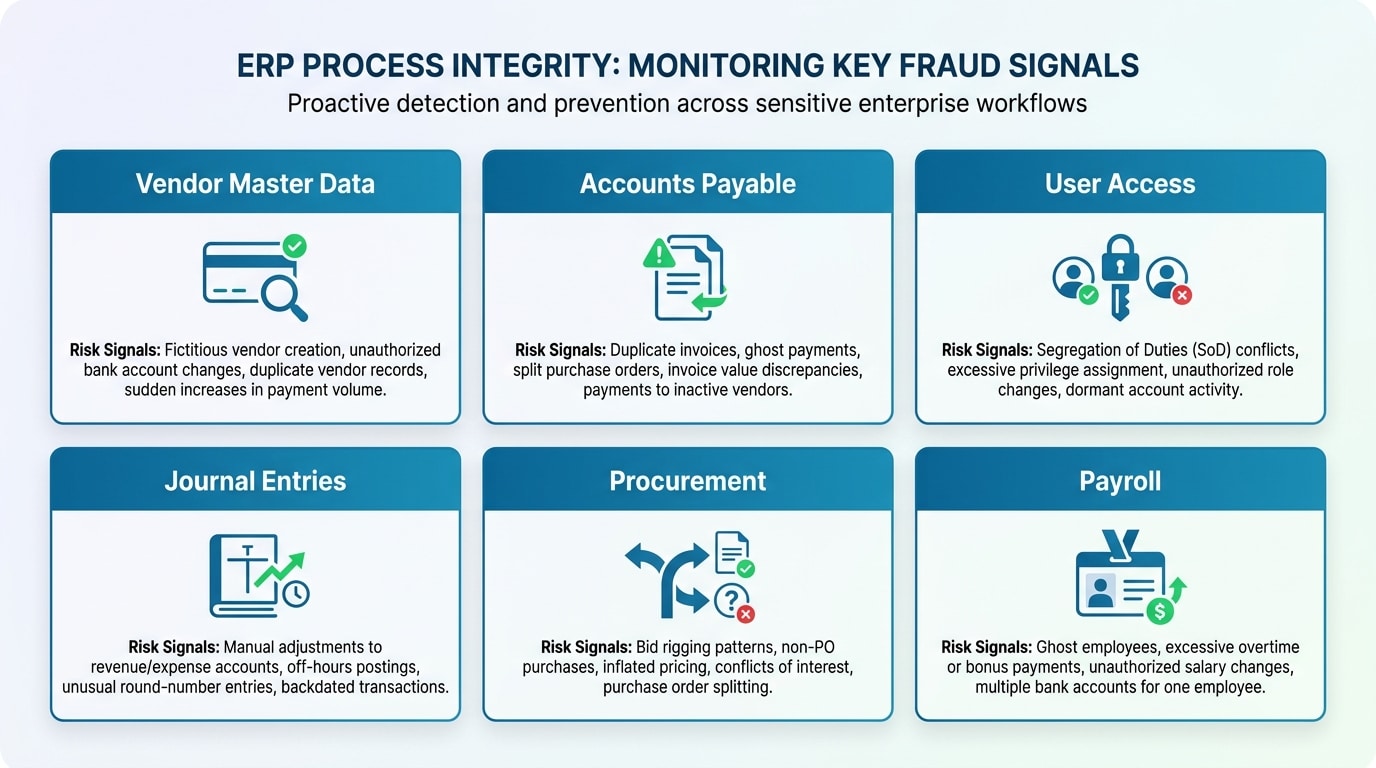
| Process Area | High-Risk Signal | Control Objective |
|---|---|---|
| Vendor master data | Bank account change before a large payment | Block or verify payment |
| Accounts payable | Duplicate invoice numbers or amounts | Prevent duplicate payment |
| User access | Conflicting SoD role assignments | Enforce least privilege |
| Journal entries | Manual entries outside business hours | Detect manipulation |
| Procurement | Split orders below approval threshold | Flag threshold avoidance |
| Payroll | Unusual bank detail updates on employees | Prevent diversion of wages |
Measuring ROI on ERP Fraud Prevention Software
ROI should be measured across three dimensions: financial loss avoided, operational efficiency gained, and control effectiveness improved. Pre-payment verification — stopping a suspicious disbursement before funds leave the bank — delivers the highest immediate value. Organizations also benefit from reduced investigation time, fewer manual reconciliations, and more efficient external audits. For finance leaders, the cumulative effect of catching even a handful of high-value frauds or errors in a given year can transform the economics of internal control.
Did You Know
Many organizations discover that their first month of continuous ERP monitoring surfaces long-standing duplicate-payment patterns and vendor anomalies that had been draining budget quietly for years.
How Detelix Supports Real Control Across Business Processes
Detelix is designed as a continuous, independent control layer that sits alongside your ERP, cross-checking actions in real time and alerting when something deviates from expected behavior. The following mapping shows how common business needs translate into practical support.
| Business Need | How Detelix Helps in Practice |
|---|---|
| Prevent fraudulent bank detail changes | Real-time alerts on sensitive master data changes before payments are released |
| Reduce duplicate or improper payments | Continuous cross-checks across invoices, vendors, and payment batches |
| Strengthen segregation of duties | Automated detection of conflicting role combinations and privileged activity |
| Accelerate investigations | Contextual alerts with audit trail and case documentation |
| Support finance teams in Israel and abroad | Adaptation to local ERP environments and business workflows |
Tip
Start your deployment with two or three highest-impact use cases — vendor bank changes, duplicate invoices, and SoD conflicts. Prove value quickly, then expand coverage based on real findings.
Is ERP Fraud Prevention Software Suitable for Mid-Sized Companies?
Yes. Mid-sized organizations often face the same risks as large enterprises — supplier fraud, payment errors, insider misuse of permissions — but with smaller audit teams and leaner finance departments. A focused, quick-to-deploy solution that targets the highest-risk use cases first delivers strong value without overwhelming the organization. Starting with procure-to-pay, vendor master data, and privileged access usually provides the fastest measurable impact.
How long does implementation typically take?
Implementation depends on data availability, process complexity, and the number of use cases prioritized. A practical approach is to start with a narrow set of high-risk scenarios — such as vendor bank changes and duplicate invoices — connect the relevant data sources, tune alerts, and define investigation workflows. From there, coverage expands incrementally. This phased approach delivers early wins while keeping the project manageable for finance and IT teams.
Reducing false positives without losing coverage
Excessive false positives are one of the main reasons fraud monitoring programs fail. Teams stop trusting the alerts, and real risks get buried. Reducing false positives requires tuning rules with business context, applying tiered risk scoring, using dynamic thresholds based on role and history, and learning from past investigation decisions. The goal is not fewer alerts at any cost — it is alerts that consistently reflect real risk and justify action.
From Routine Monitoring to Real Control
There is a meaningful difference between managing activity and actually controlling it. Many organizations generate reports, run reconciliations, and hold review meetings — and still miss the moment when damage occurs. Real control means knowing what is happening right now, across sensitive ERP processes, with enough context to act before money leaves the company. This shift from reactive review to proactive prevention is what separates organizations that absorb recurring losses from those that protect their financial integrity consistently.
Detelix ERP Control and Fraud Prevention Solutions

Proactive ERP Monitoring
Continuous oversight of sensitive ERP processes, master data changes, and financial transactions — surfacing risk before it becomes loss.

Real-Time Fraud Alerts
Contextual alerts on suspicious payments, vendor bank changes, and policy deviations — delivered with the detail needed to act.

Gatekeeper Controls
Block or verify sensitive actions — such as vendor updates or large disbursements — before they are committed in the ERP.

Proven Enterprise Experience
Deep expertise across SAP, Oracle, Priority, and other ERPs — adapted to local and international finance workflows.
See Detelix in Action
Frequently Asked Questions
What is the difference between fraud detection and fraud prevention?
Fraud detection identifies suspicious events, often after they occur. Fraud prevention combines early detection with automated controls, blocks, and verification steps that stop the event before damage is completed.
Can ERP fraud prevention software work alongside existing controls?
Yes. It is designed to complement existing approvals, permissions, and reconciliations by adding a continuous, independent verification layer across sensitive transactions and master data.
Which processes should be prioritized first?
Procure-to-pay, vendor master data, payments, privileged user activity, and journal entries are typically the highest-risk areas and deliver the fastest return on prevention investment.
How does the software handle privacy and audit requirements?
Quality platforms maintain a full audit trail, restrict access based on least privilege, and log every sensitive action, supporting both internal and external audit requirements.
Does it replace internal auditors?
No. It strengthens their work by providing continuous monitoring, reliable evidence, and faster investigation tools, allowing auditors to focus on higher-value analysis instead of manual sampling.
How do we know the controls are actually working?
Through measurable indicators: alerts generated and resolved, issues prevented, investigation times, false positive rates, and trends in policy compliance across sensitive processes.
Ready to Move From the Illusion of Control to Real Control?
If your ERP drives critical financial decisions, make sure a suspicious payment or unauthorized master data change is caught before damage occurs.