Unify Financial Controls Across Every Entity in Your Group
Detelix delivers real-time, group-wide governance over payments, vendors, and segregation of duties — no ERP migration required.
- What Exactly Is a Multi-Entity Finance Controls Platform?
- Why Do Decentralized Controls Fail at the Group Level?
- A Common Scenario: The Same Vendor, Three Entities, Zero Visibility
- How Does a Platform Balance Global Standards with Local Flexibility?
- Multi-Company ERP Governance vs. a Single ERP Rollout
- Subsidiary Risk Monitoring: Which Metrics Actually Matter?
- Implementing Group-Wide Financial Controls Step by Step
- Mistakes That Undermine Multi-Entity Control Programs
- How Do Permissions and Segregation of Duties Work Across Entities?
- Controlling Intercompany Transactions: Where Most Groups Lose Visibility
- What Should a Finance Command Center Dashboard Display?
- How Long Does It Take to Deploy Group-Wide Finance Controls?
- Choosing the Right Platform: A Practical Evaluation Framework
- End-to-End Use Case: From Policy Definition to Audit-Ready Evidence
- Frequently Asked Questions
In many organizations that operate through multiple legal entities, financial controls look robust when viewed from a single subsidiary. Each unit may run its own ERP, follow local approval workflows, and produce periodic reports. But when leadership needs a consolidated, real-time picture of risk across the entire group, the gaps become visible fast. Payments slip through inconsistent approval thresholds, vendors appear in several entities under slightly different names, and intercompany balances remain unreconciled for weeks. The challenge is not a lack of controls — it is the absence of a unified layer that connects, standardizes, and enforces those controls across every entity simultaneously.
Key Takeaways
- A multi-entity finance controls platform enforces group-wide rules across all subsidiaries without replacing existing ERP systems.
- Decentralized controls create blind spots — duplicate vendors, cross-entity SoD violations, and unreconciled intercompany balances are common risks.
- Effective platforms balance global standards (approval thresholds, SoD matrices, reporting templates) with managed local exceptions for regulatory compliance.
- Real-time anomaly alerting catches fraud and policy deviations as they occur, not weeks later during periodic audits.
- Phased deployment starting with the highest-risk processes delivers measurable results within weeks, not years.
- A group-level Finance Command Center dashboard gives CFOs actionable visibility into open exceptions, unverified vendors, and period-lock status across all entities.
What Exactly Is a Multi-Entity Finance Controls Platform?
A multi-entity finance controls platform is a centralized governance layer that defines, enforces, and monitors financial controls across multiple legal entities within a corporate group. Unlike a single-entity accounting system, it preserves the operational and legal independence of each subsidiary while overlaying a consistent set of rules — approval hierarchies, segregation of duties, data-access policies, and reporting templates — that apply group-wide.
Think of it as the single source of truth for how financial processes should behave, regardless of which ERP system or local currency a given entity uses. It captures every transaction-level action in an audit trail, flags deviations from policy in real time, and gives group-level leadership the visibility they need to intervene before damage occurs rather than discover it after the fact.
Tip
When evaluating whether your organization needs a multi-entity controls platform, map out every financial process that touches more than one subsidiary. If vendor onboarding, payment approvals, or journal entries cross entity boundaries without unified oversight, you have a governance gap that local controls alone cannot close.
Why Do Decentralized Controls Fail at the Group Level?
When each subsidiary manages its own controls independently, risk accumulates in the spaces between entities. A supplier registered in one unit may receive duplicate payments from another. An employee with creator rights in Entity A might hold approver rights in Entity B, violating segregation of duties without anyone noticing. Local finance teams may apply different materiality thresholds, categorize expenses inconsistently, or close periods on conflicting timelines — making consolidated reporting slow and unreliable.
The Bank of Israel’s operational-risk management directive highlights the importance of reporting mechanisms, a structured control environment, and “three lines of defense” precisely because fragmented oversight creates blind spots that no single local audit can cover.
Did You Know
According to the Association of Certified Fraud Examiners, organizations with fragmented financial oversight across multiple entities experience median fraud losses 30% higher than those with unified control frameworks — largely because cross-entity anomalies go undetected for longer periods.
A Common Scenario: The Same Vendor, Three Entities, Zero Visibility
Consider a mid-size group with subsidiaries in Israel, Germany, and the US. A logistics vendor is onboarded separately in each entity — with slightly different bank details each time. Locally, every onboarding follows the approved workflow. But at the group level, no one sees that total exposure to this single vendor now exceeds the board-approved concentration threshold.
Worse, the German entity’s bank-detail change request was approved by someone who also initiated it, bypassing the intended SoD rule that exists on paper but was never enforced cross-entity. This is not a hypothetical edge case; it is the kind of gap that surfaces routinely in multi-entity environments where controls are entity-centric rather than group-centric.
Tip
Run a vendor-name fuzzy match across all your entities at least quarterly. You will likely discover that 5 to 15 percent of your vendor master records represent the same counterparty registered under slightly different names, addresses, or tax IDs — each one a potential duplicate payment or concentration-risk blind spot.
How Does a Platform Balance Global Standards with Local Flexibility?
Effective group-wide financial controls do not mean forcing every subsidiary into a single rigid template. The platform defines global rules — approval thresholds, SoD matrices, mandatory document attachments, reporting structures — and then allows managed exceptions per entity for local regulatory requirements such as tax fields, statutory formats, or payment methods. The key word is “managed”: every exception is documented, time-bound, and visible to group leadership.

What Should Be Uniform and What Can Vary?
Uniform elements typically include the permissions model, SoD principles, expense-category taxonomy, cost-center structure, and consolidated reporting templates. Variable elements include local tax identifiers, currency-specific payment flows, language settings, and jurisdiction-specific compliance documents. This separation ensures that global finance standardization accelerates the monthly close without creating friction for local teams that must comply with their own regulators.
Did You Know
Groups that enforce a standardized chart of accounts and cost-center hierarchy across all entities typically reduce their consolidated close cycle by 3 to 5 business days — freeing finance teams to focus on analysis rather than reconciliation.
Multi-Company ERP Governance vs. a Single ERP Rollout
Many groups assume that rolling out one ERP across all entities solves the control problem. In practice, mergers, acquisitions, and legacy systems mean most groups run multiple ERP instances — or entirely different platforms — across their subsidiaries. Multi-company ERP governance acknowledges this reality.
Instead of replacing every system, it adds a governance layer that enforces uniform rules (who can approve, what must be attached, which combinations of roles are prohibited) across all systems simultaneously. Finance leaders can monitor group-level risk from a single interface without logging into ten separate local environments, and the organization avoids the cost, disruption, and timeline of a monolithic ERP migration.
Tip
Before investing in a group-wide ERP migration, calculate the total cost of running a governance overlay on your existing systems. In most cases, the overlay approach delivers 80 percent of the control benefit at 20 percent of the migration cost — and goes live in weeks rather than years.
Subsidiary Risk Monitoring: Which Metrics Actually Matter?
Real-time subsidiary risk monitoring depends on defining the right anomaly signals. Many organizations track only financial KPIs — revenue, margin, budget variance — but miss the process-level indicators that predict fraud, error, or policy deviation long before they hit the P&L.
| Risk Category | Example Anomaly Signal | Why It Matters |
|---|---|---|
| Vendor management | New vendor created with bank details matching an employee | Potential fictitious-vendor fraud |
| Payment controls | Invoice split into amounts just below the approval threshold | Deliberate threshold circumvention |
| Segregation of duties | Same user created a purchase order and approved the payment | SoD violation enabling unauthorized disbursement |
| Intercompany | One-sided journal entry with no matching counterpart | Unreconciled balance that distorts consolidation |
| Period close | Manual journal posted after the soft-close deadline | Late adjustments that bypass review |
The Bank of Israel’s supervision and regulation framework underscores that proactive monitoring — not just periodic auditing — is essential for any organization managing risk across multiple operating units. Translating that principle into a finance controls platform means every anomaly above generates an alert the moment it occurs, not weeks later during an audit sample.
Did You Know
Invoice-splitting — where a single expense is deliberately broken into multiple invoices below the approval threshold — is one of the most common internal fraud techniques globally. Automated detection algorithms can identify splitting patterns within seconds, flagging cases that manual reviewers would miss entirely.
Managing financial controls across multiple entities? Detelix provides real-time, automated governance that catches anomalies before they become losses.
Implementing Group-Wide Financial Controls Step by Step
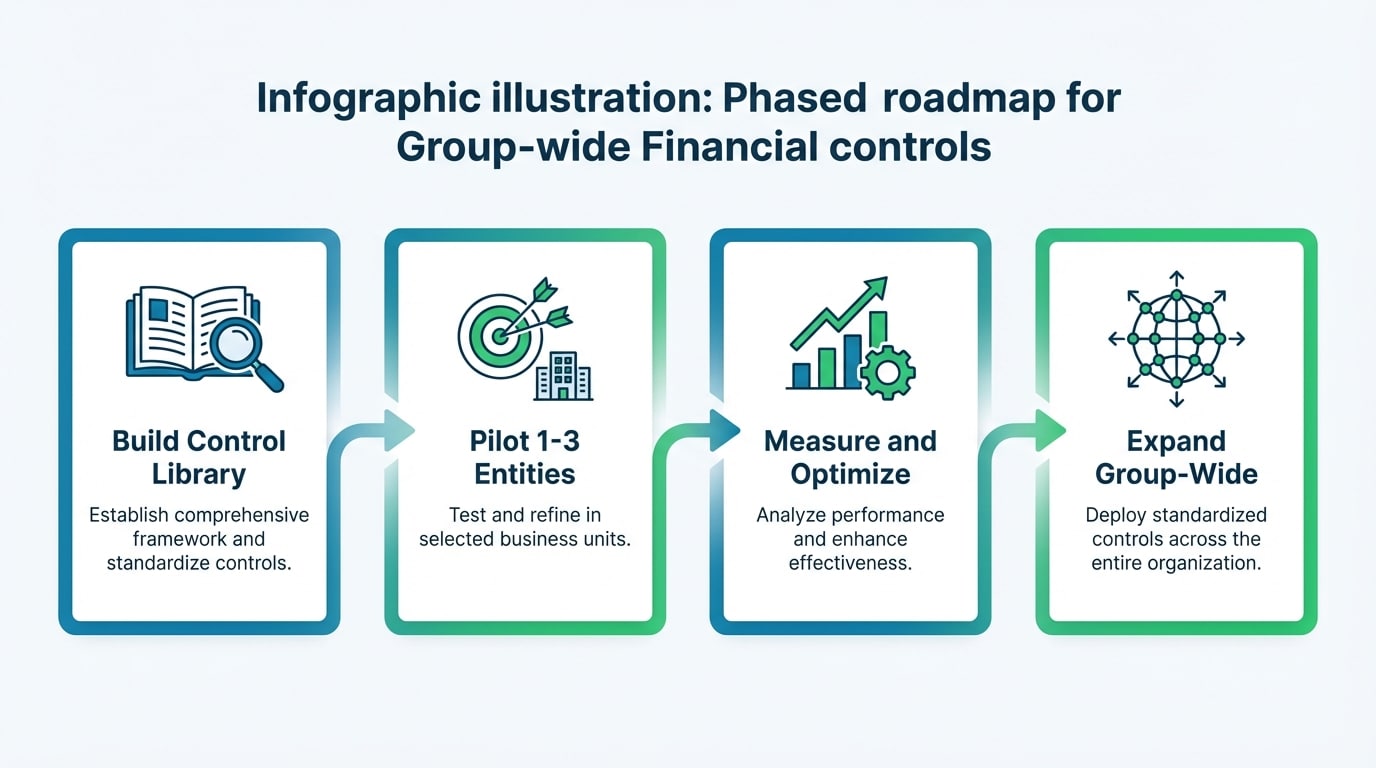
Deployment does not need to be a multi-year transformation. A phased approach yields faster results and lower risk. Start by building a Control Library — a catalog of group-level rules mapped to core processes such as procure-to-pay, expenses, and journal entries. Apply those rules to a pilot of one to three entities. Measure adoption, exception rates, and mean-time-to-resolve for flagged anomalies. Then expand entity by entity, process by process.
Quick wins — like enforcing mandatory document attachment on all payments above a defined threshold — build organizational confidence and demonstrate value to the board before the platform is fully rolled out.
Tip
Begin your pilot with the procure-to-pay cycle in your two highest-volume entities. This process typically carries the most fraud and error risk, so demonstrating control improvements here delivers the strongest business case for expanding the platform group-wide.
Mistakes That Undermine Multi-Entity Control Programs
Even well-funded control initiatives fail when they fall into predictable traps. The most common mistake is treating the platform as a reporting tool rather than an enforcement mechanism — generating dashboards that nobody acts on. The second is designing global rules in a vacuum, without consulting local finance managers, which leads to workarounds that undermine the entire framework.
A third mistake is ignoring intercompany transactions: groups focus on external vendor payments but leave internal transfers unmonitored, creating a significant reconciliation and fraud risk. Finally, some organizations deploy the platform without establishing clear ownership — no single person or team is accountable for reviewing alerts, updating rules, or escalating unresolved exceptions.
Did You Know
Research by Gartner indicates that organizations which assign a dedicated “controls owner” for their multi-entity governance platform resolve flagged exceptions 60 percent faster than those where ownership is distributed across local teams without centralized accountability.
How Do Permissions and Segregation of Duties Work Across Entities?
In a single-entity environment, SoD is relatively straightforward: you ensure that the person who creates a purchase order cannot also approve the invoice. In a multi-entity environment, the complexity multiplies. A user might hold “creator” rights in one subsidiary and “approver” rights in another, which can be legitimate — or it can create a cross-entity conflict if both entities transact with the same vendors.
A robust multi-entity finance controls platform maintains a group-wide SoD matrix that evaluates role combinations not only within each entity but across the entire group, flagging conflicts before they are exploited.
Tip
Export the complete user-role matrix from every entity in your group and cross-reference it in a single spreadsheet. If you find users who hold both “create” and “approve” permissions across different entities that share vendors, you have identified a cross-entity SoD gap that requires immediate remediation.
Controlling Intercompany Transactions: Where Most Groups Lose Visibility
Intercompany activity is one of the highest-risk areas in group finance. Errors here — mismatched currencies, unrecorded offsetting entries, timing differences — cascade directly into the consolidated financial statements and can trigger audit qualifications.
Which Intercompany Controls Are Considered Critical?
At minimum, groups need bilateral matching (every debit in Entity A must have a corresponding credit in Entity B), period-lock synchronization (both entities close the intercompany sub-ledger on the same date), standardized exchange-rate rules, and an automated checklist that blocks the monthly close until all intercompany balances are reconciled. Without these, finance teams spend days chasing discrepancies manually — a process that is not only slow but inherently error-prone.
Did You Know
Unreconciled intercompany balances are the single most cited reason for delayed consolidated financial closes, according to surveys of Fortune 500 controllers. Automated bilateral matching can eliminate over 90 percent of manual reconciliation effort.
What Should a Finance Command Center Dashboard Display?
A group-level dashboard is only useful if it surfaces actionable information, not just data. The most effective Finance Command Center designs organize information by entity, process, and severity so that a CFO or group controller can identify the highest-priority issue within seconds.
| Dashboard Widget | What It Shows | Action It Enables |
|---|---|---|
| Open exceptions by entity | Number and severity of unresolved alerts per subsidiary | Prioritize investigation on the highest-risk entity |
| Unusual permission changes | Users granted elevated access outside normal cycles | Verify legitimacy before the new access is used |
| Unverified new vendors | Vendors created in the last 7 days without full verification | Hold payments until verification is complete |
| Unmatched intercompany items | Transactions with no offsetting entry in the counterpart entity | Resolve before period close to protect consolidation |
| Period-lock status | Which entities have closed, which remain open | Accelerate stragglers to meet the group close deadline |
Detelix provides this kind of continuous, real-time visibility across ERP-driven processes — its hundreds of algorithms ensure every action in the ERP system is cross-checked against group-defined rules, so exceptions surface as they happen rather than at the end of the quarter.
Tip
Configure your Finance Command Center to send automated daily digest emails to the group controller summarizing new high-severity alerts, unresolved exceptions older than 48 hours, and entities that have not yet initiated their period-close procedures. This simple escalation mechanism dramatically improves response times.
How Long Does It Take to Deploy Group-Wide Finance Controls?
Timeline depends on the number of entities, the diversity of ERP systems, and the maturity of existing standardization. A focused pilot covering core payment and vendor controls in two or three entities can typically go live within weeks, not months.
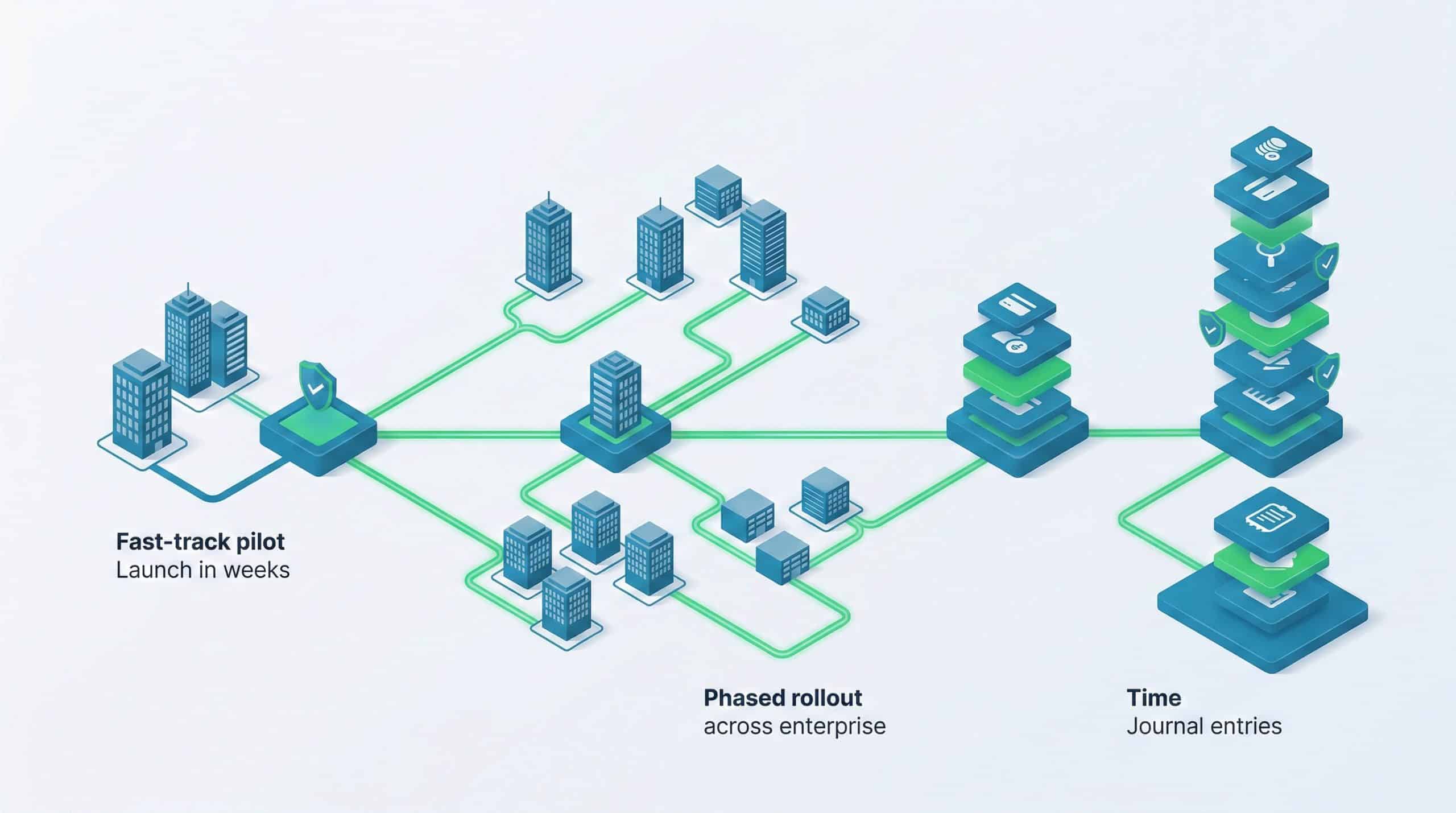
The recommended approach is to start with the processes that carry the highest fraud and error risk — supplier payments and bank-account changes are common first candidates — and then layer on additional controls (expenses, journal entries, intercompany) as the organization builds confidence. Groups that try to standardize everything at once often stall; groups that sequence by risk and value deliver measurable results faster. Detelix supports this phased model because it integrates as a layer above existing ERPs, meaning there is no need to re-implement or replace core systems before controls can be activated.
Did You Know
Organizations that adopt a phased deployment approach — starting with 2 to 3 entities and the procure-to-pay cycle — report an average 40 percent reduction in payment-related exceptions within the first 90 days. Full group-wide rollout typically follows within 6 months.
Choosing the Right Platform: A Practical Evaluation Framework
Not every solution labeled “multi-entity” delivers genuine group-wide enforcement. Some provide consolidated reporting but lack real-time alerting. Others offer dashboards but cannot block a risky transaction before it executes. When evaluating options, focus on enforcement capability, not just visibility.
Questions Worth Asking During a Demo
How do you define a global rule and apply it to all entities at once? How do you create a managed exception for a single entity without weakening the global standard? What does an alert look like in practice — who receives it, how fast, and what actions can they take directly from the alert? How do you prove enforcement during an external audit? And critically: how quickly can a newly acquired subsidiary be added to the platform?
The answers reveal whether the solution is a true governance layer or simply another reporting interface. The Israeli Civil Service Commission’s internal audit guidelines emphasize that effective controls require traceability, follow-up, and documented remediation — capabilities that should be native to any platform you select.
End-to-End Use Case: From Policy Definition to Audit-Ready Evidence
A typical deployment cycle looks like this. First, the group CFO and controllers define the Control Library — global rules for approval thresholds, SoD matrices, mandatory attachments, and vendor-verification requirements. Second, those rules are mapped to ERP processes across all entities, with managed exceptions documented for each subsidiary.
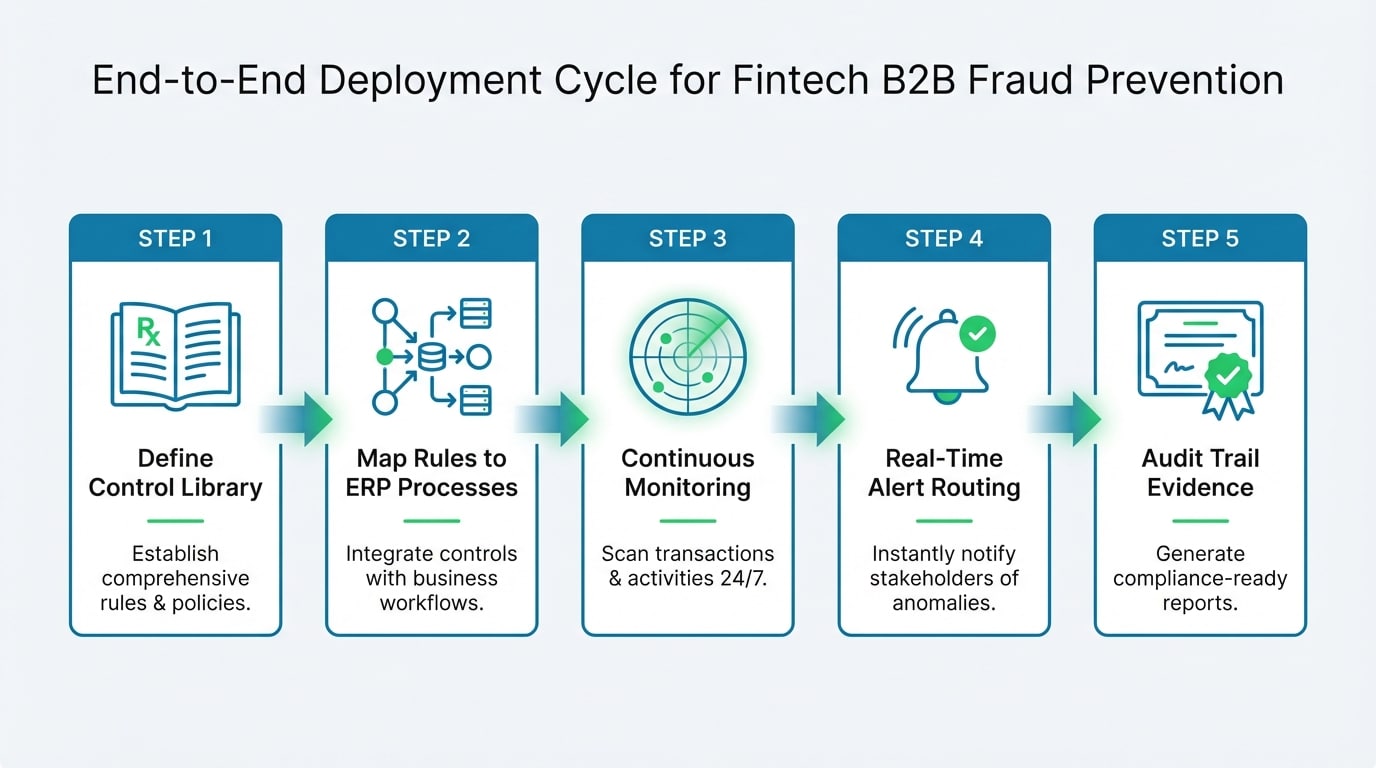
Third, the platform begins continuous monitoring: every transaction, every permission change, every vendor modification is scanned against the rule set. Fourth, real-time alerts route exceptions to the appropriate reviewer — local finance manager, group controller, or internal audit — depending on severity. Fifth, resolved and unresolved exceptions are logged with full audit trails, creating the evidence base that external auditors require.
The result is a control environment that operates continuously, not just at quarter-end, and that gives leadership confidence that the group’s financial processes are protected in real time.
Detelix Financial Controls Solutions

Proactive Monitoring
Continuous, automated scanning of every ERP transaction against your group-defined control rules — catching anomalies before they become losses.

Real-Time Alerts
Instant notifications routed to the right reviewer when policy deviations, SoD violations, or suspicious vendor activity are detected across any entity.

GateKeeper
Preventive enforcement that blocks risky transactions — such as payments to unverified vendors or SoD-conflicted approvals — before they execute.

Industry Experience
Deep expertise across banking, insurance, healthcare, and enterprise sectors — with pre-built control libraries tailored to each industry’s regulatory requirements.
See Detelix in Action
Frequently Asked Questions
Does a multi-entity finance controls platform replace the ERP?
No. It sits above existing ERP systems as a governance and enforcement layer. Each entity keeps its own ERP instance and workflows; the platform unifies the rules, monitors compliance, and provides group-level visibility without requiring a system migration.
Can the platform handle entities in different countries with different currencies?
Yes. A well-designed platform supports multi-currency transactions, local tax fields, and jurisdiction-specific regulatory requirements while maintaining a single set of group-wide control standards. Local variations are handled through managed exception profiles, not workarounds.
How does real-time alerting reduce fraud risk compared to periodic audits?
Periodic audits review a sample of past transactions — often weeks or months after the event. Real-time alerting flags suspicious activity the moment it occurs, giving the organization the opportunity to investigate and intervene before money leaves the company. The difference is prevention versus investigation.
What happens when a new subsidiary is acquired?
The new entity is onboarded to the platform by mapping its ERP data to the group’s Control Library. Global rules are applied immediately; local exceptions are configured during onboarding. Detelix is designed to integrate with new ERP environments rapidly, so the vision behind transforming control processes for financial managers includes scalability for growing groups.
Is segregation of duties enforced only within each entity or across the group?
Across the group. The platform evaluates role combinations at both the entity level and the cross-entity level, identifying conflicts that would be invisible if each subsidiary managed SoD independently.
What kind of audit evidence does the platform produce?
Every alert, resolution action, policy change, and exception approval is logged with timestamps, user identities, and supporting documentation. This creates a continuous, searchable audit trail that satisfies both internal audit requirements and external auditor expectations.
Ready to Unify Financial Controls Across Your Entire Group?
Stop relying on each subsidiary to self-report. Move from fragmented oversight to genuine, real-time group-wide governance — before the next risk becomes a loss.