Detect Insider Fraud Before It Costs You Millions
Detelix provides real-time occupational fraud detection across your ERP environment. Stop financial leakage at the source.
- What Is Occupational Fraud Detection and Why Does It Matter?
- How Does Occupational Fraud Differ from General Workplace Fraud Detection?
- Which Types of Occupational Fraud Appear Most Frequently?
- What Behavioral Red Flags Signal Fraud?
- Why Tips and Whistleblowing Channels Lead Detection
- Scenario: How a Fictitious Vendor Scheme Unfolds
- How Data Analytics Transforms Fraud Detection
- Preventive vs. Detective Controls
- How Segregation of Duties Reduces Fraud Risk
- Common Mistakes That Weaken Detection Programs
- Metrics and Tests for Detection Effectiveness
- How to Reduce False Positives Without Missing Real Fraud
- What Should Happen Once Fraud Is Suspected?
- How Continuous Monitoring Changes the Detection Timeline
- Mapping Business Needs to Detection Capabilities
- Frequently Asked Questions
Every organization operates with a certain degree of trust in its people. Employees are given access to systems, authority to approve transactions, and responsibility over sensitive financial processes. In most cases, that trust is well-placed. But when internal controls are weak, oversight is inconsistent, or processes rely too heavily on manual review, the door opens to occupational fraud — financial crime committed by the very people the organization depends on. Detecting it requires more than periodic audits or reactive investigations. It demands a structured, continuous approach that combines human awareness with data-driven technology. This article explains how occupational fraud detection works in practice, what warning signs to look for, and how to build a program that catches problems before they escalate into significant losses.
Key Takeaways
- Occupational fraud is perpetrated by insiders who exploit trusted access, making it fundamentally different from external threats and harder to detect with conventional perimeter controls.
- Tips and whistleblowing channels remain the single most effective detection method, uncovering roughly 43% of all fraud cases — nearly three times more than internal audits.
- Continuous real-time monitoring across ERP systems compresses the median detection timeline from over twelve months to days or even hours, dramatically reducing cumulative losses.
- Segregation of duties is not just a policy concept — it must be actively enforced within ERP systems with real-time conflict detection to prevent single-person control over sensitive transaction cycles.
- Reducing false positives requires better data quality, context-aware thresholds, and multi-indicator risk scoring rather than simply lowering alert volume.
What Is Occupational Fraud Detection and Why Does It Matter?
Occupational fraud detection is the systematic process of identifying signs that an employee, manager, or executive is exploiting their position within an organization for personal financial gain. Unlike external threats such as cyberattacks or third-party scams, occupational fraud originates from inside the organization — perpetrated by individuals who understand the processes, know where the controls are weak, and often have legitimate system access.
The concept is rooted in what fraud examiners call “The Fraud Triangle”: opportunity, pressure, and rationalization. When all three converge, even a trusted employee can become a threat. Industry research suggests that organizations lose approximately 5% of annual revenue to fraud, making detection not just a compliance concern but a direct protection of profitability. Building effective protection against embezzlement requires a dedicated strategy that combines people, process, and technology.
Tip
Map the Fraud Triangle to your own organization: identify which roles have the most opportunity (broad system access), which departments face the most financial pressure (tight budgets, performance targets), and where rationalization is easiest (weak tone from the top). This mapping exercise reveals your highest-risk areas before any data analysis begins.
How Does Occupational Fraud Differ from General Workplace Fraud Detection?
Workplace fraud detection is a broad term that covers any fraudulent activity occurring within or against a business environment. It can include external vendor scams, customer fraud, identity theft, or cyberattacks. Occupational fraud, by contrast, is narrower and more specific: it refers exclusively to cases where the perpetrator is an insider — someone who breaches their fiduciary duty by abusing the trust, access, or authority granted to them.
The detection methods differ accordingly. External fraud often relies on perimeter controls and cybersecurity tools. Employee occupational fraud requires monitoring internal behavior: transaction patterns, approval workflows, system overrides, and relationships between employees and vendors. This distinction matters because the same ERP system that protects against external threats may leave internal manipulation completely invisible.
Did You Know
According to the Association of Certified Fraud Examiners, the median loss caused by occupational fraud is $117,000 per case — but schemes perpetrated by owners or executives carry a median loss exceeding $459,000. The higher the authority, the greater the potential damage.
Which Types of Occupational Fraud Appear Most Frequently?
Asset Misappropriation
This is the most common category, present in nearly 89% of all reported cases. It includes cash theft, skimming, fraudulent expense reimbursements, payroll manipulation, and theft of inventory or supplies. While individual amounts may seem small, the cumulative damage over months or years can be substantial — especially when the perpetrator has learned how to avoid triggering standard controls.
Corruption and Conflict of Interest
Corruption schemes involve bribery, kickbacks, and undisclosed conflicts of interest — particularly in procurement. A purchasing manager who steers contracts to a vendor in exchange for personal payments is a classic example. These schemes are harder to detect through transaction data alone because the financial trail may appear legitimate on the surface.
Financial Statement Fraud
Though the least frequent, this type causes the greatest financial damage. It involves intentional misstatement of revenue, expenses, or asset values to deceive stakeholders. Detection typically requires a combination of analytical review, audit procedures, and attention to management behavior around reporting periods.
Tip
When building your detection program, allocate resources proportionally: asset misappropriation is the most frequent scheme type, but financial statement fraud causes losses that are orders of magnitude higher. Your monitoring rules should cover both the high-frequency, low-value patterns and the low-frequency, catastrophic scenarios.
What Behavioral Red Flags Signal That Someone May Be Committing Fraud?
Behavioral indicators are often the earliest clues. Employees living visibly beyond their means, displaying sudden financial difficulties, or maintaining an unusually close relationship with a specific vendor should raise questions. One particularly telling pattern is the employee who never takes vacation, insists on handling certain tasks alone, and resists any attempt to cross-train a colleague. This behavior often masks a scheme that would unravel the moment someone else reviews the process. While none of these signs constitute proof, they warrant closer examination — especially when they coincide with anomalies in the data.
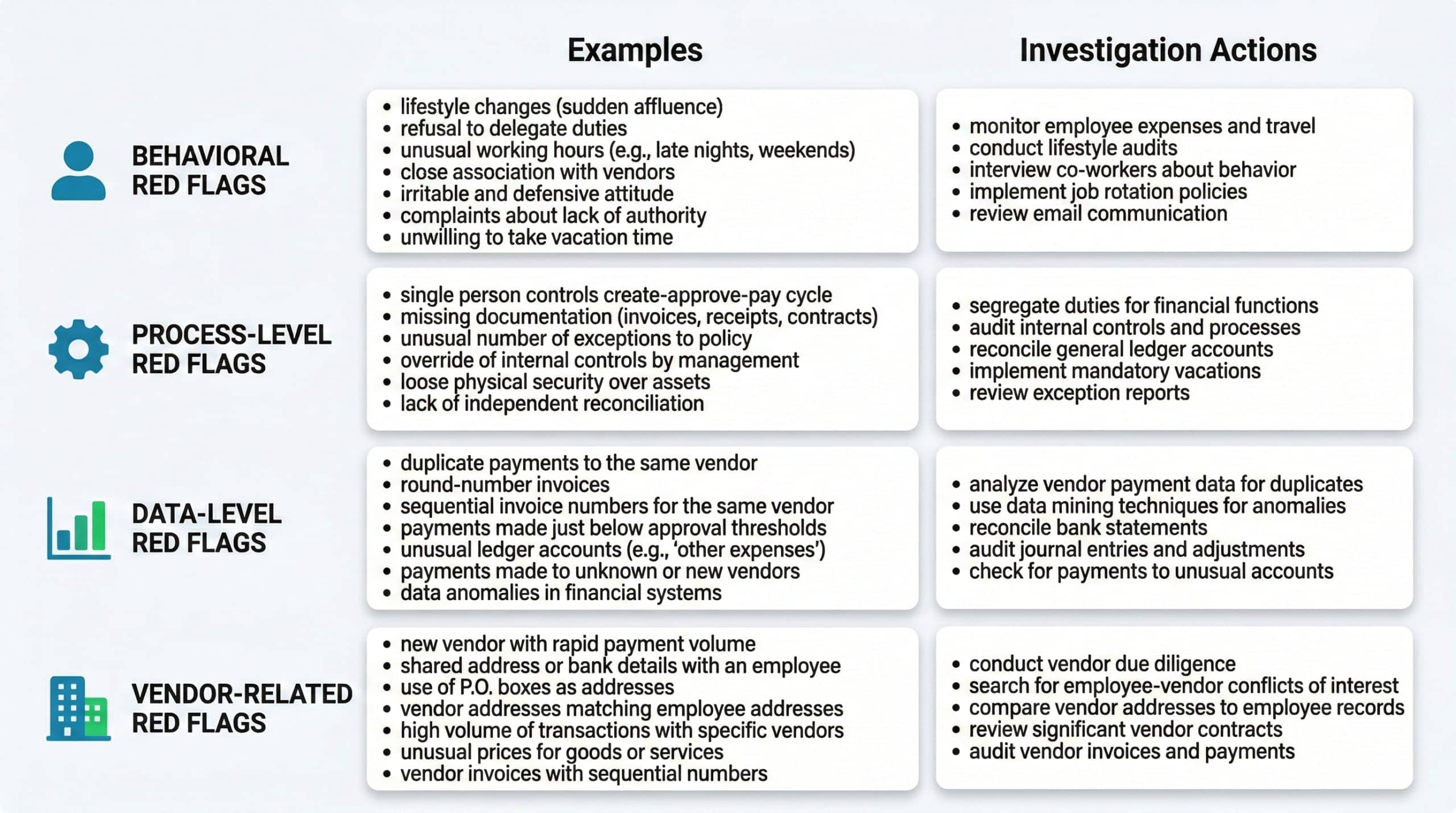
| Red Flag Category | Examples | What to Investigate |
|---|---|---|
| Behavioral | Lifestyle changes, refusal to delegate, working unusual hours alone | Compare access logs with transaction timing; review delegation history |
| Process-Level | One person controls create-approve-pay cycle; missing documentation | Map segregation of duties; check for override patterns |
| Data-Level | Duplicate payments, round-number invoices, sequential invoice numbers from different vendors | Run duplicate detection and Benford’s Law analysis on payment data |
| Vendor-Related | New vendor with rapid payment volume, shared address or bank details with employee | Cross-reference vendor master with employee records |
Did You Know
Benford’s Law — a mathematical principle about the expected distribution of leading digits in naturally occurring data sets — is one of the most reliable initial screening tools for detecting fabricated invoices and expense claims. Fraudsters who invent numbers tend to distribute digits more evenly than real-world data would produce.
Why Are Tips and Whistleblowing Channels Still the Leading Detection Method?
Despite significant advances in analytics and automation, tips from employees, vendors, and customers remain the single most effective way to detect occupational fraud. Research indicates that roughly 43% of all fraud cases are uncovered through tips — nearly three times more than any other method, including internal audits or management review. The reason is straightforward: people who work alongside the perpetrator often notice irregularities long before the data reflects them. A colleague may observe unexplained vendor visits, hear a suspicious phone conversation, or notice that certain invoices are always processed in a rush. The challenge is not the availability of information but whether the organization has created a channel and culture that encourages people to come forward.
Building Trust in the Reporting Channel
An anonymous hotline or online form is only effective if employees believe their reports will be taken seriously and that they will not face retaliation. Clear non-retaliation policies, visible leadership support, and periodic communication about the reporting process are essential. In Israel, the State Comptroller’s ombudsman office provides formal protections for whistleblowers in the public sector, reinforcing the principle that good-faith reporting deserves institutional backing. Organizations in the private sector should develop equivalent internal protections to encourage timely disclosure.
Tip
Promote your whistleblowing channel at least twice per year through all-hands meetings, internal newsletters, or mandatory training sessions. Organizations that actively communicate the existence and confidentiality of their reporting mechanism receive significantly more actionable tips than those that simply maintain a hotline without promotion.
A Scenario: How a Fictitious Vendor Scheme Unfolds Undetected
Consider a mid-size manufacturing company where the procurement manager has sole authority to onboard new vendors and approve purchase orders up to a certain threshold. Over six months, the manager creates a fictitious vendor, submits invoices for consulting services that were never rendered, and approves payments that route to a personal bank account. The invoices are just below the threshold requiring a second signature. The amounts are irregular enough to avoid pattern detection but consistent enough to accumulate over $200,000.
Because the same person controls vendor setup, purchase order approval, and invoice verification, there is no natural checkpoint in the process. This scenario illustrates why segregation of duties and continuous monitoring are not theoretical concepts — they are practical safeguards that prevent exactly this kind of damage.
Did You Know
Fictitious vendor schemes account for a significant share of all asset misappropriation cases. One of the most reliable detection tests is cross-referencing vendor master data — addresses, phone numbers, and bank account details — against the employee database. Matches or near-matches between vendor and employee records are a strong indicator of a shell company arrangement.
How Can Data Analytics Transform the Way Organizations Detect Occupational Fraud?
Traditional fraud detection relied on manual sampling — auditors reviewing a small percentage of transactions and hoping to find irregularities. Modern analytics flips this approach by enabling 100% transaction coverage. Every payment, every vendor change, every expense claim can be scanned against a set of rules, thresholds, and behavioral baselines.
Anomaly detection algorithms flag outliers: a vendor receiving payments far above the norm, an employee submitting expense reports at unusual times, or a pattern of split transactions designed to stay below approval limits. Platforms like Detelix take this further by operating in real time across ERP-driven processes, providing continuous visibility rather than periodic snapshots. When organizations use machine learning to monitor pricing and discounts, they can also detect revenue leakage that manual audits consistently miss.
Your ERP data already contains the signals that reveal insider fraud. The question is whether you can see them in time.
Detelix provides continuous, real-time monitoring that catches anomalies before they become losses.
Preventive vs. Detective Controls: What Is the Right Balance?
Preventive controls stop fraud from happening in the first place. Detective controls identify fraud that has already occurred or is in progress. Both are essential, and relying on one category alone creates dangerous gaps.
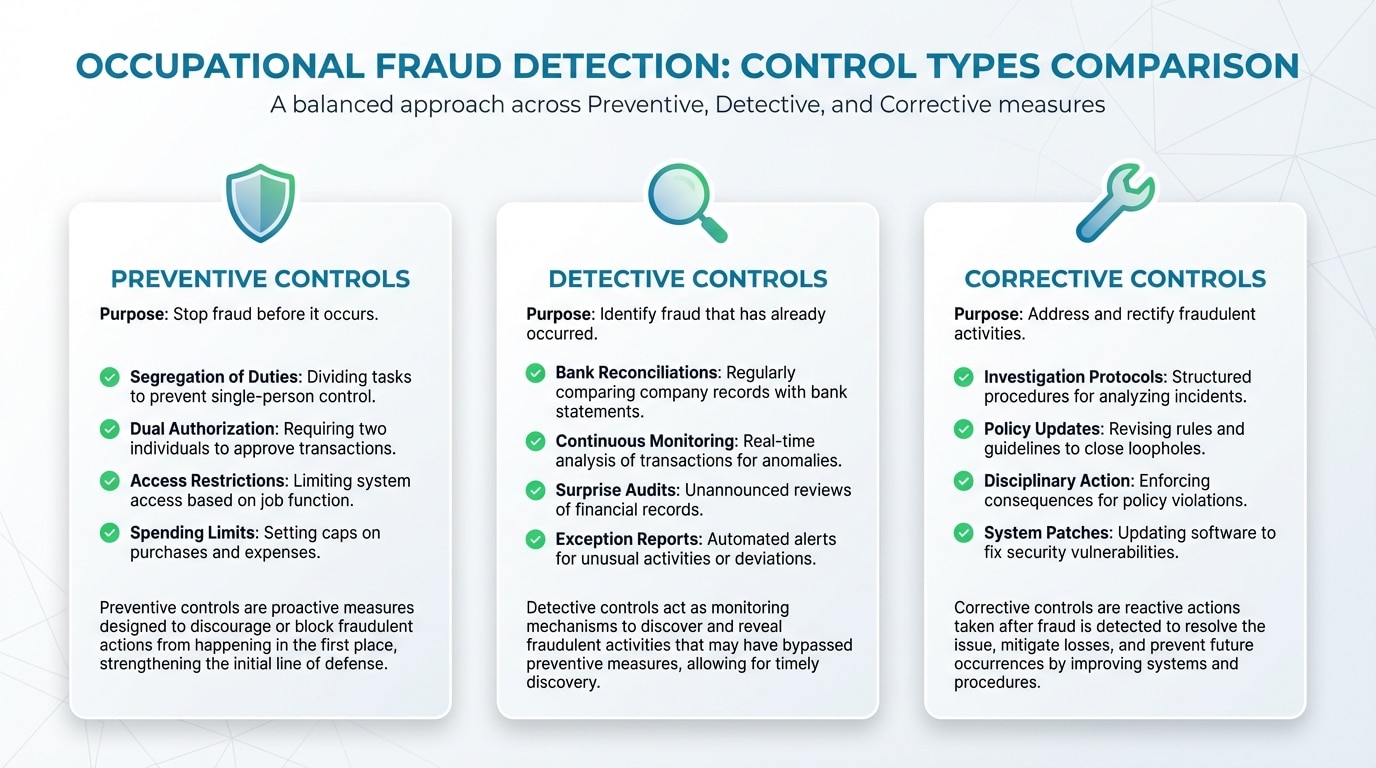
| Control Type | Purpose | Examples |
|---|---|---|
| Preventive | Reduce opportunity before a transaction occurs | Segregation of duties, dual authorization, access restrictions, spending limits |
| Detective | Identify irregularities during or after processing | Bank reconciliations, continuous monitoring, surprise audits, exception reports |
| Corrective | Respond and remediate after detection | Investigation protocols, policy updates, disciplinary action, system patches |
The key insight is that preventive controls handle the predictable risks — standard approval flows, access management, and policy enforcement. But sophisticated fraud, especially when it involves collusion or management override, requires detective controls that can spot what prevention missed. Organizations that invest in internal audit functions operating independently alongside real-time monitoring systems achieve far better coverage than those relying on either approach alone.
How Segregation of Duties Reduces Fraud Risk in Practice
The principle is simple: no single person should control two or more phases of a sensitive transaction. In the procure-to-pay cycle, this means separating who can add a new vendor, who approves purchase orders, who confirms receipt of goods, and who authorizes payment. When these roles overlap, a single individual can create a vendor, generate a fictitious purchase order, confirm delivery of goods that never arrived, and approve payment — all without anyone else reviewing the process.
Effective segregation of duties requires not just policy documentation but active enforcement within the ERP system. This includes monitoring for SoD conflicts, flagging users with excessive permissions, and reviewing override activity. Detelix provides organizations with real-time cross-checking of role assignments and transaction flows, making it possible to identify SoD violations as they occur rather than discovering them during an annual audit cycle.
Did You Know
In a study of organizations with fewer than 100 employees, the median fraud loss was significantly higher than in larger organizations — precisely because smaller companies tend to have fewer segregation of duties controls. A single employee wearing multiple hats is convenient operationally but creates exactly the kind of concentrated access that fraud schemes exploit.
Common Mistakes That Weaken an Occupational Fraud Detection Program
Even organizations with formal anti-fraud policies often make errors that undermine their effectiveness. One frequent mistake is treating fraud detection as solely an audit function rather than an organizational responsibility. When detection is confined to quarterly reviews, months of damage can accumulate unnoticed.
Another common error is failing to update detection rules as the business evolves — new product lines, new vendor relationships, or changes in payment methods can all create control gaps that existing rules do not cover. A third mistake is ignoring low-value anomalies. Many significant fraud schemes begin with small “test” transactions designed to see whether controls will catch them. When those early signals are dismissed, the perpetrator gains confidence and escalates.
Finally, over-reliance on a single detection method — whether tips, audits, or analytics — creates blind spots that sophisticated fraudsters learn to exploit.
Tip
Schedule a quarterly review of your detection rules and thresholds. Every time the business adds a new payment channel, onboards a significant vendor, or restructures a department, ask whether the existing monitoring logic still covers the updated process. Detection rules that were accurate six months ago may be obsolete today.
Which Metrics and Tests Indicate Whether Your Detection Program Is Actually Working?
Measuring the effectiveness of a fraud detection program is as important as running one. Without metrics, there is no way to distinguish between a program that catches fraud early and one that simply has not been tested.
Key performance indicators include: median time from scheme inception to detection, the ratio of tips received to investigations opened, the percentage of alerts confirmed as genuine issues versus false positives, and the financial recovery rate on confirmed cases. Surprise audits and unannounced data reviews serve as practical tests of whether controls are functioning. Organizations should also track how many SoD conflicts exist in the ERP at any given time, how quickly they are resolved, and whether override activity is trending upward.
According to official audit findings on local government entities, the use of targeted data analytics to focus on high-risk transactions significantly improves audit precision compared to random sampling alone.
Tip
Track your false positive rate monthly, not just annually. If the rate exceeds 80%, your detection rules need recalibration — not more analyst headcount. A high false positive rate erodes investigator confidence and delays response to genuine threats.
How to Reduce False Positives Without Missing Real Fraud
Alert fatigue is one of the most serious operational risks in any detection program. When internal audit teams receive hundreds of alerts per week — most of which turn out to be legitimate transactions — they inevitably begin treating all alerts with lower urgency. The result is that genuine fraud signals get buried.
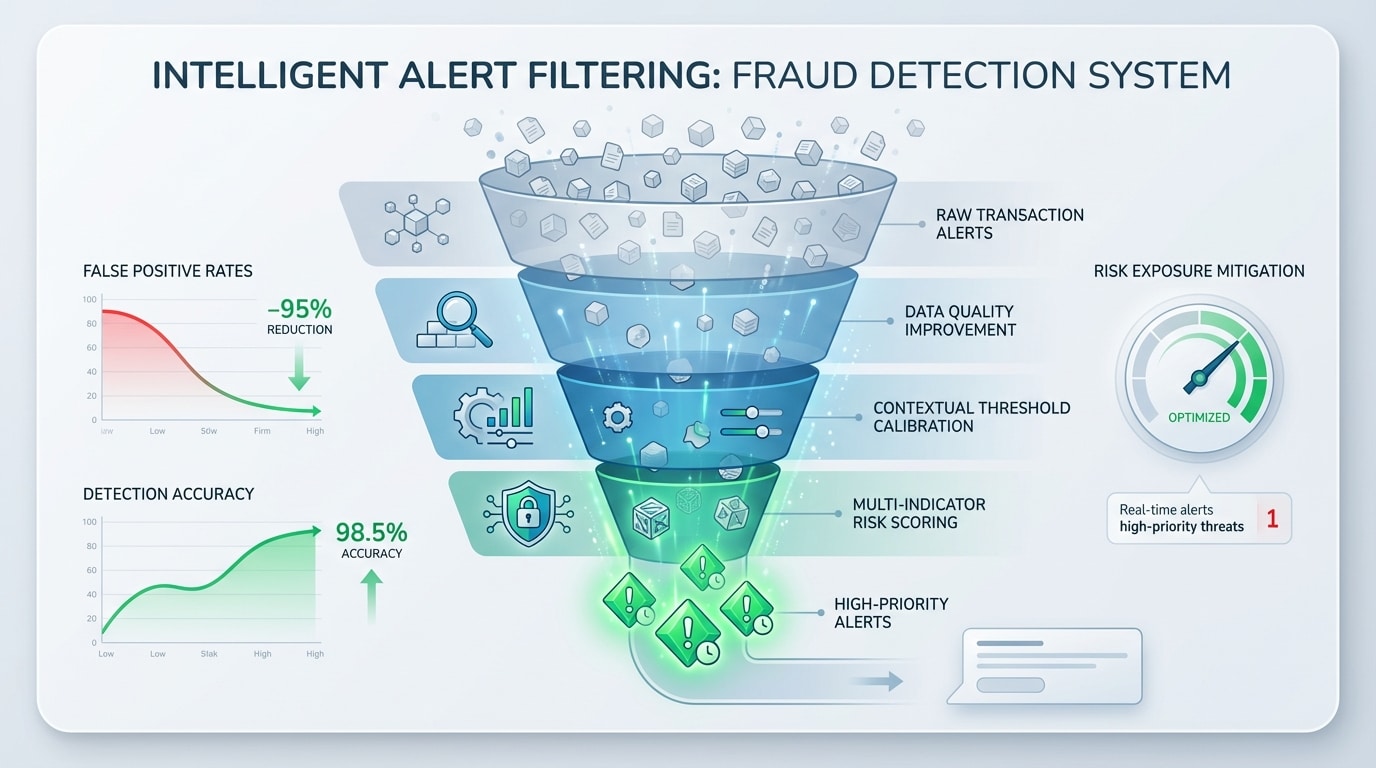
Reducing false positives requires several coordinated actions. First, improve data quality: incomplete or outdated vendor records, duplicate entries, and inconsistent naming conventions generate noise that obscures real anomalies. Second, calibrate thresholds by context — what constitutes an unusual payment in one business unit may be routine in another. Third, implement risk scoring that assigns higher priority to alerts combining multiple indicators: a behavioral red flag plus a financial anomaly plus a control gap should rank far above an isolated data outlier.
Detelix addresses this challenge by layering contextual intelligence into its alerting engine, enabling teams to focus their investigation time on the alerts most likely to represent actual risk.
Did You Know
Organizations that implement multi-indicator risk scoring — combining behavioral, transactional, and access-based signals into a single alert priority — report up to a 60% reduction in false positives while simultaneously improving their detection rate for genuine fraud cases.
What Should Happen Once a Suspicion of Fraud Arises?
Securing Evidence Immediately
The first priority is preserving the digital trail. This means locking relevant system access, capturing transaction logs, and ensuring that no data can be altered or deleted. Speed matters because perpetrators who sense they are under scrutiny may attempt to cover their tracks by modifying records or destroying documentation.
Maintaining Confidentiality Throughout the Process
Investigations should operate on a strict need-to-know basis. Premature disclosure can alert the suspect, compromise evidence, cause reputational harm, or create legal liability for the organization. Only the investigation lead, legal counsel, and designated senior management should be informed until findings are confirmed.
Coordinating Legal and HR Involvement
Every investigation must comply with local labor laws, data protection regulations, and evidentiary standards. In Israel, for example, the process must respect employee rights while building a case that would be admissible if the matter proceeds to legal action. Early coordination between internal audit, legal, and human resources ensures that the investigation is both thorough and defensible.
Tip
Prepare an investigation playbook before you need it. Document who leads the investigation, who must be notified, how digital evidence is preserved, and which external resources (forensic accountants, legal counsel) are on standby. When a fraud suspicion arises, the first 48 hours are critical — and that is not the time to be designing your process from scratch.
How Continuous Monitoring Changes the Detection Timeline
One of the most damaging statistics in occupational fraud is the median duration of a scheme before detection. Without continuous monitoring, the typical fraud scheme runs for twelve months or longer before it is discovered — by which point the cumulative financial loss can be severe.
Continuous monitoring compresses this timeline dramatically. By scanning every transaction against predefined rules and behavioral baselines as it occurs, organizations can detect anomalies within days or even hours rather than months. The deterrence effect is equally important: when employees know that every action is subject to real-time review, the perceived risk of committing fraud increases significantly.
This shift — from periodic, sample-based auditing to continuous, full-coverage monitoring — represents one of the most impactful changes an organization can make to its fraud defense posture. Detelix operates as an organizational gatekeeper within this model, providing finance and operations leaders with the visibility to know what is happening right now, not only after the quarterly report.
Did You Know
Organizations with proactive, continuous monitoring detect fraud schemes at a median duration of roughly 6 months — half the time compared to organizations relying solely on passive detection methods. The financial impact scales proportionally: shorter detection times mean significantly smaller cumulative losses.
Mapping Business Needs to Practical Detection Capabilities
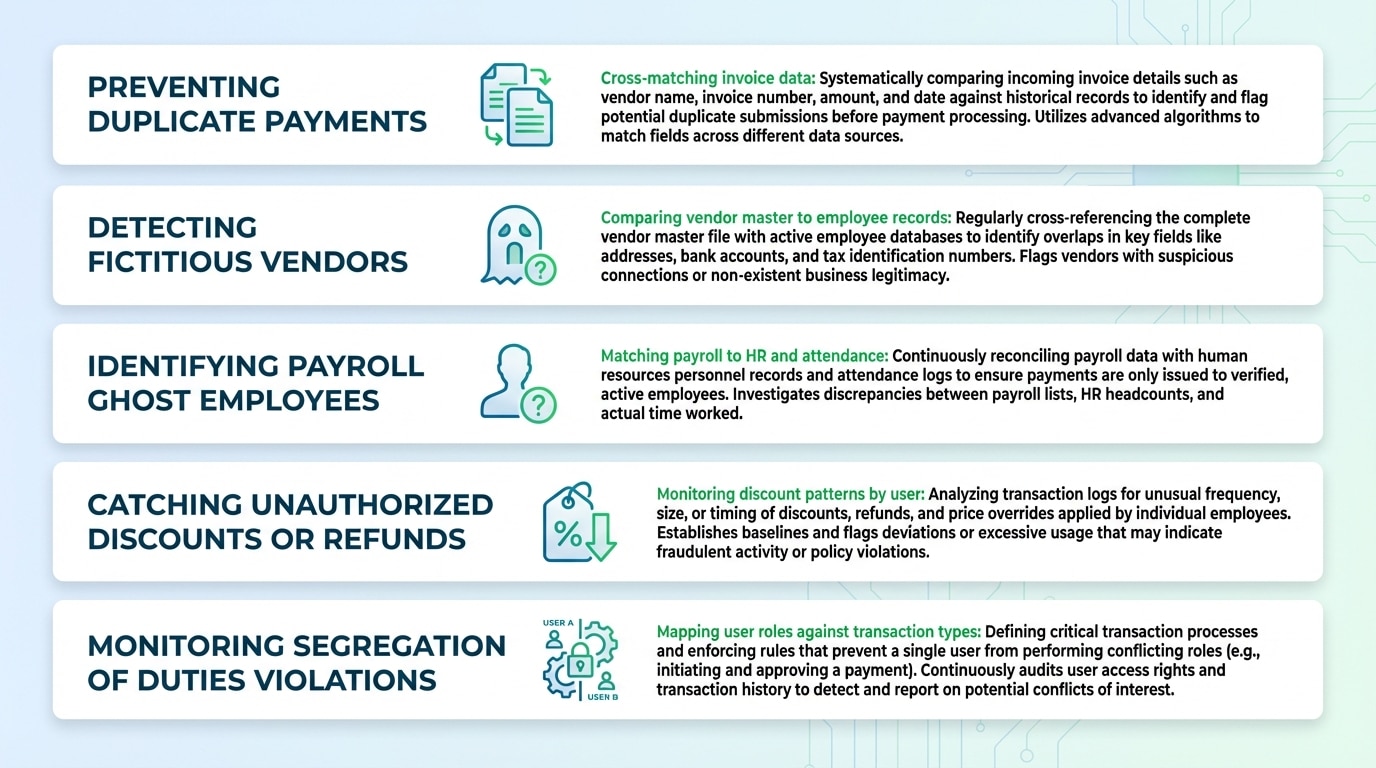
| Business Need | Detection Approach | How Real-Time Platforms Help |
|---|---|---|
| Preventing duplicate payments to vendors | Cross-matching invoice numbers, amounts, dates, and bank details | Automated scanning of every payment run before execution, flagging matches instantly |
| Detecting fictitious vendors | Comparing vendor master data against employee records (address, phone, bank account) | Continuous cross-referencing with alerts on any overlap |
| Identifying payroll ghost employees | Matching payroll records to HR onboarding, access logs, and attendance systems | Real-time reconciliation that flags employees without corresponding activity |
| Catching unauthorized discounts or refunds | Monitoring discount patterns by user, customer, and time period | Anomaly detection that compares each transaction to baseline behavior |
| Monitoring segregation of duties violations | Mapping user roles against transaction types to identify conflicts | Continuous SoD analysis with escalation for high-risk combinations |
Is your organization confident that its current controls would catch an insider scheme before significant damage occurs? If you want to move from periodic reviews to real-time visibility over your most sensitive financial processes, the team at Detelix can help you understand where your gaps are and how to close them. Reach out to start a conversation about building stronger, more responsive fraud detection across your ERP environment.
Detelix Fraud Prevention Solutions

Proactive Monitoring
Continuous surveillance of ERP transactions to detect anomalies, policy violations, and suspicious patterns before they escalate into losses.
Learn More
Real-Time Alerts
Instant notifications when high-risk transactions occur, enabling finance and audit teams to respond within minutes rather than months.
Learn More
Gatekeeper
Automated enforcement of segregation of duties, approval workflows, and access controls directly within your ERP environment.
Learn More
Experience
Decades of domain expertise in financial process integrity, delivered through a platform built by fraud prevention specialists.
Learn MoreSee Detelix in Action
Frequently Asked Questions
Can occupational fraud be detected without a dedicated technology platform?
It can — through manual audits, tip lines, and management review. However, manual methods cover only a fraction of transactions and typically detect fraud much later, resulting in higher losses. Technology platforms enable full transaction coverage and significantly reduce detection time.
How long does it typically take to detect occupational fraud without continuous monitoring?
Industry data consistently shows that the median duration of a fraud scheme before detection exceeds twelve months when organizations rely solely on periodic audits. Continuous monitoring can reduce this to weeks or even days, depending on the sophistication of the detection rules.
Is occupational fraud detection only relevant for large corporations?
No. In fact, smaller organizations often suffer proportionally greater losses because they tend to have fewer internal controls and less segregation of duties. A single trusted employee with broad access can cause outsized damage in a small or mid-size company.
What role does management play in an effective fraud detection program?
Management sets the tone. When leadership visibly supports ethical behavior, funds adequate controls, and responds decisively to confirmed fraud, it creates an environment where detection programs can function effectively. Conversely, when management treats fraud prevention as a checkbox exercise, control gaps tend to widen over time.
How should an organization handle a fraud case involving a senior executive?
Cases involving senior executives require independent oversight — typically through the board of directors, an external forensic team, or legal counsel operating outside the normal reporting chain. The usual internal investigation process may be compromised when the suspect has authority over the people who would normally conduct the review.
Ready to Close the Gaps in Your Fraud Detection?
Move from periodic audits to continuous, real-time visibility across every financial process. Detelix helps you detect insider threats before they become significant losses.