Automate Your SOX Compliance With Confidence
Replace spreadsheets and manual evidence chasing with a structured, auditor-ready compliance platform. Talk to Detelix today.
- What Is SOX Compliance Automation Software?
- Why Are Organizations Moving From Manual Spreadsheets?
- How Does SOX 404 Automation Accelerate the Audit Cycle?
- Core Features of Professional SOX Audit Software
- How to Automate SOX Evidence Collection
- Managing ITGC vs. Process Controls
- Generating Auditor-Ready Working Papers
- Key Criteria for Selecting SOX Compliance Automation Software
- Typical Implementation Timeline
- Benefits for Pre-IPO and High-Growth Firms
- Measuring ROI: Time Savings, Cost Reduction, and Risk Mitigation
- Future-Proofing Your Compliance
- Frequently Asked Questions
For many organizations subject to the Sarbanes-Oxley Act, the annual compliance cycle still feels like an endurance test. Teams chase documents through email threads, reconcile spreadsheet versions late into the quarter, and scramble to assemble evidence binders days before the external auditor arrives. The controls themselves may be well designed, but the process of proving they work often relies on manual labor that introduces the very risks SOX was created to prevent: human error, inconsistent documentation, and gaps in traceability. SOX compliance automation software exists to close that gap, replacing reactive paperwork with a structured, auditable digital environment that gives finance leaders real control over every stage of the compliance lifecycle.
Key Takeaways
- SOX compliance automation software digitizes the entire compliance lifecycle, from risk assessment and control mapping through evidence collection, testing, issue tracking, and reporting.
- Automated platforms reduce audit-cycle bottlenecks by 30-50% through structured PBC requests, roll-forward test plans, and real-time status dashboards.
- Immutable audit trails and version-controlled evidence satisfy PCAOB requirements more consistently than manual spreadsheet-based processes.
- Continuous monitoring capabilities, such as those provided by Detelix, extend compliance beyond periodic testing to detect anomalies and control failures in real time.
- Pre-IPO and high-growth firms benefit disproportionately by building compliant control environments before compliance debt accumulates.
- Selecting the right platform requires evaluating traceability, role-based access, ERP integration, and user adoption, not just feature lists.
What Is SOX Compliance Automation Software?
SOX compliance automation software is a purpose-built platform that digitizes the end-to-end Sarbanes-Oxley compliance process. Instead of managing control inventories in static files, organizations use a centralized system for risk assessment, control mapping, evidence collection, testing, issue tracking, and reporting. The SEC’s Section 404 guide makes clear that management must evaluate internal controls over financial reporting (ICFR) using a recognized framework, maintain adequate documentation, and provide reasonable assurance of effectiveness. Automation platforms translate those requirements into repeatable digital workflows.
Tip
Before evaluating any SOX automation platform, map your current control inventory to the specific ICFR assertions each control addresses. A clean, assertion-level mapping accelerates implementation by weeks and ensures the platform reflects your actual control environment from day one.
What sets automated SOX compliance apart from generic project-management tools is traceability. Every action, including who uploaded a document, who approved a test result, and when a status changed, is logged in an immutable audit trail. This shifts the compliance function from reactive tracking to proactive management, giving controllers and internal auditors visibility into progress and risk at any point in the cycle. Platforms like Detelix extend this visibility further by providing real-time monitoring of sensitive ERP-driven processes, ensuring that the controls being tested actually reflect what is happening in production systems.
Why Are Organizations Moving From Manual Spreadsheets to Automated SOX Compliance?
Spreadsheets served their purpose in the early years of Sarbanes-Oxley compliance, but they were never designed to manage a multi-stakeholder process with hundreds of controls, strict deadlines, and regulatory scrutiny. Version-control failures alone can undermine an entire testing cycle: when two analysts update the same workbook simultaneously, one set of results can silently overwrite the other. Add to that the hours spent chasing stakeholders for signatures, re-requesting evidence that was “already sent,” and reconciling conflicting status updates, and the hidden cost of manual compliance becomes significant.
Did You Know
According to compliance industry surveys, organizations managing SOX programs manually spend an average of 40-60% of total compliance hours on administrative tasks like evidence collection, status tracking, and document formatting rather than on substantive control evaluation.
The SEC’s interpretive guidance (Release 33-8810) encourages a top-down, risk-based approach to ICFR evaluation, an approach that demands clear prioritization, consistent documentation, and the ability to demonstrate how management arrived at its conclusions. Automated SOX compliance platforms deliver exactly that: a single version of the truth, role-based access to sensitive data, and structured workflows that enforce consistency without slowing teams down.
How Does SOX 404 Automation Accelerate the Audit Cycle?
Audit cycles typically slow down at three predictable bottlenecks: test-plan creation, evidence collection, and working-paper assembly. SOX 404 automation addresses each of these by replacing ad-hoc coordination with structured, trackable workflows. When a test plan is generated from a pre-configured control library, assignments are pushed to owners automatically, and dashboards show managers which controls are on track, which are overdue, and where bottlenecks are forming before they delay the entire engagement.
Streamlining Test-Plan Documentation
Instead of rebuilding test programs from scratch each year, SOX audit software allows teams to roll forward prior-year plans, adjust scope based on risk changes, and distribute assignments with built-in deadlines and reminders. Templates standardize the format of each test so that every control owner documents objectives, populations, sample sizes, and results in the same way. This consistency reduces the back-and-forth that typically occurs when external auditors receive inconsistent documentation across business units.
Tip
When rolling forward prior-year test plans, schedule a 30-minute risk-change review with each process owner before re-distributing assignments. This brief checkpoint catches organizational changes, system migrations, or new regulatory requirements that might invalidate last year’s testing approach.
Real-Time Tracking of Control Effectiveness
The shift from after-the-fact status reports to live dashboards fundamentally changes how SOX program managers operate. Rather than compiling a weekly status email from dozens of individual updates, they can see completion rates, exception counts, and open remediation items in real time. When a control test reveals an exception, the system can trigger an issue-management workflow immediately, ensuring that remediation begins while context is still fresh, not weeks later during a retrospective review.
What Are the Core Features of Professional SOX Audit Software?
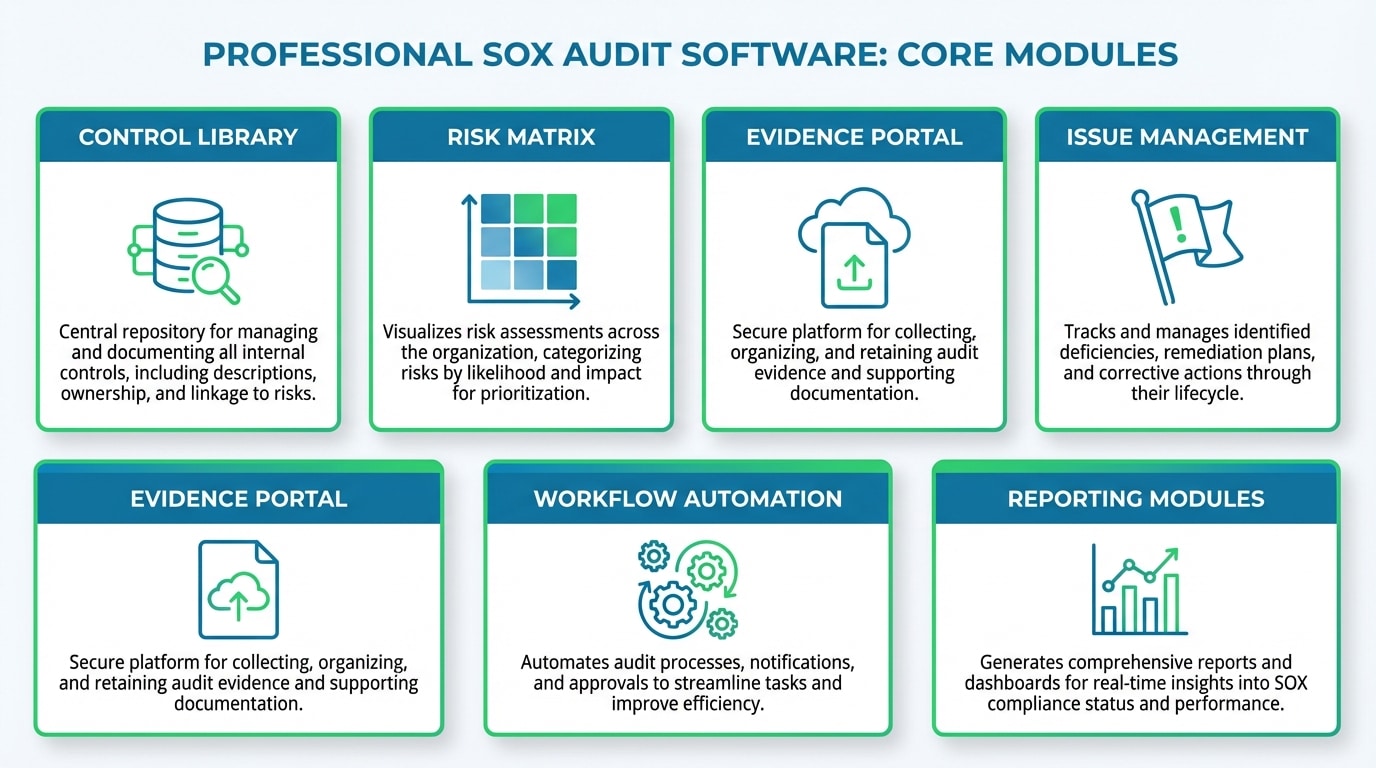
A mature SOX audit software platform typically includes several interconnected modules. A Control Library serves as the single repository of all controls, mapped to specific SOX compliance requirements, risk areas, and financial-statement assertions. A Risk Matrix helps prioritize testing efforts based on likelihood and impact. An Evidence Portal manages document submission, version control, and approval workflows. Issue Management tracks exceptions from identification through remediation and re-testing.
Did You Know
Organizations that implement centralized control libraries with assertion-level mapping report up to 35% fewer auditor rework requests compared to those maintaining controls across distributed spreadsheets and shared drives.
Workflow automation is the connective tissue: tasks are assigned with clear owners, due dates, and escalation paths. Automated reminders reduce the need for manual follow-up. Reporting modules generate executive dashboards and auditor-ready exports, so leadership and external auditors receive consistent, well-structured information without requiring the compliance team to build custom reports each cycle.
How to Automate SOX Evidence Collection Without Losing Traceability
Evidence collection is where most SOX programs lose the most time and where traceability matters most. PCAOB Auditing Standard No. 15 defines what constitutes sufficient and appropriate audit evidence, making it clear that documentation must be reliable, relevant, and tied directly to the control being tested. Automated SOX compliance platforms operationalize these requirements by building evidence management into every step of the testing workflow.
Automating PBC (Provided by Client) Requests
Rather than sending individual emails to each control owner, the system generates structured PBC requests with clear descriptions of what is needed, the relevant testing period, and a submission deadline. Owners upload directly into the platform, and the system timestamps and logs every submission. Late or incomplete items trigger automatic reminders, and program managers can see a real-time view of outstanding requests across all business units.
Tip
Configure PBC request templates with explicit file-naming conventions and format requirements (PDF, Excel, screenshots with timestamps). This prevents the most common evidence rejection reason: improperly formatted or unlabeled documents that require re-submission.
Ensuring Data Integrity and Version Control
Once evidence is submitted and linked to a specific control test, the platform locks the version to prevent unauthorized modification. Any subsequent changes generate a new version with a full change log. This immutability is not just a technical feature. It is a direct response to auditor expectations. When an external auditor can see exactly who uploaded a document, when it was received, and that it has not been altered since, the review process accelerates and confidence in the evidence increases.
Managing ITGC vs. Process Controls in a Digital Environment
Information Technology General Controls (ITGC) and business process controls require fundamentally different types of evidence and testing approaches. ITGC, covering access management, change management, and IT operations, relies on system-generated logs, user-access reports, and change tickets. Business process controls, such as three-way matching in procurement or journal-entry approvals, require financial documents, workflow screenshots, and sign-off records.
Did You Know
The NIST SP 800-92 guide on log management recommends that organizations retain system logs for a minimum period aligned with regulatory requirements and establish automated mechanisms for log integrity verification, both of which are core capabilities of modern SOX automation platforms.
Effective SOX compliance automation software accommodates both. For ITGC, the platform may integrate with identity-management systems or ERP logs to pull access reviews automatically. The NIST SP 800-92 guide on log management provides best-practice principles for collecting, retaining, and analyzing system logs, principles that a well-configured automation tool should reflect. For process controls, the same platform manages document-based evidence with approval chains, linking each piece of evidence to the specific control, testing period, and tester responsible. Detelix adds value here by continuously monitoring ERP transactions in real time, which means the evidence of control effectiveness is not limited to periodic samples but reflects actual operational behavior throughout the year.
Managing hundreds of SOX controls across ITGC and business processes? See how Detelix combines structured compliance workflows with real-time ERP monitoring to eliminate evidence gaps.
Can You Generate Auditor-Ready Working Papers Automatically?
Yes, provided the system captures the right data points at every stage. External auditors expect working papers that clearly state the test objective, the population and sample, the testing methodology, the results (including any exceptions), and the reviewer’s sign-off. SOX audit software assembles this information from data already captured during the testing workflow, producing standardized exports that auditors can review without requesting supplementary explanations.
This matters because a significant portion of audit overruns comes from rework: the auditor asks for clarification, the team digs through files, a new version is produced, and the cycle repeats. When working papers are generated from a structured platform with full traceability, as required by PCAOB AS 2201, the auditor receives everything needed in a consistent format, reducing questions and accelerating the review.
Tip
Share a sample working-paper export from your chosen platform with your external auditor before the first testing cycle. Early alignment on format, level of detail, and cross-referencing conventions prevents a wave of rework requests during the review phase.
Key Criteria for Selecting SOX Compliance Automation Software
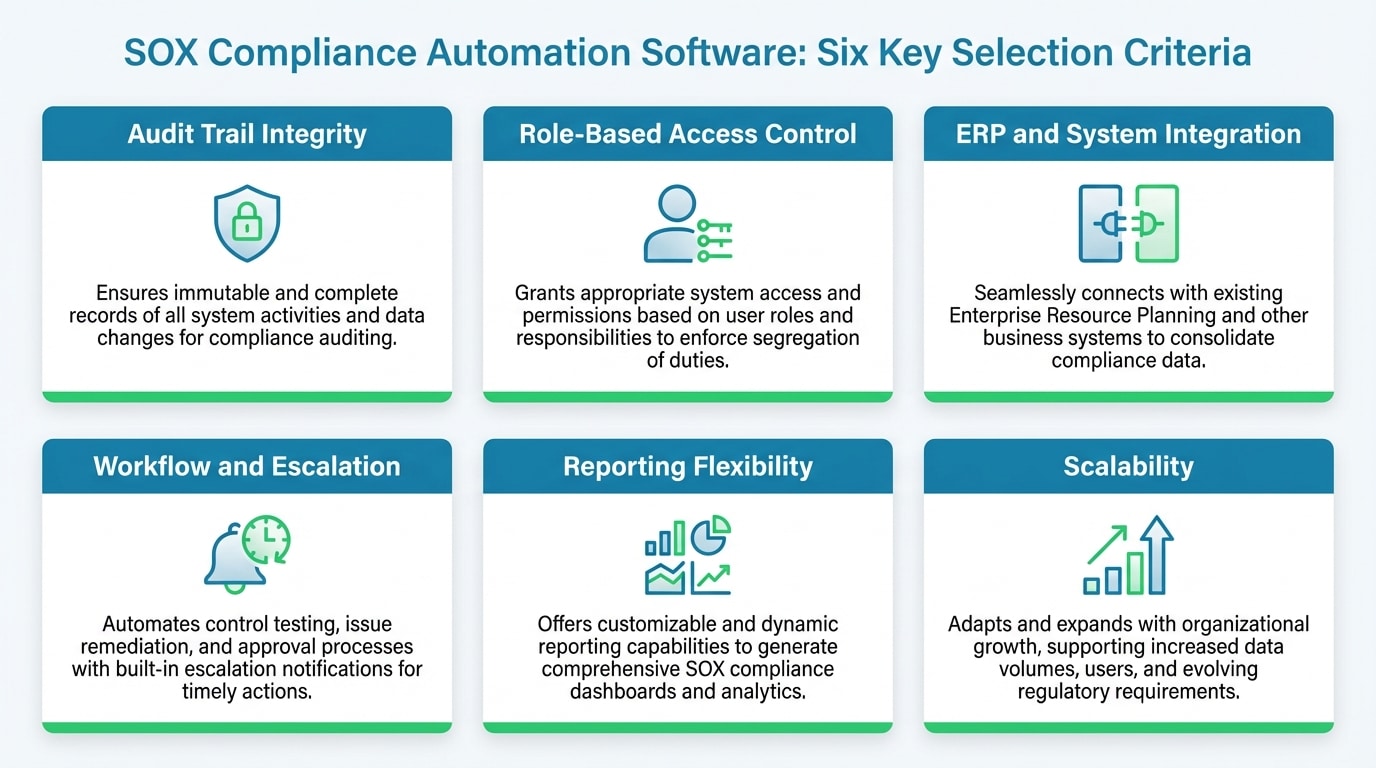
Choosing the right platform is not simply a matter of feature comparison. The decision should reflect how well the tool fits your organization’s specific control environment, team structure, and growth trajectory. Below is a practical framework for evaluation.
| Criterion | Why It Matters | What to Look For |
|---|---|---|
| Audit Trail Integrity | Auditors require proof that evidence and results have not been altered | Immutable logs with timestamps, user IDs, and action descriptions |
| Role-Based Access Control | Segregation of duties must extend to the compliance tool itself | Granular permissions aligned with the NIST RBAC model |
| ERP and System Integration | Manual data extraction defeats the purpose of automation | Pre-built connectors or APIs for major ERP and identity platforms |
| Workflow and Escalation | Deadlines slip without automated reminders and escalation paths | Configurable workflows with SLA tracking and notifications |
| Reporting Flexibility | Different stakeholders need different views | Executive dashboards, auditor export packs, and drill-down capability |
| Scalability | Control counts grow with the business | Ability to add entities, controls, and users without re-implementation |
Balancing Functionality With User Adoption
A powerful tool that no one uses is worse than a spreadsheet. Look for intuitive interfaces, clear task queues for control owners, and a minimal learning curve for non-finance participants who need to upload evidence or respond to PBC requests. Pilot testing with a cross-functional group, not just the SOX team, reveals adoption risks early.
Did You Know
Studies on enterprise software adoption show that platforms requiring more than two hours of training for non-core users see a 40% drop in on-time evidence submissions compared to tools with self-service onboarding. User adoption is a compliance risk in itself.
Technical Security and Data Privacy Requirements
Because the platform stores sensitive financial evidence, it must meet enterprise-grade security standards: encryption at rest and in transit, multi-factor authentication, and detailed access logs. Detelix, for example, integrates security and control monitoring into the same operational layer, so the compliance tool itself operates under the same rigor it is designed to enforce.
What Is the Typical Implementation Timeline for SOX Automation?
Implementation timelines vary, but most organizations move from initial configuration to a working pilot in four to eight weeks, with full rollout completing within one to three months depending on the number of controls, entities, and integrations. The key accelerator is preparation: organizations that enter the implementation with a clean control inventory, defined ownership, and a documented PBC list move significantly faster than those that must build these from scratch.
Tip
Start your pilot with 15-25 controls that span both ITGC and process areas, and include at least two business units. This cross-sectional approach exposes integration challenges, permission issues, and workflow gaps early, before they affect the broader rollout.
A phased approach reduces risk. Start with a pilot covering 15-25 representative controls across ITGC and process areas. Validate the workflow, evidence-collection process, and working-paper output. Then expand to remaining controls in planned waves, incorporating feedback from the pilot group. This approach also gives the external auditor early visibility into the platform, reducing surprises during the year-end review.
Does Automation Benefit Pre-IPO Companies and High-Growth Firms?
Perhaps even more than it benefits mature public companies. The SEC’s Release 33-8760 details ICFR requirements for newly public companies, and the reality is that building a compliant control environment under time pressure, while simultaneously scaling operations, is extraordinarily difficult without a structured platform. Organizations that adopt automated SOX compliance early avoid accumulating “compliance debt”: undocumented controls, inconsistent evidence, and ad-hoc processes that become exponentially harder to fix as the company grows.
Did You Know
Pre-IPO companies that implement structured SOX compliance platforms before their first filing year report 50% fewer material weakness findings in their initial audit compared to organizations that attempt to retroactively document controls using spreadsheets during the IPO process.
Technology allows the compliance function to scale without proportional headcount increases. Instead of hiring additional analysts to manage a growing control population, the platform absorbs administrative overhead, sending reminders, tracking statuses, enforcing deadlines, so the team can focus on judgment-intensive work like risk assessment and exception analysis.
Measuring ROI: Time Savings, Cost Reduction, and Risk Mitigation
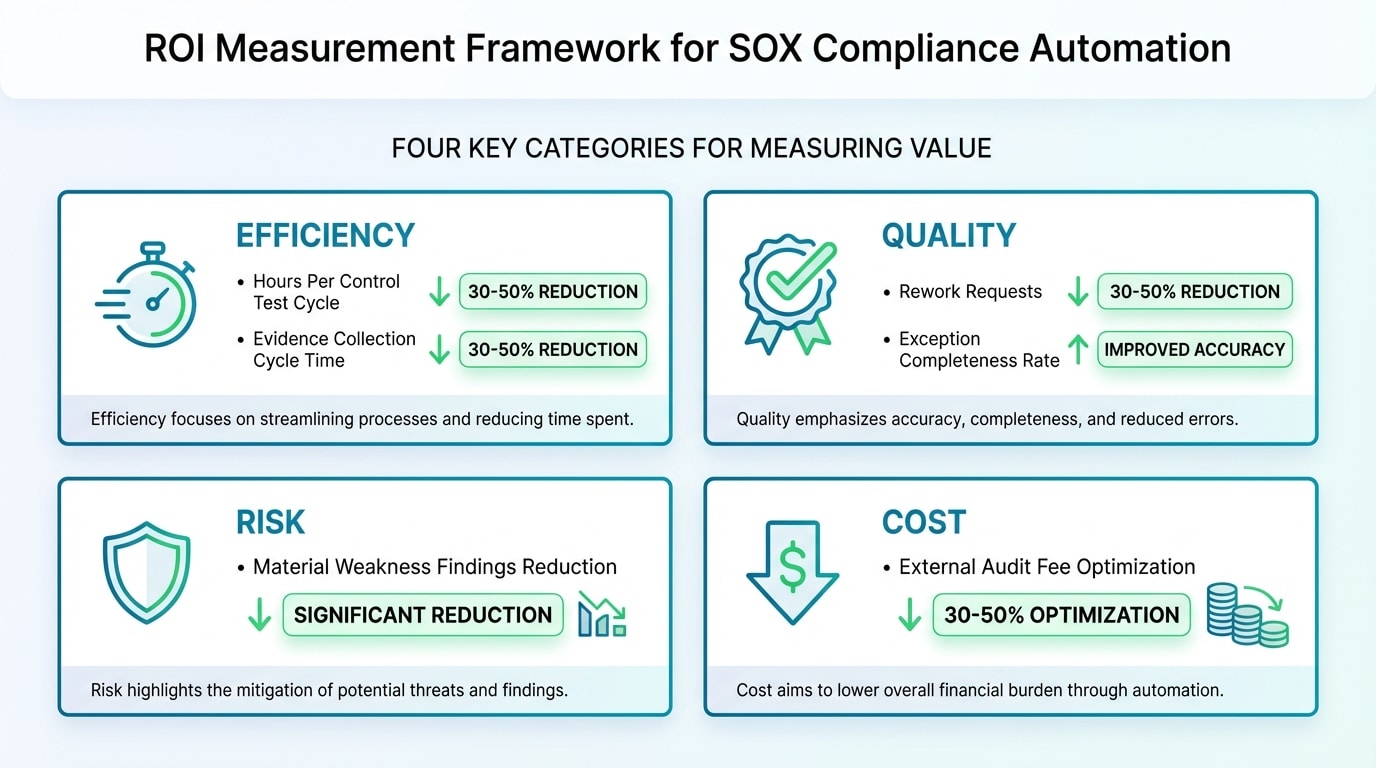
Quantifying the return on SOX compliance automation software requires looking at three categories: efficiency, quality, and risk. The table below provides a practical measurement framework.
| ROI Category | Metric | How Automation Improves It |
|---|---|---|
| Efficiency | Hours per control test cycle | Automated PBC, templates, and roll-forward reduce manual effort by 30-50% |
| Efficiency | Evidence collection cycle time | Structured requests with deadlines cut collection time significantly |
| Quality | Rework requests from external auditor | Standardized working papers and full traceability reduce clarification loops |
| Quality | Exception completeness rate | Automated issue tracking ensures no exception is lost or unresolved |
| Risk | Material weakness or significant deficiency findings | Consistent documentation reduces risk of findings caused by incomplete evidence |
| Cost | External audit fees | Auditor-ready outputs and fewer rework cycles can lower fees over time |
Tip
Establish baseline measurements for hours per control test, evidence collection cycle time, and auditor rework requests before implementing automation. Without a pre-automation benchmark, it becomes difficult to quantify the ROI that leadership and the audit committee expect to see.
The strategic value extends beyond annual savings. A well-documented, auditable compliance process strengthens investor confidence, supports favorable audit opinions, and positions the organization for smoother regulatory interactions over time.
Future-Proofing Your Compliance: Continuous Monitoring and Scalability
Regulatory expectations evolve, and so do the risks organizations face. The most forward-looking compliance programs are moving beyond periodic testing toward continuous monitoring, where controls are validated not once a quarter but in real time, as transactions flow through business systems. This is where platforms like Detelix deliver a distinct advantage: by combining SOX compliance workflows with continuous, real-time monitoring of ERP processes, the platform allows organizations to detect anomalies, policy deviations, and control failures as they occur, not months later during a scheduled test.
Did You Know
Organizations using continuous monitoring report detecting control exceptions an average of 47 days earlier than those relying on quarterly testing cycles. Earlier detection dramatically reduces remediation costs and prevents exceptions from compounding into material weaknesses.
Scalability matters equally. As organizations expand into new markets, add entities, or adopt new ERP modules, the compliance platform must absorb that growth without requiring a full re-implementation. The ability to add controls, map new processes, and onboard additional users within the existing framework ensures that compliance keeps pace with the business rather than becoming a bottleneck.
Detelix Compliance and Monitoring Solutions

Proactive Monitoring
Continuous, automated monitoring of ERP transactions and business processes to detect anomalies and control deviations before they escalate.

Real-Time Alerts
Instant notifications when suspicious activities or policy violations are detected, enabling rapid response and reducing control gaps.

GateKeeper
Preventive controls that block unauthorized or high-risk transactions at the point of entry, enforcing segregation of duties and approval workflows.

Industry Experience
Deep domain expertise across healthcare, finance, manufacturing, and government sectors, with pre-built control libraries tailored to industry regulations.
See Detelix in Action
Frequently Asked Questions
Does automated SOX compliance replace the internal audit or SOX team?
No. Automation handles repetitive, administrative tasks such as sending reminders, logging evidence, and generating reports so that skilled professionals can focus on risk assessment, judgment calls, and exception analysis. The team remains essential; the tool amplifies their effectiveness.
Can evidence collected automatically be accepted by external auditors?
Yes, provided the evidence meets the standards of sufficiency and appropriateness defined by PCAOB auditing standards. Automated platforms that maintain immutable audit trails, version control, and clear linkage between evidence and controls typically satisfy auditor requirements more consistently than manual processes.
How does SOX automation handle changes in control design mid-year?
Most platforms allow you to version controls: the original design is preserved for the period it was effective, and the updated control is documented with its own evidence and testing from the change date forward. This ensures that both the auditor and management have a clear timeline of what was in place and when.
Is SOX compliance automation software relevant only for U.S.-listed companies?
While SOX is a U.S. regulatory requirement, many organizations adopt similar internal-control frameworks voluntarily, especially those preparing for an IPO, dual-listed companies, or subsidiaries of U.S. public entities. The structured approach to control documentation and testing is valuable regardless of jurisdiction.
What is the biggest mistake organizations make when selecting SOX software?
Prioritizing user-interface aesthetics over traceability and audit-readiness. A visually appealing dashboard means little if the platform cannot produce working papers with full provenance, maintain an immutable audit trail, or enforce role-based access that satisfies segregation-of-duties requirements.
Ready to Move From Routine to Real Control?
Stop managing SOX compliance through scattered spreadsheets and email chains. Discover how Detelix combines structured automation with real-time ERP monitoring to give you genuine visibility into control effectiveness.