Take Control of Your Vendor Master Data
Automated governance, real-time monitoring, and fraud prevention for every supplier record in your ERP. Talk to Detelix today.
- What Is Vendor Master Data Governance and How Does It Differ from Data Management?
- Why Is Governance Critical for Payments, Compliance, and Fraud Prevention?
- How Do Vendor Master Data Controls Work Inside an Organization?
- A Scenario: What Happens When Bank Details Change Without Governance?
- Which Fields Deserve the Highest Protection?
- Automated Validation: Check Data Quality Without Overloading Your Team
- Preventing Duplicate Vendors at the Point of Creation
- Common Mistakes Organizations Make When Governing Vendor Data
- Building Vendor Onboarding Controls Based on Risk Tiers
- Why Real-Time Monitoring Changes the Equation
- Red Flags Worth Configuring on Day One
- Real-Time Versus Batch Processing: When Does Each Approach Fit?
- Measuring Success: KPIs That Connect Data Quality to Business Outcomes
- Designing a Change Management Workflow That Does Not Create Bottlenecks
- How to Choose the Right Vendor Master Data Governance Software
- What Does a Realistic Implementation Timeline Look Like?
- Frequently Asked Questions
Every organization that pays suppliers depends on the accuracy of its vendor master file. A single wrong bank account number, an undetected duplicate record, or an unauthorized change to payment terms can translate directly into financial loss, compliance violations, or fraud exposure. Vendor master data governance software provides the structured rules, automated controls, and continuous monitoring needed to keep this critical data accurate, consistent, and secure throughout its lifecycle. Without a deliberate governance layer, even well-intentioned teams find themselves relying on manual checks that inevitably break down as transaction volumes grow and ERP environments become more complex.
Key Takeaways
- Vendor master data governance goes beyond centralized storage by enforcing policies, approval workflows, and validation rules that prevent unauthorized or erroneous changes.
- Real-time monitoring of sensitive fields such as bank accounts, payment terms, and vendor status catches fraud attempts and process errors within minutes rather than weeks.
- Risk-based tiering of vendors allows organizations to apply proportionate controls, keeping onboarding efficient for low-risk suppliers while scrutinizing high-risk records.
- Duplicate vendor records, ghost vendors, and unauthorized bank detail changes are the three most costly governance failures, all preventable through automated controls.
- Measurable KPIs for data quality, risk events, and operational efficiency connect governance efforts directly to business outcomes and audit readiness.
What Is Vendor Master Data Governance and How Does It Differ from Data Management?
The distinction matters more than most organizations realize. Vendor master data management focuses on creating a single, unified record for every supplier—often called a “Golden Record”—and synchronizing it across systems. Governance, on the other hand, is the set of policies, roles, approval workflows, and enforcement mechanisms that determine who can create or change a record, what validation rules apply, and how exceptions are handled. You can have a beautifully centralized master file and still suffer from unauthorized changes, missing tax IDs, or duplicate vendors if no governance discipline sits on top of it.
The ISO 8000-110:2021 standard reinforces this point by defining conformance requirements for exchanging characteristic data—emphasizing that quality is not just about storage but about rules that travel with the data across organizational boundaries.
Tip
When evaluating your current vendor data practices, ask a simple question: can you name the person who approved every bank account change made in the last 90 days? If the answer is no, you have a management system but not a governance system.
Why Is Governance Critical for Payments, Compliance, and Fraud Prevention?
Vendor master data sits at the intersection of procurement, accounts payable, and treasury. When this data is wrong, the consequences cascade quickly: payments land in the wrong account, duplicate invoices get paid twice, tax reporting mismatches trigger regulatory penalties, and fraudsters exploit gaps to redirect funds. Consider a common scenario—an employee or external attacker changes a supplier’s bank details shortly before a payment run. Without governance controls that flag and require dual approval for that change, the payment goes out to a fraudulent account, and recovery is unlikely.
Which Risk Scenarios Appear Most Frequently?
Three patterns dominate. First, duplicate vendor creation that leads to split spending data and duplicate payments. Second, changes to sensitive fields—bank account, payment terms, tax ID—without proper authorization or verification. Third, “ghost vendors” or shell suppliers created by insiders to siphon funds. Each pattern is preventable with the right governance controls, but manual spreadsheet reviews rarely catch them in time.
Did You Know
Organizations commonly discover duplicate rates between 5% and 15% when they first run a comprehensive scan of their vendor master file. Each duplicate creates a potential pathway for duplicate payments, making deduplication one of the highest-ROI governance activities.
How Do Vendor Master Data Controls Work Inside an Organization?
Effective controls combine preventive and detective mechanisms. Preventive controls block or restrict actions at the point of entry—for example, requiring a tax ID before a vendor record can be activated, or enforcing dual approval before a bank account change takes effect. Detective controls monitor activity after it occurs, flagging anomalies for review. Both types depend on a clear audit trail that records who changed what, when, and why.
The Israel State Comptroller’s 2024 report on information security in collection systems underscores the importance of automatic logging and monitoring mechanisms, role-based access control, and the avoidance of generic user accounts—principles that apply directly to vendor data governance.
| Control Type | Purpose | Example |
|---|---|---|
| Preventive – Field Validation | Block incomplete or incorrectly formatted records | Reject a vendor without a valid tax ID or IBAN |
| Preventive – Dual Approval | Require a second authorized user for sensitive changes | Bank account change needs finance manager sign-off |
| Preventive – Segregation of Duties | Ensure the person who creates a vendor cannot also approve payments | Separate roles for master data steward and AP clerk |
| Detective – Real-Time Alert | Flag suspicious patterns as they happen | Alert when a new vendor shares a bank account with an employee |
| Detective – Periodic Scan | Identify data decay, dormant vendors, or emerging duplicates | Weekly duplicate-detection sweep across the full vendor file |
Tip
Map your existing controls against both the preventive and detective categories. Most organizations discover they are heavily weighted toward detective controls (after-the-fact audits) and underinvested in preventive controls that stop errors before they enter the system.
A Scenario: What Happens When Bank Details Change Without Governance?
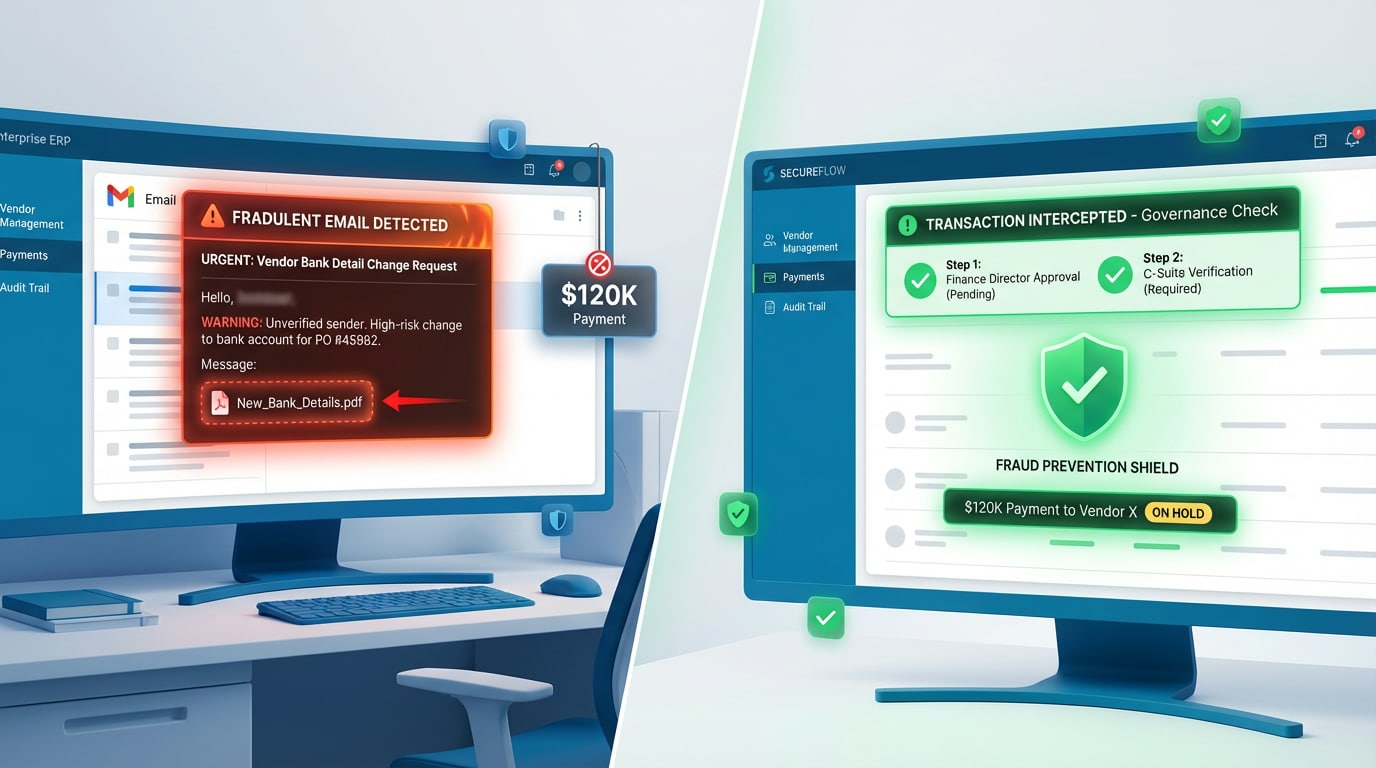
Imagine a mid-size manufacturer with 4,000 active suppliers. A procurement clerk receives an email—apparently from a long-standing vendor—requesting updated bank details. The clerk updates the record in the ERP, and two days later a scheduled payment of $120,000 goes to the new account. It takes three weeks for the real vendor to complain about non-payment. By then, the money is gone.
With governance software in place, the change would have triggered an automatic hold, a notification to the finance team, and a requirement to verify the new account against an independent source before the record became active. Israel’s National Insurance Institute, for instance, explicitly requires that bank account changes be verified against bank records before any payment is processed—a principle every organization should adopt for its own vendor file.
Did You Know
Business email compromise (BEC) schemes targeting vendor bank account changes accounted for over $2.9 billion in reported losses in 2023 according to the FBI’s Internet Crime Report. A single fraudulent bank detail change can exceed the annual cost of a governance platform.
Which Fields in the Vendor Master File Deserve the Highest Protection?
Not every field carries equal risk. Organizations should classify fields into sensitivity tiers and apply controls accordingly. The highest-risk fields are those that directly affect where money goes, how much is paid, and the legal identity of the counterparty. These include bank account and routing numbers, payment terms and methods, tax identification numbers, legal entity name, and the vendor’s active/blocked status. Changes to any of these fields should require a documented reason, a second approval, and ideally an automated cross-check before the new value takes effect.
Tip
Create a formal “sensitive fields register” and review it annually. As your business processes evolve—new payment methods, new regulatory requirements, new ERP modules—the list of fields requiring heightened governance will change too.
Automated Validation: How to Check Data Quality Without Overloading Your Team
Manual validation does not scale. When a procurement team handles hundreds of vendor updates each month, expecting line-by-line review is unrealistic. Vendor master data governance software applies validation rules automatically—checking format compliance (is the IBAN the right length for the country?), logical consistency (does the country code match the currency?), and completeness (are all mandatory fields populated?).
The ISO 8000-140:2016 standard on master data completeness treats data completeness as a measurable quality property, which means organizations can set targets, track progress, and hold data stewards accountable.
Format Checks Versus Business Logic Checks
Format checks catch structural errors—wrong character count in a tax ID, letters in a numeric field, or missing country codes. Business logic checks go deeper: does this vendor’s payment term match the contract? Is the discount percentage within policy limits? Has this vendor been flagged in a sanctions list? Combining both layers dramatically reduces the number of errors that reach the payment stage.
Did You Know
The ISO 8000 series of standards defines master data quality as a measurable, auditable property rather than a subjective judgment. This means organizations can benchmark their vendor data quality against internationally recognized criteria and demonstrate compliance to auditors and regulators.
Preventing Duplicate Vendors at the Point of Creation
Duplicates are one of the most expensive data quality problems in any vendor file. They fragment spending data, create opportunities for duplicate payments, and weaken negotiating leverage. Effective governance software uses fuzzy matching algorithms that compare new entries against existing records on multiple identifiers—name, address, tax ID, bank account—and flag potential matches even when spelling varies or abbreviations differ.
When a partial match is detected, the system routes the request to a data steward for review rather than silently creating a new record. Organizations that cleanse and secure vendor master data before deploying governance rules often discover duplicate rates between 5% and 15% in their existing files.
Concerned about hidden duplicates, unauthorized changes, or gaps in your vendor master file? Detelix delivers real-time monitoring and automated controls that protect every sensitive field.
Common Mistakes Organizations Make When Governing Vendor Data
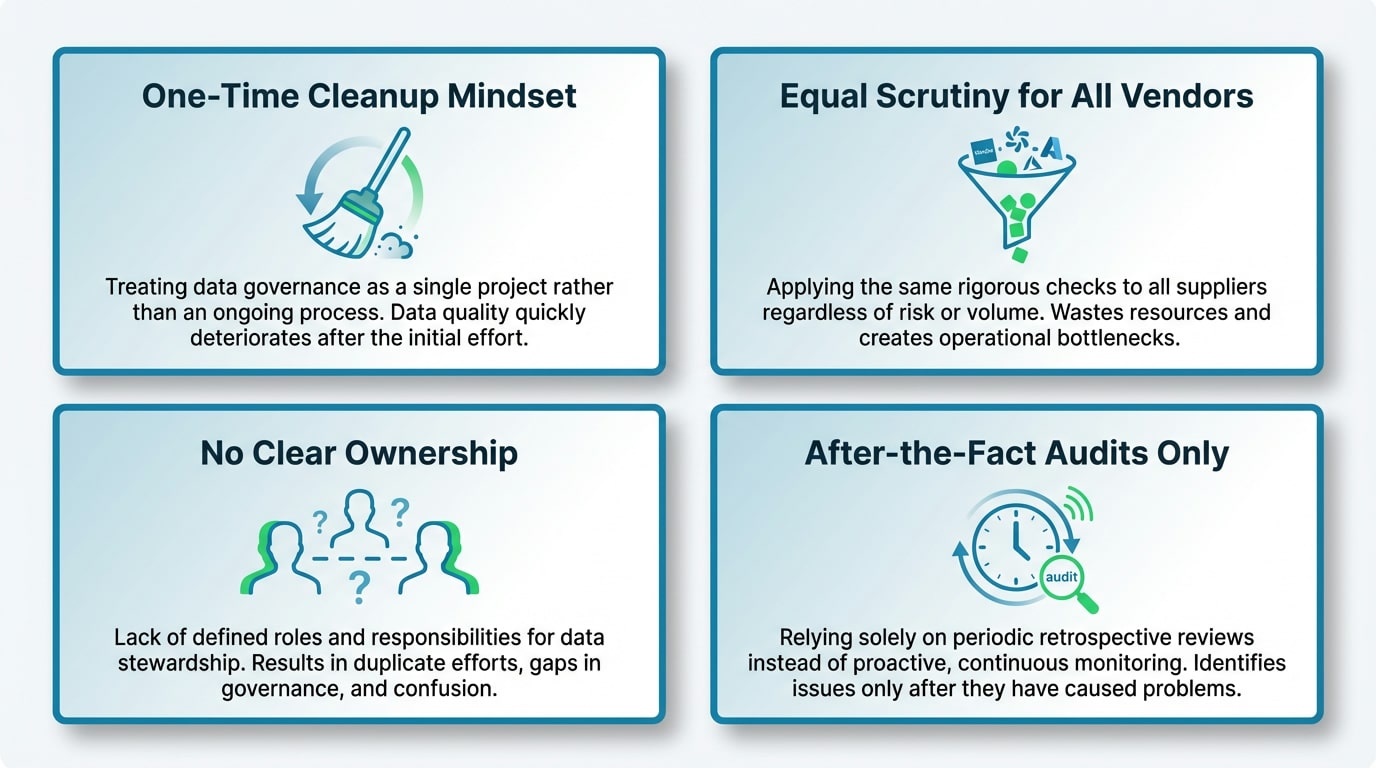
The first mistake is treating governance as a one-time cleanup project rather than an ongoing discipline. Data quality degrades continuously—vendors change addresses, merge, or go bankrupt. The second mistake is applying the same level of scrutiny to every vendor, which overwhelms approval queues and creates bottlenecks. A risk-based tiering approach solves this.
The third mistake is failing to assign clear ownership: when procurement, finance, and IT all assume someone else is responsible, nobody governs effectively. And the fourth is relying on after-the-fact audits instead of real-time controls, which means problems are discovered only after money has already left the organization.
Tip
Assign a single data steward or governance committee with explicit authority over the vendor master file. Document accountability in a RACI matrix so that every stakeholder—procurement, finance, IT, compliance—knows exactly who is responsible, accountable, consulted, and informed for each governance activity.
Building Vendor Onboarding Controls Based on Risk Tiers
Not every supplier requires the same vetting intensity. A strategic vendor supplying critical raw materials at millions of dollars per year warrants a thorough onboarding process including site visits, financial health checks, and executive approval. A one-time office supply vendor does not. Risk-based tiering classifies vendors into categories—typically low, medium, and high—and applies proportionate controls.
| Risk Tier | Typical Criteria | Onboarding Requirements |
|---|---|---|
| High | Annual spend above threshold; access to sensitive data; sole-source | Dual approval, bank verification, tax certificate, compliance screening, contract review |
| Medium | Moderate spend; recurring relationship; standard goods/services | Single approval with data steward review, automated tax ID check, duplicate scan |
| Low | One-time or low-value purchase; commoditized service | Automated validation only; flagged for periodic review if reactivated |
This tiered approach keeps the process efficient for low-risk vendors while ensuring that high-risk records receive the scrutiny they deserve.
Did You Know
Organizations that implement risk-based vendor tiering typically reduce their approval queue backlogs by 40% to 60% because low-risk records flow through automated validation without manual intervention, freeing data stewards to focus on the records that actually warrant scrutiny.
Why Real-Time Monitoring Changes the Equation
Governance rules define what should happen. Real-time vendor data monitoring verifies what actually happens—continuously. Every create, change, or delete event in the vendor master file generates a signal that can be evaluated against predefined rules. When a change violates policy or matches a known fraud pattern, the system generates an alert with full context: which field changed, from what value to what value, who made the change, and what related transactions exist.
This is the difference between reviewing a quarterly audit report and knowing, within minutes, that a sensitive change just occurred. Detelix provides this real-time monitoring capability across ERP-driven processes, enabling finance and control teams to detect irregular activity as it happens rather than weeks or months after the fact.
Red Flags Worth Configuring on Day One
When implementing real-time vendor data monitoring, certain rules deliver immediate value. A vendor and an employee sharing the same bank account is a high-priority alert. Multiple vendors registered at the same address—especially a residential one—warrant investigation. A bank account change occurring within 48 hours of a large payment run is a classic fraud indicator. A newly created vendor receiving an invoice on the same day suggests either a process bypass or a fictitious vendor scheme.
Configuring these red flags from the start establishes a baseline of protection. The key to avoiding alert fatigue is combining specificity (narrow conditions) with severity scoring (not every alert is equally urgent). Detelix’s approach of cross-checking events against behavioral patterns helps teams focus on genuinely suspicious activity rather than drowning in false positives.
Tip
Start with five to seven high-confidence rules rather than deploying dozens of alerts simultaneously. Tune thresholds based on your first 30 days of data, then gradually expand coverage. This approach builds trust in the system and prevents the alert fatigue that undermines monitoring programs.
Real-Time Versus Batch Processing: When Does Each Approach Fit?
Organizations often ask whether they need real-time monitoring or whether periodic batch scans are sufficient. The answer depends on the risk profile of the event. Sensitive field changes—bank account, payment terms, vendor status—should be monitored in real time because the window between change and payment can be very short.
Broader data quality tasks—standardizing address formats, identifying dormant vendors, enriching records with external data—are well suited to batch processing on a daily or weekly schedule. Most mature governance programs run a hybrid model: real-time alerts for high-risk events, batch scans for housekeeping, and periodic deep reviews for strategic analysis.
Did You Know
The average time between a fraudulent bank account change and the next payment run is often less than 72 hours. Batch processing that runs weekly leaves a window of exposure measured in days—long enough for a fraudulent payment to clear and become unrecoverable.
Measuring Success: KPIs That Connect Data Quality to Business Outcomes
Governance without measurement is guesswork. The ISO 8000-63:2019 framework for data quality process measurement provides a structured approach: define goals, formulate questions, select metrics, and track them consistently. For vendor master data, practical KPIs fall into three categories.
Data quality KPIs include the percentage of vendor records with complete mandatory fields, the duplicate rate (number of suspected duplicates per 1,000 records), and the rate of records failing validation rules. Risk and control KPIs track the number of sensitive field changes requiring approval, the average time to resolve flagged alerts, and the number of blocked or rejected changes. Operational KPIs measure vendor onboarding cycle time, the backlog in approval queues, and the number of payment rejections caused by incorrect vendor data.
Establishing a baseline before implementation and reviewing trends monthly gives leadership clear evidence of improvement—or early warning that governance is slipping.

Tip
Include at least one “business impact” KPI in your governance dashboard, such as the dollar value of duplicate payments prevented or the number of payment rejections avoided. These metrics translate data quality improvements into language that resonates with executive leadership and budget decision-makers.
Designing a Change Management Workflow That Does Not Create Bottlenecks
A well-designed workflow routes only risk-relevant changes through approval chains while allowing low-risk updates to flow through with automated validation alone. For sensitive changes, the workflow should present the approver with a side-by-side comparison of old and new values, the identity of the requester, the stated reason for the change, and any related open transactions.
Service-level agreements keep the process moving—if an approver does not act within 24 hours, the request escalates. Every step is logged in an immutable audit trail that records the decision, the timestamp, and the approver’s identity. This trail is not just good practice; it is essential for internal and external audit readiness.
Did You Know
Organizations with automated escalation rules in their change management workflows reduce average approval cycle times by over 50% compared to those relying on manual follow-up emails. The combination of SLA enforcement and automatic routing ensures that governance does not become a synonym for delay.
How to Choose the Right Vendor Master Data Governance Software
Selection criteria should prioritize substance over interface aesthetics. Start with integration capabilities: does the solution connect natively to your ERP environment (SAP, Oracle, NetSuite, Priority, or others)? Next, evaluate the flexibility of validation rules—can your team configure new rules without developer support? Assess the real-time monitoring engine: does it process change events as they occur, or does it rely solely on batch extraction? Finally, examine audit and reporting capabilities: can you generate a complete change history for any vendor record on demand?
Detelix is built for organizations that need proactive control rather than passive data storage. It monitors sensitive ERP processes continuously, cross-checks every action against configurable rules, and delivers actionable alerts to the right people with full operational context. For teams that want to move from routine monitoring to real control over their vendor data, this capability is the differentiator that matters most.
| Business Need | What Detelix Delivers in Practice |
|---|---|
| Detect unauthorized changes to bank details | Real-time alerts with old-vs-new value comparison, requester identity, and related payment context |
| Prevent duplicate vendor creation | Cross-referencing new records against existing data using multiple identifiers before activation |
| Enforce segregation of duties | Continuous SoD monitoring across vendor creation, approval, and payment processes |
| Maintain audit readiness | Immutable logs of every change event, approval decision, and alert resolution |
| Reduce alert fatigue | Behavioral scoring that prioritizes genuinely suspicious patterns over routine noise |
What Does a Realistic Implementation Timeline Look Like?
One of the most common concerns is that governance projects take months and require massive IT resources. In practice, organizations can start with a minimum viable set of controls—protecting the highest-risk fields with real-time alerts and dual approval—and expand from there.
The first phase typically involves mapping sensitive fields, defining mandatory validation rules, and activating monitoring for critical change events. Subsequent phases add risk-based tiering, KPI dashboards, and integration with procurement and compliance workflows. Detelix’s architecture is designed for rapid deployment precisely because it layers controls on top of existing ERP data without requiring changes to the underlying system, allowing teams to achieve meaningful protection within weeks rather than quarters.

Detelix Continuous Control Solutions

Proactive Monitoring
Continuous surveillance of ERP transactions and master data changes to detect anomalies before they become costly incidents.

Real-Time Alerts
Instant notifications with full context when sensitive vendor data changes, suspicious patterns emerge, or policy violations occur.

GateKeeper
Automated approval workflows and hold-and-release controls that enforce segregation of duties and dual authorization for high-risk changes.

Experience & Expertise
Decades of combined expertise in ERP security, internal controls, and fraud prevention across industries and regulatory environments.
See Detelix in Action
Frequently Asked Questions
Who should own vendor master data governance—Procurement, Finance, or IT?
Ownership works best as a shared responsibility with clear role definitions. Finance typically owns the payment-related fields and approval authority. Procurement owns the commercial relationship and onboarding process. IT provides the platform and integration support. A designated data steward or governance committee coordinates across functions and resolves conflicts. Without explicit ownership, governance gaps emerge quickly.
Can governance software block a change until a second person approves it?
Yes. Most vendor master data governance platforms support configurable hold-and-release workflows. When a user modifies a sensitive field, the new value is staged but not activated until a designated approver reviews and confirms it. This “four-eyes” principle is standard practice for high-risk fields such as bank accounts and payment terms.
How often should the vendor file be scanned for duplicates and data quality issues?
Real-time monitoring should run continuously for change events. In addition, a full duplicate-detection and data quality scan should run at least weekly. Organizations with high vendor creation volumes may benefit from daily scans. A comprehensive deep review—including dormant vendor analysis and spend consolidation—is recommended quarterly.
What is the typical ROI of investing in vendor data governance?
ROI comes from three sources: direct savings from prevented duplicate payments and fraud, efficiency gains from reduced manual data cleanup and fewer payment rejections, and compliance value from audit readiness and regulatory alignment. Organizations commonly report that a single prevented fraudulent payment can exceed the annual cost of the governance platform.
Does implementing governance slow down the procurement process?
When designed correctly, it does not. Risk-based tiering ensures that low-risk vendors pass through with minimal friction, while only high-risk records receive intensive review. Automated validation handles the majority of checks instantly. The net effect is actually faster onboarding because fewer errors reach downstream processes, reducing rework and payment delays.
Ready to Move from Routine Checks to Real Control?
If your organization still depends on spreadsheets and periodic audits to govern vendor master data, the exposure is growing every day. See how Detelix delivers continuous, automated vendor data governance in real time.