Take Control of Your Vendor Master Data Before Fraud Takes Control of You
Detelix delivers real-time governance, automated verification, and full audit trails for every vendor record change. Get a free risk assessment today.
- What Is Vendor Master Data Governance Software?
- Why Vendor Master Data Controls Are the First Line of Defense
- A Real Fraud Scenario: Unchecked Bank Account Changes
- Securing the Entry Point — Vendor Onboarding Risk Controls
- How a Secure Onboarding Workflow Operates End to End
- Duplicate Vendors — the Silent Drain on Financial Accuracy
- Segregation of Duties in Vendor Data
- Which Fields Trigger Enhanced Controls
- Real-Time Monitoring vs. Periodic Checks
- Measuring Success — KPIs That Prove Governance Works
- Connecting Governance Software to Your ERP
- How Detelix Strengthens Vendor Master Data Governance
- Frequently Asked Questions
In many organizations, vendor data lives inside the ERP as a static “address book” — names, bank details, tax IDs, and payment terms that someone entered months or years ago. Finance teams trust this data every time a payment runs, yet few organizations have a structured, enforceable framework that governs who can create or change a vendor record, under what conditions, and with what evidence. This gap between stored data and governed data is precisely where fraud, duplicate payments, and costly errors take root. Vendor master data governance software closes that gap by turning passive records into an actively controlled, continuously monitored layer of financial defense.
Key Takeaways
- Vendor master data governance enforces rules around who can create, modify, and approve vendor records — going far beyond basic supplier management.
- Payment fraud most commonly originates from uncontrolled changes to sensitive fields like bank accounts and IBANs, not from dramatic system breaches.
- A risk-tiered approach to field sensitivity reduces alert fatigue while maintaining full protection over payment-critical and identity-critical data.
- Real-time monitoring catches fraudulent changes the moment they occur, closing the exposure window that periodic reviews leave open for weeks.
- Segregation of duties, automated approval workflows, and complete audit trails form the operational backbone of effective governance.
- Detelix provides an ERP-agnostic governance layer with independent monitoring, correlated alerts, and auditor-ready documentation.
What Is Vendor Master Data Governance Software and How Does It Differ from Basic Supplier Management?
Basic supplier management focuses on storing contact information, tracking purchase orders, and managing contracts. Governance software adds a fundamentally different dimension: it defines and enforces the rules around data itself. Who is authorized to edit a bank account field? What validation must pass before a new vendor becomes payment-eligible? How is every change logged, time-stamped, and attributed to a specific individual?
Think of it as the difference between having a filing cabinet and having a secure vault with access logs. The filing cabinet holds documents; the vault controls who opens it, records every access, and alerts you to anomalies. International frameworks such as the ISO 8000 series on master data quality reinforce this distinction by establishing standards for completeness, accuracy, and architectural governance of master data — principles that apply directly to vendor records.
Tip
Before evaluating governance software, audit your current ERP to identify which vendor fields can be edited without any approval workflow. The resulting list often reveals critical gaps that basic supplier management tools cannot address.
Why Vendor Master Data Controls Are the First Line of Defense Against Payment Fraud
Most payment fraud does not start with a dramatic system breach. It starts with a single field change that looks perfectly normal inside the ERP — a bank account number updated, a payment address redirected, or a new vendor record created with details that mirror an existing supplier. If no control layer validates these changes independently, money flows to the wrong account before anyone notices.
A Calcalist investigation highlighted exactly this scenario: authorized users changed supplier bank details to divert payments, and the recommendation was clear — no single person should be able to execute such a change alone. Two-person approval for sensitive fields is not bureaucracy; it is a financial firewall.
Did You Know
According to the Association of Certified Fraud Examiners, billing schemes — which frequently exploit weak vendor master data controls — account for a median loss of $100,000 per incident, making them among the costliest occupational fraud types.
A Real Fraud Scenario: What Happens When Bank Account Changes Go Unchecked
Consider a mid-size organization that receives an email, seemingly from a long-standing vendor, requesting updated banking details. The accounts payable clerk updates the record. No secondary verification is required. The next scheduled payment — tens of thousands of dollars — lands in a fraudulent account. By the time the real vendor calls to inquire about the missing payment, the money is unrecoverable.
This is not hypothetical. Court records document cases where fraudsters presented false pretenses regarding bank account changes, successfully diverting large sums. The common thread in every case: a lack of independent verification and insufficient audit trail for sensitive field modifications.
Tip
Implement a mandatory 48-hour payment hold after any bank account change on a vendor record. This buffer gives your team time to verify the change through an independent channel — such as calling the vendor on a previously verified phone number — before funds leave your account.
Securing the Entry Point — Vendor Onboarding Risk Controls
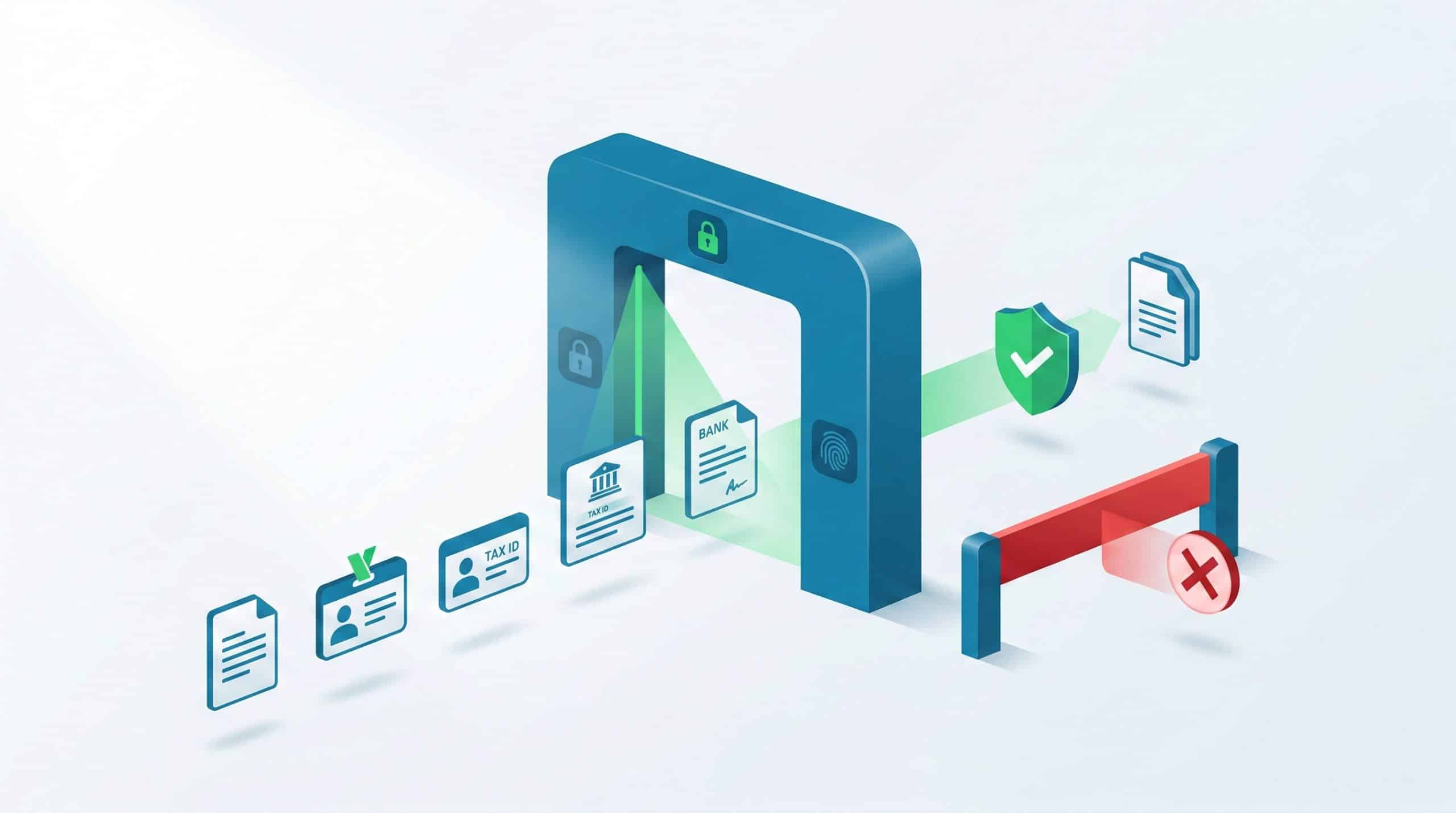
You cannot fix at the payment stage what you failed to verify at the onboarding stage. When a new vendor enters your system without proper screening, every subsequent transaction carries inherited risk. Onboarding controls act as the organizational gatekeeper, ensuring that only verified, legitimate entities become payment-eligible.
What Must Be Verified Before a Vendor Becomes Active
Critical checks during onboarding include: confirming the legal entity name against official registries, validating the tax identification number, verifying bank account ownership through independent documentation — such as a cancelled check or official bank confirmation letter, as required by Israeli government procurement processes — and screening against sanctions and debarment lists. Each verification must produce an evidence artifact stored for audit purposes.
Did You Know
Organizations that screen vendors against global sanctions lists during onboarding reduce post-activation compliance incidents by up to 60%, according to supply chain risk management benchmarks published by Dun and Bradstreet.
How a Secure Onboarding Workflow Actually Operates from End to End
A governed onboarding process follows a clear, repeatable path: the business unit submits a vendor request with supporting documentation. The system performs automated validation — format checks on tax IDs, duplicate detection against existing records, and sanctions screening. If all checks pass, the request routes to an approver whose role is separated from the requester. Only after approval does the vendor record synchronize to the ERP as “active.” Every step, decision, and timestamp is preserved in a complete audit trail.
The value here is consistency. Whether your organization onboards five vendors a month or five hundred, every supplier follows the same controlled path. Exceptions are managed through documented escalation, not informal email threads that leave no trace.
Tip
Map your current onboarding process as a flowchart and identify every point where a single individual can both request and approve a vendor creation. Each of those points represents a segregation-of-duties gap that governance software should eliminate.
Duplicate Vendors — the Silent Drain on Financial Accuracy
Duplicate vendor records are among the most common and most underestimated data quality problems. They arise from typos, abbreviations, mergers, branch openings, or urgent requests that bypass the normal creation process. The consequences are tangible: duplicate payments, loss of negotiating leverage with “preferred” suppliers, and inflated vendor counts that obscure spending analysis.
| Matching Approach | How It Works | Best Used For |
|---|---|---|
| Exact matching | Compares fields character-by-character (tax ID, IBAN) | Catching identical records entered twice |
| Fuzzy / probabilistic matching | Identifies similar names, transposed digits, or shared addresses | Detecting variants like “ABC Ltd” vs. “ABC Limited” |
| Cross-field correlation | Flags different vendors sharing the same bank account or phone number | Uncovering shell entities or restructured suppliers |
Effective governance software runs these checks in real time — blocking a duplicate before creation — and also performs periodic scans across the entire master file to catch legacy duplicates that predate the control layer.
Did You Know
Research from the Institute of Finance and Management estimates that between 1% and 3% of all vendor payments in large enterprises are duplicates — a figure that translates to millions of dollars in recoverable overpayments for organizations with high transaction volumes.
Your vendor master data is only as secure as the controls protecting it. Detelix helps finance teams detect duplicates, enforce approval workflows, and monitor every sensitive field change in real time.
Segregation of Duties in Vendor Data — Without Slowing Down Operations
Segregation of duties (SoD) in vendor master data means that the person who requests a new vendor or a data change is never the same person who approves it, and neither is the person who executes the related payment. This principle is foundational to internal control frameworks, yet many organizations implement it loosely — or not at all — for vendor data changes.
Good SoD design does not create bottlenecks. It creates clarity. When roles are pre-defined and approval routes are automated based on the type and sensitivity of the change, the process actually accelerates because there is no ambiguity about who needs to act next. A bank account change, for example, might require two independent approvers plus a 48-hour payment hold, while an address correction requires only one.
Tip
Document your SoD matrix for vendor data in a formal policy and review it quarterly. Even the best automated controls become ineffective if role assignments drift over time due to staff turnover or organizational restructuring.
Which Fields Trigger Enhanced Controls — and Why “Sensitive” Is Not the Same as “All”
Not every vendor data field carries the same risk. Governance software must distinguish between routine updates and changes that directly affect where money goes or how compliance is assessed. Treating every field change as high-risk generates alert fatigue; treating none as high-risk invites fraud.
| Field Category | Examples | Control Level |
|---|---|---|
| Payment-critical | Bank account, IBAN, payment method, currency | Dual approval + independent verification + payment hold |
| Identity-critical | Legal name, tax ID, country of incorporation, beneficial ownership | Dual approval + document re-verification |
| Operational | Contact person, phone, email, delivery address | Single approval + audit log |
| Low-sensitivity | Internal notes, category tags, language preference | Audit log only |
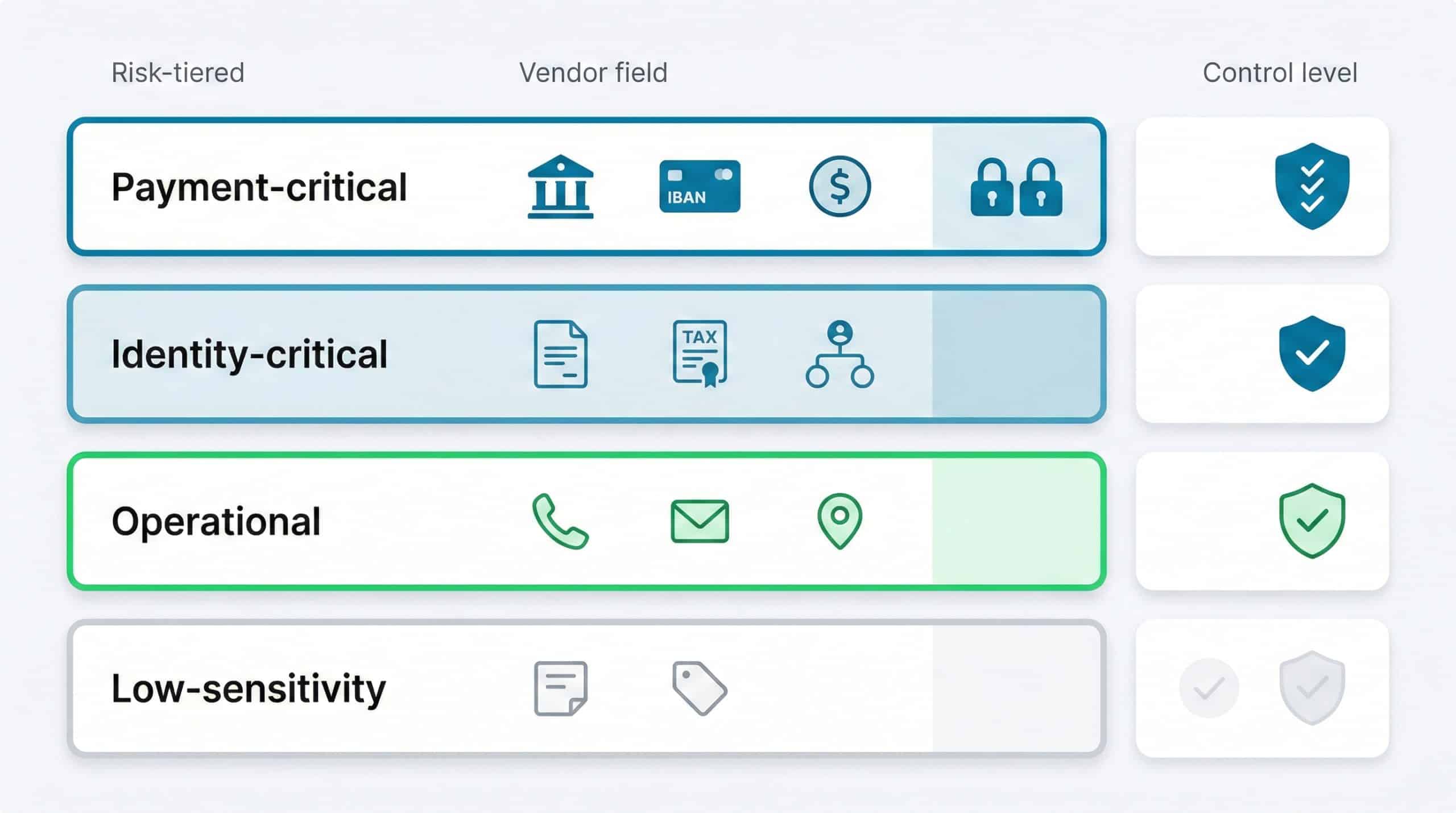
This risk-tiered approach ensures that controls are proportionate, reducing false positives while maintaining full protection over the fields that matter most.
Did You Know
A study by Gartner found that organizations using risk-tiered master data controls experience 40% fewer false-positive alerts compared to those applying uniform controls across all fields — resulting in faster processing times and higher team compliance with governance protocols.
Real-Time Monitoring vs. Periodic Checks — When Does Each Approach Fail?
Many organizations rely on monthly or quarterly data quality reviews. The problem is timing: if a bank account was fraudulently changed on day one and the next review happens on day thirty, up to thirty days of payments may have been misdirected. Real-time monitoring closes this window to near zero by flagging sensitive changes the moment they occur.
Real-time alerts are especially critical for payment-altering fields. When your system can immediately notify a controller that “Vendor X bank account was changed by User Y at 14:32 — no supporting documentation attached,” the controller can freeze the payment run and investigate before money leaves the organization. This is the difference between managing data and actually controlling it.
Tip
Configure your governance platform to send real-time alerts for payment-critical fields while using daily batch reports for operational fields. This layered approach ensures immediate response where it matters most without overwhelming your team with low-priority notifications.
Measuring Success — KPIs That Prove Your Governance Program Works
Governance without measurement is governance on paper. Finance leaders need a dashboard that quantifies the health of vendor master data and the effectiveness of controls. The most actionable KPIs include: percentage of vendor records with all critical fields complete, average cycle time from vendor request to approval, number of duplicate creation attempts blocked, ratio of alerts to confirmed findings (signal-to-noise), and trend analysis of data quality by business unit or region.
These metrics do more than satisfy auditors. They give CFOs and controllers a real-time view of organizational control posture, enabling faster decisions about where to tighten processes and where efficiency can be improved.
Did You Know
Organizations that track and report vendor master data KPIs monthly reduce their average duplicate payment rate by over 50% within the first year of implementing a structured governance program, according to accounts payable benchmarking data.
Connecting Governance Software to Your ERP Without Breaking Payment Flows
Integration is where many governance initiatives stall. The software must respect the ERP as the “system of record” while enforcing rules before data reaches it. This means operating as a controlled gateway: vendor changes are submitted, validated, and approved in the governance layer, then synchronized to the ERP only after all controls have passed. The ERP never receives unverified data.
Key integration principles include: preventing direct edits to sensitive ERP fields outside the governance workflow, maintaining “before and after” snapshots of every change for audit purposes, and using status flags (Pending, Approved, Rejected) that the ERP respects in its payment logic. When designed correctly, this integration strengthens both data quality and payment integrity without adding manual steps for end users.
Tip
When evaluating governance platforms, ask specifically about their ERP connector architecture. Solutions that use API-based, bidirectional synchronization — rather than flat-file imports — reduce data latency and eliminate the reconciliation errors common with batch transfer methods.
How Detelix Strengthens Vendor Master Data Governance in Practice
Detelix approaches vendor master data governance as a continuous, real-time protection layer that operates alongside your existing ERP and financial systems. Rather than replacing workflows, it adds intelligence: cross-checking every vendor data change against configurable rules, detecting anomalies such as a new vendor sharing bank details with an existing one, and alerting the right person before a suspicious payment is executed.

Three capabilities stand out in practical deployments. First, Detelix provides independent, automated monitoring that does not rely on the same users who enter data — eliminating the “fox guarding the henhouse” problem. Second, its alert engine is tuned to reduce false positives by correlating multiple risk signals rather than triggering on isolated field changes. Third, every detection, alert, and resolution is documented in a full audit trail, giving internal auditors and external regulators the evidence they need without requiring manual log compilation.
Is your organization confident that every vendor data change happening right now is legitimate, verified, and fully documented? If the answer requires assumptions rather than evidence, it may be time to move from routine monitoring to real control. Contact the Detelix team to discover how real-time vendor master data governance can protect your payments, strengthen your audit posture, and give your finance leadership genuine operational peace of mind.
Detelix Fraud Prevention Solutions

Proactive Monitoring
Continuous oversight of vendor master data changes with automated validation against configurable business rules and compliance policies.

Real-Time Alerts
Instant notifications when sensitive vendor fields are modified, enabling immediate investigation before fraudulent payments are executed.

Gatekeeper
Automated vendor onboarding verification and approval workflows that enforce segregation of duties and prevent unauthorized record creation.

Experience
Decades of domain expertise in financial controls, ERP integration, and fraud detection — applied directly to your organization’s unique risk profile.
See Detelix in Action
Frequently Asked Questions
What is the difference between vendor master data management and governance?
Management focuses on storing, organizing, and maintaining vendor records. Governance adds the enforcement layer: rules about who can change what, under which conditions, with what approvals, and how every action is documented. Management is about having the data; governance is about controlling it.
How quickly can vendor master data governance software be implemented?
Implementation timelines depend on the complexity of ERP integrations and the number of business units involved. Solutions that operate as an overlay on existing systems — rather than requiring ERP customization — can typically be deployed in weeks rather than months, with core controls active from day one.
Does real-time monitoring generate too many false alerts?
It does if the system relies on single-signal triggers. Effective platforms correlate multiple data points — for example, a bank account change combined with a recent email domain change and an unusual requester role — to surface only high-confidence alerts. The KPI to track is your signal-to-noise ratio, which should improve as rules are refined over time.
Can governance software work across multiple ERP systems?
Yes. Organizations running SAP alongside Oracle, NetSuite, or other platforms benefit from an ERP-agnostic governance layer that normalizes vendor data from all sources, applies consistent rules, and provides a unified dashboard regardless of the underlying system.
What evidence should be retained for audit purposes when a vendor bank account changes?
Best practice is to retain: the original change request with requester identity and timestamp, supporting documentation (bank confirmation letter, cancelled check), the identity of each approver and their approval timestamp, a “before and after” snapshot of the changed fields, and any alerts or exceptions raised during the process.
How does segregation of duties apply to small finance teams with limited staff?
Even small teams can implement SoD by ensuring that no single individual controls the entire chain from vendor creation to payment execution. Automated workflows compensate for limited headcount by enforcing approval gates, escalation paths, and system-level restrictions that prevent one person from completing all steps.
Ready to Close the Gap Between Stored Data and Governed Data?
Every unverified vendor record is a potential payment risk. Let Detelix show you exactly where your vendor master data vulnerabilities are — and how to eliminate them.