Take Control of Vendor Risk Before It Controls You
Detelix delivers continuous, real-time oversight of vendor-related processes so your organization stays protected. Get a free consultation today.
- What Is Vendor Risk Management Software and Why Does It Matter Now?
- How Does VRM Differ from Third-Party Risk Management?
- Five Common Mistakes That Undermine Vendor Risk Programs
- Why Are Organizations Shifting to Continuous Vendor Compliance Monitoring?
- What Does Vendor Due Diligence Software Actually Cover?
- How Does the End-to-End Vendor Risk Lifecycle Look Inside the Software?
- Which Capabilities Separate a Strong Platform from a Basic Document Repository?
- What Scenario Illustrates the Danger of Manual Vendor Management?
- How Do You Evaluate Vendor Risk Management Software Based on Business Outcomes?
- What Drives the Cost of Vendor Risk Management Software?
- When Does a Managed Service Make More Sense Than an In-House Platform?
- How Can Continuous Monitoring Avoid Alert Fatigue?
- What Does Effective Remediation Look Like Inside a VRM Platform?
- How Does Supplier Risk Management Extend Beyond Software and IT Vendors?
- Benchmarks and Indicators: How Do You Measure the Health of Your VRM Program?
- What Should Compliance-Driven Organizations Look for in a VRM Platform?
- What Trends Will Shape Vendor Risk Management in 2025 and Beyond?
- Frequently Asked Questions
In many organizations, the relationship with external vendors appears well-managed on the surface. Contracts are signed, services are delivered, and invoices are paid. Yet beneath this routine lies a growing landscape of risk—cybersecurity vulnerabilities, regulatory non-compliance, financial instability, and operational failures—that can quietly erode the trust and stability your organization depends on. As supply chains become more digital and interconnected, the old approach of reviewing a vendor once a year through a static questionnaire is no longer enough. The question facing CFOs, risk leaders, and security teams today is not whether to manage vendor risk, but how to do it with the speed, accuracy, and depth that the modern threat environment demands. This is where vendor risk management software transforms the equation, moving your organization from reactive firefighting to proactive, continuous control.
Key Takeaways
- Vendor risk management software centralizes vendor oversight, replacing scattered spreadsheets and manual effort with automated workflows and data-driven risk scoring.
- Continuous compliance monitoring detects vendor risk changes in real time, closing the dangerous gaps that annual reviews leave open.
- Risk-based tiering ensures your team invests deep due diligence where it matters most—on high-risk, high-access vendors—without wasting resources on low-risk relationships.
- Structured remediation workflows with ownership, deadlines, and evidence tracking turn audit findings into closed gaps rather than open-ended to-do lists.
- Measuring KPIs such as onboarding time, assessment completion rate, and open findings older than 90 days reveals whether your VRM program delivers genuine improvement or just adds process.
What Is Vendor Risk Management Software and Why Does It Matter Now?
Vendor risk management software is a platform that centralizes every aspect of third-party oversight into a single, structured environment. Instead of scattering vendor data across spreadsheets, email threads, and shared drives, the software manages vendor profiles, risk assessments, compliance documents, approval workflows, and ongoing monitoring from one place. It replaces manual effort with automation and replaces guesswork with data-driven risk scoring.
The urgency behind adopting such a platform has intensified. A report by the Israeli State Comptroller (January 2024) highlighted that supply chain cyber risks represent a significant organizational threat, stressing the need to embed cybersecurity requirements into procurement processes, vendor assessments, and ongoing oversight. The message is clear: the days of informal vendor management are over.
Tip
Before evaluating any VRM platform, audit your current vendor management process. Map every spreadsheet, shared folder, and email chain your team uses to track vendor data. This inventory reveals the true scope of fragmentation the software needs to consolidate.
How Does VRM Differ from Third-Party Risk Management?
The terms “vendor risk management” and “third-party risk management” are frequently used interchangeably, but there is a meaningful distinction. Third-party risk management (TPRM) is the broader discipline—it covers every external relationship, including consultants, subcontractors, joint-venture partners, and even fourth parties (the vendors your vendors rely on). Vendor risk management software, by contrast, focuses specifically on commercial suppliers and service providers whose products or access points create direct risk exposure for your organization.
In practice, a strong VRM platform should scale to address the full TPRM scope. When evaluating solutions, your team should consider whether the software can accommodate different relationship types, varying risk categories, and tiered assessment depths—not just a single vendor template applied uniformly.
Did You Know
According to industry research, the average enterprise relies on over 5,800 third-party relationships. Yet fewer than 40% of organizations have automated processes in place to monitor those relationships continuously—leaving the majority dependent on periodic, manual reviews that miss emerging threats.
Five Common Mistakes That Undermine Vendor Risk Programs
Before exploring features and workflows, it is worth examining where organizations typically go wrong. Recognizing these patterns helps you evaluate software through the lens of real operational needs rather than marketing claims.
| Mistake | Business Consequence | What the Software Should Solve |
|---|---|---|
| Relying on annual questionnaires with no follow-up | Risks change between assessments and go undetected | Continuous monitoring with risk-triggered alerts |
| Storing evidence in scattered folders and inboxes | Audit preparation takes weeks; gaps are discovered too late | Centralized evidence repository with version control |
| Treating all vendors the same regardless of criticality | Over-investing in low-risk vendors while under-scrutinizing critical ones | Risk-based tiering that adjusts assessment depth automatically |
| No documented remediation process | Findings remain open indefinitely; accountability is unclear | Workflow-driven remediation with deadlines and ownership |
| Disconnecting vendor risk from broader governance | Compliance teams work in silos; leadership lacks visibility | Dashboards and reports that connect VRM to enterprise risk |
Tip
Use this table as a diagnostic checklist. If your organization currently exhibits three or more of these patterns, prioritize platforms that address those specific gaps rather than selecting a tool with the longest feature list.
Why Are Organizations Shifting to Continuous Vendor Compliance Monitoring?
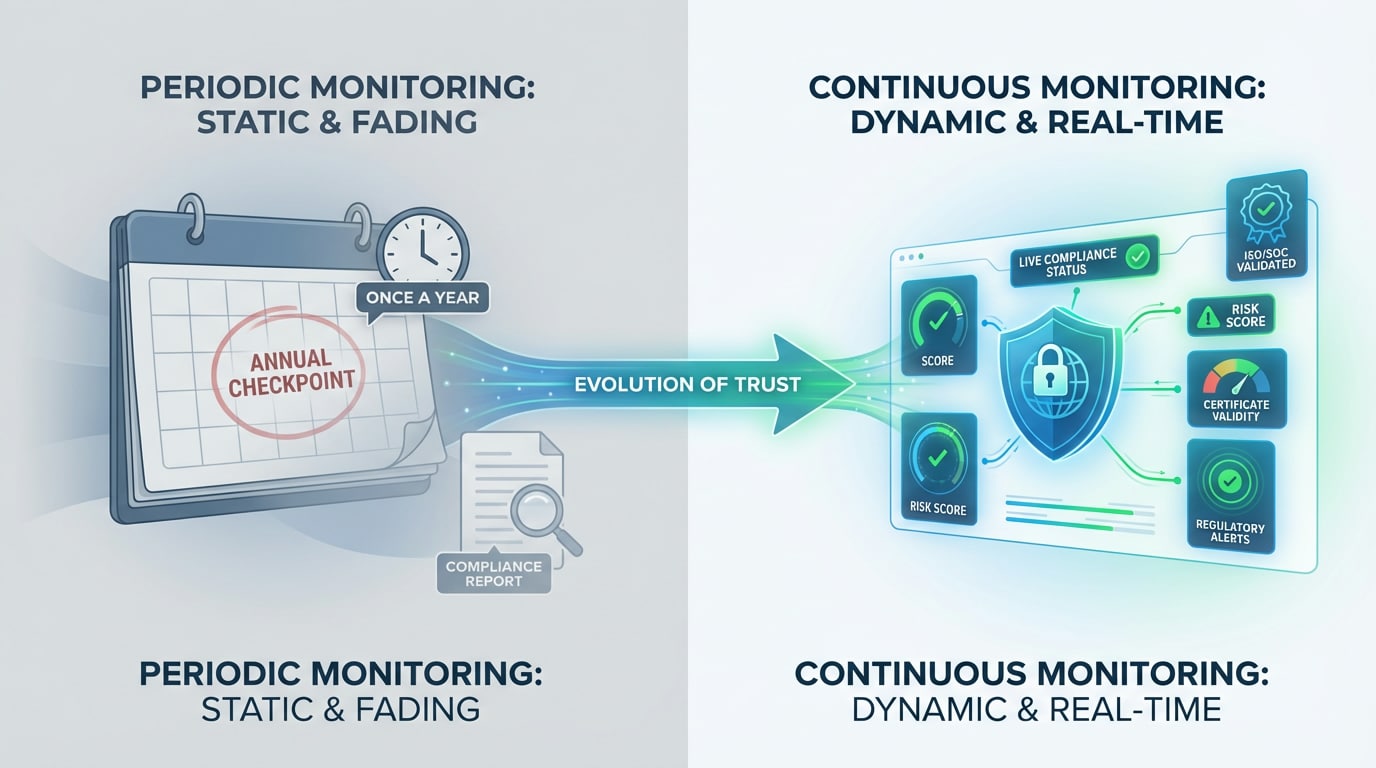
Vendor compliance monitoring is the practice of tracking whether a vendor continues to meet your organization’s requirements—security policies, contractual obligations, regulatory standards, and insurance coverage—on an ongoing basis rather than only at the point of onboarding. The shift from periodic to continuous is driven by a simple reality: risk does not follow a calendar.
A vendor that passed a thorough assessment six months ago may have since experienced a data breach, lost a key certification, or undergone a change in ownership. Without continuous monitoring, your organization inherits those risks silently. An Israeli banking regulation (Directive 363) explicitly requires financial institutions to map material vendors, conduct periodic risk assessments, and include contractual provisions for logs, penetration testing, incident reporting, and sub-vendor oversight—principles that apply far beyond banking.
Did You Know
Israeli banking Directive 363 requires financial institutions to include contractual provisions for penetration testing, incident reporting within defined timeframes, and sub-vendor oversight. Many organizations outside the banking sector are voluntarily adopting these same standards as a best-practice baseline for vendor contracts.
What Does Vendor Due Diligence Software Actually Cover?
Vendor due diligence software handles the initial and ongoing investigation of a vendor’s fitness. This includes distributing and collecting questionnaires, gathering documentation such as SOC 2 reports, ISO 27001 certificates, and cyber-insurance policies, verifying the validity of those documents, and producing an assessment that decision-makers can act on.
A well-designed due diligence module supports branching logic in questionnaires—so a vendor processing personal data receives privacy-specific questions, while a facilities vendor sees a shorter, operationally focused form. It also maintains a history of every decision: who approved, who raised an exception, and what evidence supported the conclusion. This audit trail is not a luxury; it is what enables your organization to demonstrate control to regulators and internal auditors alike.
Tip
When building your due diligence questionnaire library, create separate templates for at least three vendor categories: data processors, technology service providers, and non-technical suppliers. Branching logic should adapt question depth based on data access level and system connectivity.
How Does the End-to-End Vendor Risk Lifecycle Look Inside the Software?
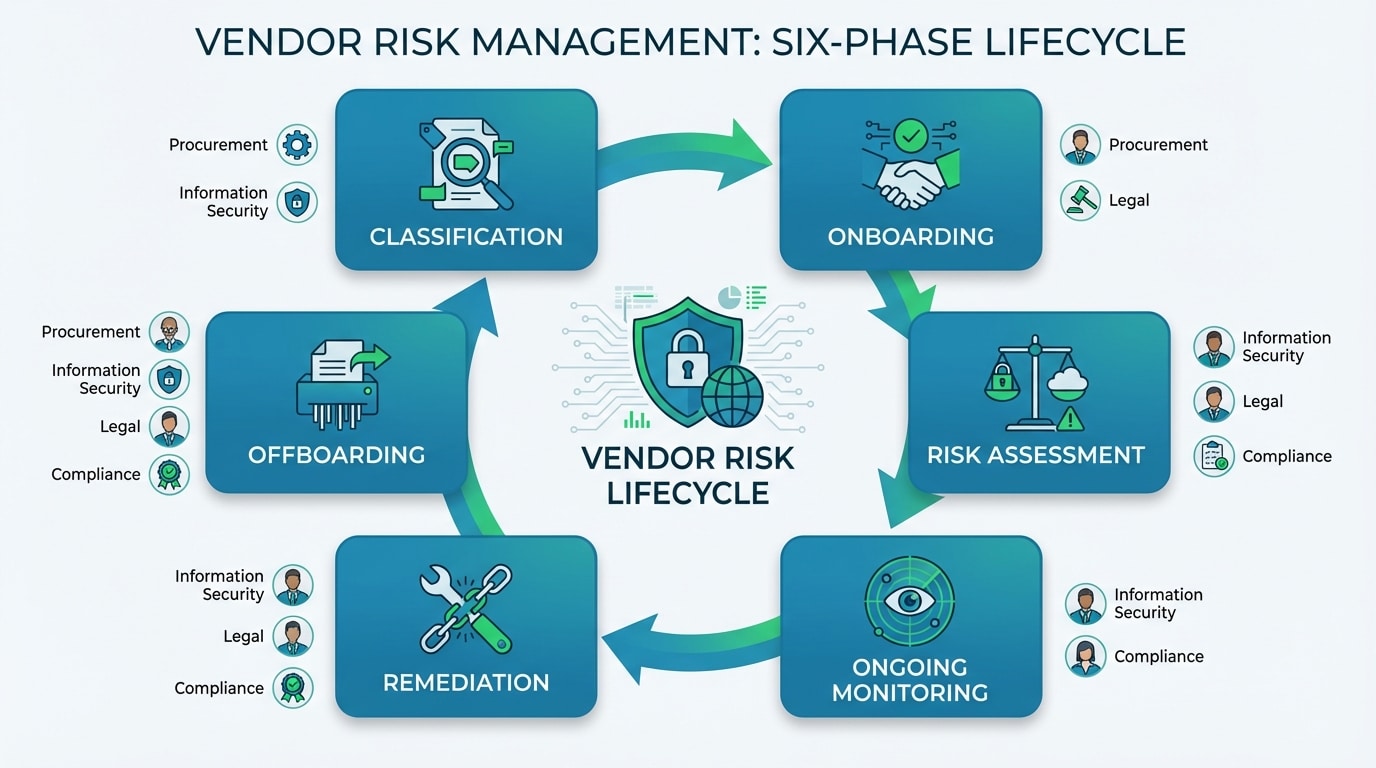
The lifecycle managed by vendor risk management software typically spans six phases: classification, onboarding, risk assessment, ongoing monitoring, remediation, and offboarding. Each phase involves different stakeholders—procurement, information security, legal, compliance—and the software orchestrates their tasks so nothing falls through the cracks.
Risk-Based Tiering and Onboarding
At the outset, the software classifies the vendor according to data sensitivity, system access, business criticality, and regulatory relevance. A Tier 1 vendor with access to customer databases undergoes deep due diligence; a Tier 3 vendor providing office supplies may need only basic verification. This tiering logic drives onboarding speed and assessment depth, ensuring resources are allocated where risk is highest.
Did You Know
Organizations that implement risk-based tiering typically reduce the time spent on low-risk vendor assessments by 60-70%, freeing security and compliance teams to concentrate on the vendors that pose the greatest threat to operations and data integrity.
Ongoing Monitoring and Offboarding
Once a vendor is active, the platform monitors for changes—certificate expirations, adverse news, compliance status shifts—and generates alerts routed to the appropriate owner. When a relationship ends, the offboarding process ensures data return or destruction is documented, access is revoked, and evidence is preserved for future reference or audit.
Which Capabilities Separate a Strong Platform from a Basic Document Repository?
Many tools can store documents. Far fewer can manage risk. The difference lies in automation, intelligence, and workflow. A strong vendor risk management software platform includes automated questionnaire distribution with branching logic, a document repository with expiration tracking and version control, configurable risk-scoring models that calculate both inherent and residual risk, approval workflows with escalation paths and exception handling, a vendor-facing portal that reduces back-and-forth, and reporting dashboards tailored for executive leadership and audit committees.
Without these capabilities, your team ends up with a glorified filing cabinet—organized, perhaps, but not genuinely controlling risk. An efficient protection system should do more than archive evidence; it should actively flag deviations, enforce deadlines, and generate the insights your leadership needs to make informed decisions.
What Scenario Illustrates the Danger of Manual Vendor Management?
Consider a mid-sized financial services firm that onboards a new cloud-based payroll vendor. The procurement team collects the vendor’s SOC 2 report, verifies insurance, and files everything in a shared drive. Six months later, the vendor suffers a ransomware attack. The firm’s security team discovers that the SOC 2 report expired two months ago, the vendor’s incident response plan was never reviewed, and there is no contractual clause requiring the vendor to notify the firm within a specific timeframe.
In a software-driven process, the platform would have flagged the SOC 2 expiration automatically, triggered a renewal request, and ensured the contract included mandatory breach notification. The gap between “we have a document” and “we have a living, enforced control” is exactly what vendor risk management software closes.
Tip
Set automated expiration alerts for all vendor certifications, insurance policies, and compliance documents at 90, 60, and 30 days before expiry. This three-stage escalation ensures your team has sufficient time to collect updated evidence without last-minute scrambling.
Your vendor relationships carry hidden risks that spreadsheets cannot detect. Let Detelix show you how continuous, real-time oversight transforms vendor management from a compliance checkbox into genuine operational control.
How Do You Evaluate Vendor Risk Management Software Based on Business Outcomes?
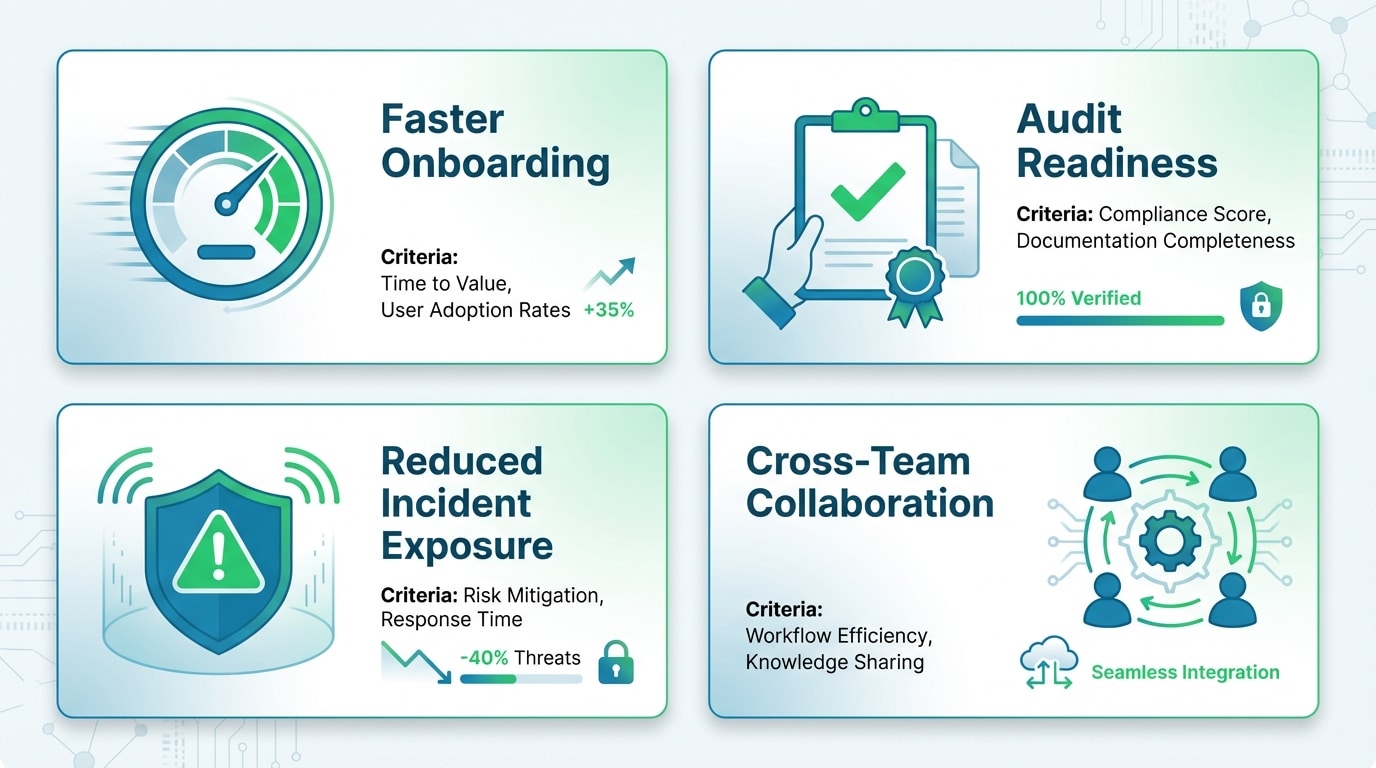
Choosing the right platform starts with defining the outcomes you need, not the features you want. The most common outcomes organizations seek are faster onboarding without cutting corners, audit readiness at any moment, reduced exposure to vendor-originated incidents, and improved collaboration between security, procurement, and compliance teams.
| Business Outcome | Evaluation Criterion | Questions to Ask During a Demo |
|---|---|---|
| Faster onboarding | Workflow automation, vendor portal, template library | How quickly can a Tier 1 vendor complete onboarding end to end? |
| Audit readiness | Audit trail depth, evidence export, reporting granularity | Can I generate a full vendor risk report for auditors in one click? |
| Reduced incident exposure | Continuous monitoring signals, alert routing, remediation tracking | How does the platform handle a vendor breach notification in real time? |
| Cross-team collaboration | Role-based access, task assignment, shared dashboards | Can procurement and security work in parallel without duplicating effort? |
When evaluating platforms, build use-case scenarios that mirror your actual vendor portfolio. If you manage 200 vendors across three continents and two regulatory regimes, the demo should reflect that complexity—not a simplified, best-case walkthrough.
Did You Know
A Ponemon Institute study found that 59% of organizations experienced a data breach caused by a third party, yet only 16% said they could effectively mitigate third-party risks. The gap between awareness and capability underscores why platform selection must be driven by demonstrable outcomes, not feature checklists.
What Drives the Cost of Vendor Risk Management Software?
Pricing typically depends on the number of vendors managed, the modules included (monitoring, integrations, advanced analytics), the number of internal users, and whether managed services are part of the package. Some platforms charge per assessment; others use a flat annual license.
However, cost should be measured against total cost of ownership (TCO), not just the subscription fee. TCO includes the hours your team currently spends chasing vendors for documents, the delays in onboarding that slow revenue-generating projects, and the potential financial impact of a vendor-originated breach or regulatory fine. Organizations that quantify these hidden costs often discover that the software pays for itself within the first year through time savings and risk reduction alone.
Tip
Calculate your current cost of manual vendor management by tracking hours spent per vendor on document collection, follow-up emails, and report compilation over a single quarter. Multiply by your team’s blended hourly rate. This figure gives you a concrete baseline to compare against platform subscription costs.
When Does a Managed Service Make More Sense Than an In-House Platform?
The choice between a managed (“done-for-you”) VRM service and an internally operated platform depends on your team’s size, maturity, and strategic priorities. A managed service suits organizations with small security or compliance teams that cannot dedicate headcount to vendor follow-ups. It also works well when the primary goal is speed—getting a program running in weeks rather than months.
An in-house platform, on the other hand, gives larger teams full control over risk models, policies, exception workflows, and reporting formats. Many organizations find a hybrid model effective: the platform automates workflows and provides the control framework, while a managed layer handles the repetitive tasks of document collection and vendor communication. Detelix, for example, offers organizations continuous, real-time oversight of sensitive business processes—including vendor-related financial transactions—so that teams gain visibility without being overwhelmed by operational noise.
How Can Continuous Monitoring Avoid Alert Fatigue?
One of the most frequent objections to continuous vendor monitoring is the fear of being flooded with alerts. The solution lies in risk-based alerting—setting thresholds that match the vendor’s tier and the nature of the signal. A Tier 1 vendor experiencing a data breach warrants an immediate, high-priority alert. A Tier 3 vendor whose insurance certificate is expiring in 60 days generates a low-priority reminder routed to procurement.
Effective platforms also consolidate related signals into a single, contextualized notification rather than firing separate alerts for every data point. This “signal-to-action” approach pairs each alert with a predefined playbook: triage the alert, contact the vendor, collect evidence, make a decision, and document the outcome. Quality metrics—such as false-positive rates and average response time—help your team tune the system over time so that alerts remain actionable, not exhausting.
Did You Know
Security operations teams report that up to 45% of alerts are false positives. Effective VRM platforms use risk-based filtering and signal consolidation to reduce false-positive vendor alerts to under 10%, ensuring that every notification your team receives demands genuine attention.
What Does Effective Remediation Look Like Inside a VRM Platform?
Identifying a risk is only half the equation. The other half is closing the gap. Vendor risk management software should support a structured remediation process: document the finding, assign an owner, set a deadline, track progress, and verify resolution with evidence. When a vendor cannot resolve an issue immediately, the platform should allow a documented exception—approved by the appropriate authority—with a clear rationale and a follow-up date.
This is where the concept of a “Plan of Action and Milestones” (POA&M) becomes practical. Rather than leaving findings in an open-ended queue, the software links each finding to the specific control, policy, or risk it relates to. This traceability is what auditors look for when they assess whether your vendor risk program is genuinely effective or merely performative.
Tip
Establish a maximum remediation window for each risk severity level: 15 business days for critical findings, 30 for high, 60 for medium, and 90 for low. Configure your VRM platform to escalate automatically when a deadline approaches without evidence of progress.
How Does Supplier Risk Management Extend Beyond Software and IT Vendors?
Supplier risk management broadens the lens to include operational, logistical, and physical supply chain risks—quality failures, delivery disruptions, geopolitical instability, and environmental compliance. While vendor risk management software often emphasizes cybersecurity and data protection, the strongest platforms accommodate these additional risk domains through configurable assessment templates and scoring models.
Fourth-party risk adds another layer. Your organization may have strong controls over a direct vendor, but what about the cloud provider that vendor relies on, or the subcontractor handling your data in a different jurisdiction? A mature VRM program maps these dependencies and monitors them as part of the broader risk picture. Platforms that support fourth-party visibility give your team the ability to ask the right questions before a downstream failure becomes your problem.
Did You Know
A major cloud infrastructure outage in 2023 affected thousands of downstream businesses simultaneously, yet only 12% of those organizations had formally assessed their fourth-party concentration risk. Mapping your vendors’ critical dependencies is no longer optional—it is a prerequisite for operational resilience.
Benchmarks and Indicators: How Do You Measure the Health of Your VRM Program?
| KPI | What It Measures | Target Range |
|---|---|---|
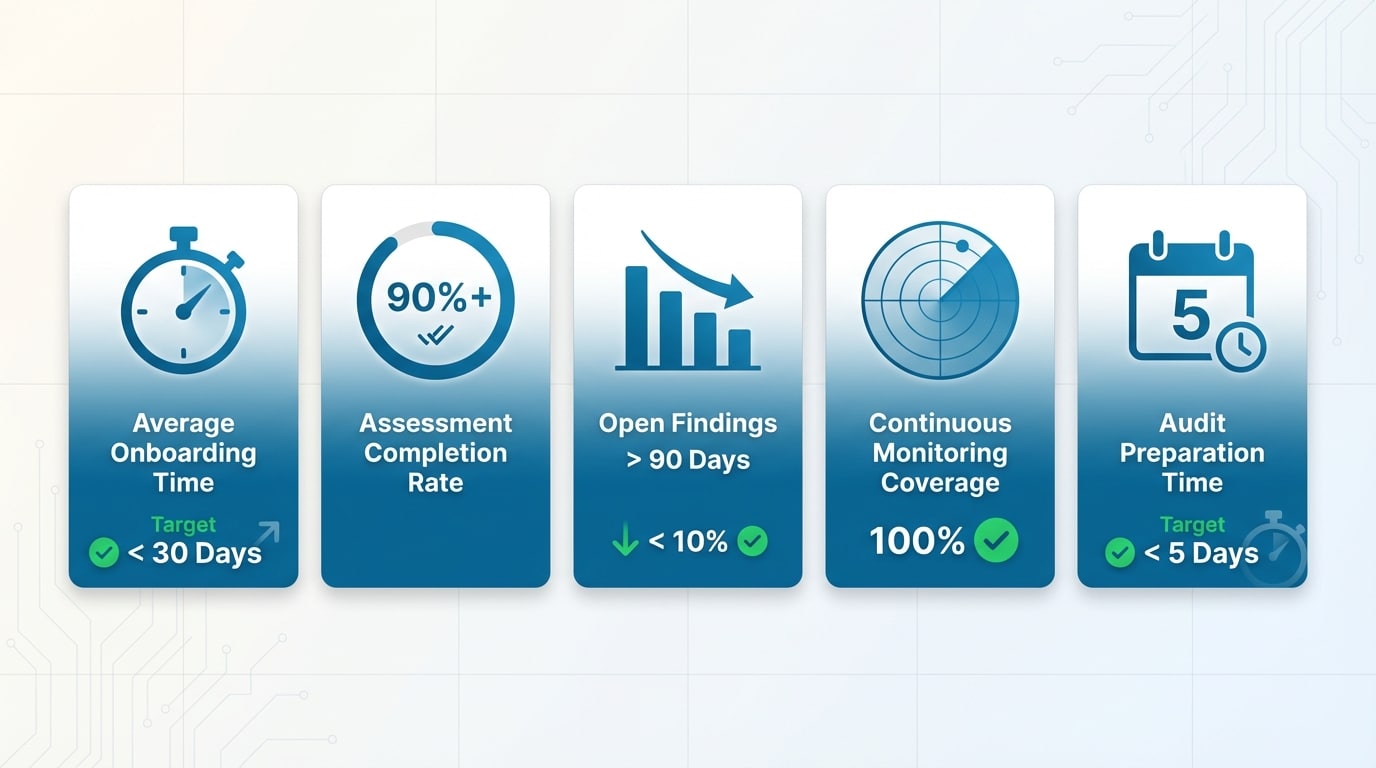
| Average onboarding time (Tier 1) | Efficiency of due diligence and approval | Under 30 business days |
| Assessment completion rate | Vendor responsiveness and follow-up effectiveness | Above 90% |
| Open findings older than 90 days | Remediation velocity and accountability | Below 10% of total findings |
| Continuous monitoring coverage | Percentage of active vendors under automated monitoring | 100% of Tier 1 and Tier 2 |
| Audit preparation time | Readiness and evidence quality | Under 5 business days for a full report |
Tracking these indicators over time reveals whether your investment in vendor risk management software is delivering measurable improvement or just adding process. Detelix provides organizations with real-time dashboards that connect vendor-related financial activity to broader control metrics, enabling leadership to see not only what is happening but whether it aligns with policy—before damage occurs.
What Should Compliance-Driven Organizations Look for in a VRM Platform?
For organizations operating under regulatory frameworks—whether financial services directives, privacy regulations, or industry-specific standards—the software must do more than manage risk. It must produce evidence. Every assessment, every approval, every exception, and every remediation action should be logged with a timestamp, an owner, and a rationale. This audit trail is what transforms vendor risk management from a best practice into a compliance obligation fulfilled.
The platform should also map vendor controls to specific regulatory requirements, making it straightforward to demonstrate coverage during an audit. If a regulator asks how you verified that a critical vendor maintains adequate incident response capabilities, your team should be able to produce the answer—along with supporting documentation—in minutes, not weeks. Organizations seeking effective protection against embezzlement and financial mismanagement during the vendor lifecycle find that this level of traceability also deters internal control bypasses.
Tip
Create a regulatory mapping matrix that links each compliance requirement (SOX, GDPR, PCI DSS, Directive 363) to specific vendor assessment questions and evidence types. Your VRM platform should allow you to tag vendor controls against this matrix so that audit responses are pre-built, not assembled on demand.
What Trends Will Shape Vendor Risk Management in 2025 and Beyond?
Several developments are accelerating the evolution of vendor risk management software. AI-assisted risk scoring is moving from experimental to practical, enabling platforms to analyze large volumes of vendor data—financial filings, news sentiment, breach databases—and surface risks that manual review would miss. Global privacy regulations continue to multiply, creating a patchwork of compliance obligations that demand flexible, jurisdiction-aware assessment frameworks.
The integration of VRM with broader enterprise systems—GRC platforms, identity and access management, ERP environments, and procurement workflows—is becoming a baseline expectation rather than a premium feature. Organizations that invest in an adaptable platform today position themselves to absorb future regulatory requirements without starting over. Detelix exemplifies this forward-looking approach by continuously scanning sensitive ERP processes across the vendor payment lifecycle, ensuring that control keeps pace with complexity.
Detelix Continuous Control Solutions

Proactive Monitoring
Continuous oversight of sensitive business processes to detect anomalies and policy violations before they escalate into financial damage.

Real-Time Alerts
Instant notifications when vendor-related transactions or processes deviate from established controls, enabling immediate response.

GateKeeper
Automated enforcement of approval workflows and segregation of duties across vendor payment processes and master data changes.

Industry Experience
Deep domain expertise across healthcare, finance, government, and enterprise sectors, ensuring controls are tailored to your regulatory environment.
See Detelix in Action
Frequently Asked Questions
Can vendor risk management software help with audit preparation?
Yes. A well-implemented platform maintains a continuous audit trail—every assessment, approval, exception, and remediation action is logged with timestamps and ownership. This means your team can generate a comprehensive vendor risk report for auditors within minutes rather than spending weeks assembling evidence from scattered sources.
What documents should we collect from vendors during due diligence?
The standard set includes SOC 2 Type II reports, ISO 27001 certificates, cyber-insurance policies, business continuity plans, and data processing agreements. Depending on the vendor’s tier and the data they access, you may also require penetration test summaries, privacy impact assessments, and evidence of employee security training. The software should track document validity and alert you before anything expires.
How do we handle fourth-party risk—the vendors our vendors depend on?
Start by requiring your direct vendors to disclose their critical subcontractors and the services those subcontractors provide. Your VRM platform should allow you to record these dependencies, assess the concentration risk they create, and include contractual provisions that give you notification rights when a vendor changes a key sub-vendor.
Is it realistic for a small team to run a vendor risk program effectively?
It is, provided the team relies on automation rather than manual effort. Risk-based tiering ensures that deep assessments are reserved for high-risk vendors, while lower-tier vendors follow a streamlined, largely automated path. A managed-service component can handle routine tasks like document collection and vendor follow-ups, freeing your team to focus on risk decisions and strategic oversight.
How quickly can we expect to see ROI from implementing VRM software?
Most organizations report measurable time savings within the first quarter—particularly in onboarding speed and audit preparation. The larger financial ROI emerges over the first year as the platform prevents costly incidents, reduces regulatory exposure, and eliminates the hidden costs of manual vendor management such as duplicated effort and missed deadlines.
Ready to Move from Managing Vendors to Controlling Vendor Risk?
The gap between having a vendor list and having a vendor risk program is the gap between hoping nothing goes wrong and knowing you can detect and respond when something does. Talk to Detelix today about building continuous visibility into your third-party relationships.