Stop ERP Fraud Before It Becomes a Loss
Detelix delivers real-time, independent oversight over the workflows, permissions, and master data that fraudsters actually exploit inside enterprise systems.
- What ERP Fraud Really Is and How It Differs From Traditional Financial Fraud
- Why Enterprise Systems Become a Natural Hiding Place for Fraud
- How Fraudsters Exploit ERP Systems in Practice
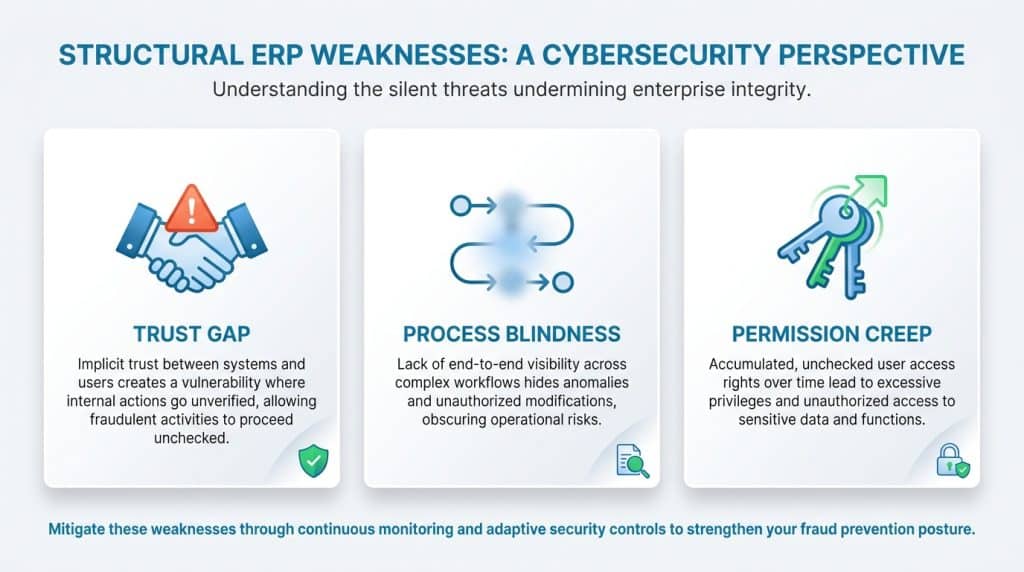
- The Trust Gap, Process Blindness, and Permission Creep
- A Scenario: How a Single Vendor Change Becomes a Loss
- Common ERP Exploitation Techniques in Procurement and Accounts Payable
- Mapping Typical Fraud Schemes to Their ERP Entry Points
- Why Segregation of Duties and Least Privilege Remain Non-Negotiable
- Why Audit Logs Alone Will Not Catch Sophisticated Insiders
- Early Warning Signs That Something Is Wrong Inside the ERP
- Common Mistakes Organizations Make When Defending the ERP
- Building a Modern Anti-Fraud Strategy for ERP Environments
- How Detelix Addresses Specific ERP Control Needs
- Comparing Traditional Controls to Real-Time Protection
- When to Run a Dedicated ERP Fraud Assessment
- Frequently Asked Questions
In many organizations, financial controls look strong on paper. There are approval flows, ERP permissions, reconciliations, and layered review procedures. Yet when sophisticated fraudsters target enterprise systems, they rarely try to break in from the outside. Instead, they operate from within the legitimate flow of business, using trusted access, familiar workflows, and the sheer complexity of the ERP to hide their activity in plain sight. Understanding how fraudsters exploit ERP systems is the first step toward moving from the illusion of control to real, continuous protection of the processes that actually move money.
Key Takeaways
- ERP fraud hides inside legitimate workflows, not outside the system, which is why perimeter security alone does not prevent it.
- Vendor master data changes, split invoices, and permission creep are among the highest-impact exploitation patterns in finance.
- Audit logs record what happened, but they rarely provide the behavioral context needed to distinguish fraud from routine work.
- Segregation of duties and least privilege remain foundational, yet they must be paired with continuous, real-time monitoring.
- Detelix operates as an independent control layer that flags anomalies while transactions are happening, not months later.
What ERP Fraud Really Is and How It Differs From Traditional Financial Fraud
ERP fraud is the manipulation of business processes, permissions, master data, or automated controls inside an enterprise system to conceal improper activity or generate personal gain. Unlike traditional financial fraud, which is often viewed as an external hacking event or a standalone accounting manipulation, ERP exploitation happens at the intersection of legitimate workflows and weak oversight. The transactions appear normal. The users are authorized. The approvals are recorded. But the outcome is loss.
This is where the challenge becomes operational rather than purely technical. Detecting this type of activity often requires cracking hidden errors, frauds, and sophisticated manipulations that blend into massive volumes of routine data. According to COSO’s Fraud Deterrence guidance, fraud risk management must be integrated with internal control, governance, and data analytics to be effective, not treated as a separate audit exercise.
Tip
Reframe ERP fraud inside your risk register as a process risk, not an IT risk. The moment it is categorized as an operational concern, the right teams, including finance, audit, and procurement, start owning prevention instead of waiting for cybersecurity alerts that will never come.
Why Enterprise Systems Become a Natural Hiding Place for Fraud
Modern ERP environments connect finance, procurement, inventory, payroll, and vendor management into one continuous flow. That integration is exactly what creates the opportunity. A single manipulated record can cascade across modules and appear consistent everywhere it is checked. When reconciliation relies on the same data that was tampered with, the fraud validates itself.
The scale also matters. A finance team processing tens of thousands of transactions per month cannot manually inspect every entry, and standard reports often summarize the very anomalies a reviewer should see. Fraudsters count on this volume. They design their actions to look statistically unremarkable, which is why process-level visibility, not just system-level logging, is what separates organizations that detect fraud early from those that discover it years later.
Did You Know
The Association of Certified Fraud Examiners consistently reports that occupational fraud schemes last a median of more than a year before detection. The reason is rarely missing data. It is the absence of a control layer that asks whether the data pattern is normal for this specific business.
How Fraudsters Exploit ERP Systems in Practice
Fraudsters exploit ERP systems through a combination of authorized access, accumulated permissions, master data changes, workflow bypasses, and unreviewed automations. The operation rarely looks like a cyberattack. It looks like work.
Typical patterns include creating a fictitious supplier, quietly changing the bank account of a legitimate vendor, splitting invoices to slip under approval thresholds, deleting or adjusting audit entries, or leveraging an account with excessive rights to push transactions through multiple steps alone. Sometimes the actor is an internal employee. Sometimes it is an external attacker using credentials harvested from that employee. The ERP cannot tell the difference without a control layer designed to detect behavioral anomalies.
The Trust Gap, Process Blindness, and Permission Creep
Three structural weaknesses make ERP systems particularly attractive targets. The first is the trust gap, where long-tenured employees receive less scrutiny precisely because they have been reliable for years. The second is process blindness, where the technical system is hardened but the underlying business process, such as vendor onboarding or payment release, contains unchecked steps. The third is permission creep, where users accumulate rights over promotions, projects, and role changes that no one ever revokes.
Government findings reinforce how costly this becomes. The U.S. GAO report on weak internal controls documented how gaps in segregation of duties and payment-process oversight directly enabled fraud and improper payments. The pattern is consistent: the control existed on paper, but not in the live process.
Tip
Run a quarterly entitlement review scoped specifically to finance, procurement, and payroll users. The goal is not to find malicious activity but to remove rights that no longer match a user’s current role. This one discipline dramatically reduces the attack surface without adding friction.
A Scenario: How a Single Vendor Change Becomes a Loss
Consider a common scenario. An accounts payable clerk with legitimate access updates the bank details for an established supplier after receiving what looks like a routine email request. The change is saved. The next scheduled payment run sends funds to the new account. Reconciliation matches the invoice, the PO, and the payment. Everything balances. Three weeks later, the real supplier calls about an overdue invoice.
Nothing in this flow triggered a traditional security alert. No password was stolen. No malware was deployed. The control gap was the absence of an independent, real-time check on sensitive master data changes. This is precisely the kind of exposure that makes the Dangers of changing bank account details in ERP systems such a critical topic for finance leaders to address operationally, not just theoretically.
Did You Know
The FBI’s Internet Crime Complaint Center has consistently ranked business email compromise, often used to trigger exactly this type of vendor banking change, among the costliest financial crime categories reported each year, with losses measured in billions of dollars globally.
Common ERP Exploitation Techniques in Procurement and Accounts Payable
Procurement and AP are the most frequently targeted areas because they combine data, approval, and money in a short cycle. Fraud schemes in this area rarely require technical sophistication. They require process knowledge.
Vendor Master Data Manipulation
Fraudsters create ghost vendors or modify banking details on legitimate ones. Because the vendor record is trusted downstream, every transaction flowing through it inherits that trust.
Transactional Bypassing and Split Payments
A large invoice is divided into several smaller ones, each sitting just below the threshold that would trigger executive approval. The system processes each piece as routine.
Exploiting Automated Workflows
Auto-approval rules designed for efficiency become a weakness when fraudsters push many low-value transactions through the same path, knowing none will be manually reviewed.
Mapping Typical Fraud Schemes to Their ERP Entry Points
| Fraud Scheme | Primary ERP Entry Point | Why It Often Goes Undetected |
|---|---|---|
| Fictitious vendor payments | Vendor master data creation | New vendor looks legitimate; no independent verification |
| Bank account redirection | Vendor master data edit | Change is authorized by a trusted user |
| Invoice splitting | AP invoice entry | Each piece falls below approval thresholds |
| Duplicate payments | Payment run | Small variations in invoice numbers evade matching |
| Unauthorized refunds | Customer credit workflow | Refunds blend with normal customer service activity |
| Inventory shrinkage | Stock adjustments between warehouses | Movement hides missing quantities |
Your ERP controls may look strong on paper. The question is whether they catch sophisticated manipulation while it is happening, or only after payments have left the organization.
Why Segregation of Duties and Least Privilege Remain Non-Negotiable
Segregation of duties prevents a single person from controlling the full chain of a transaction. When the user who creates a vendor is different from the one who approves it, and different again from the one who releases payment, fraud becomes far harder to execute and nearly impossible to hide alone. The principle of least privilege reinforces this by ensuring users only hold the access their current role genuinely requires.
These are not theoretical controls. NIST guidance on privileged account management emphasizes that accounts with elevated access require tight monitoring, auditing, and life-cycle discipline. Without that discipline, service accounts and administrative users become the single largest exposure point inside any enterprise system.
Tip
Map each sensitive transaction, such as vendor creation, bank detail edit, and payment release, to at least two distinct user roles before reviewing permissions. If one user currently holds two roles in the chain, that is not a theoretical gap. It is an active exposure waiting to be exploited.
Why Audit Logs Alone Will Not Catch Sophisticated Insiders
Many organizations assume that enabling audit logs provides adequate fraud defense. In practice, logs answer the question of what happened, but rarely why, and almost never whether the action deviated from normal business behavior. A sophisticated insider performs actions that look entirely standard in a log entry yet are fraudulent in context.
Volume compounds the problem. A mid-sized ERP generates millions of log events per month. Without correlation, behavioral baselining, and process-aware analysis, the log becomes an archive rather than a detection tool. As CISA has emphasized in its expanded logging guidance, logs deliver value only when they are actively used for threat hunting and investigation. This is also why the hidden risks of verifying a supplier’s bank account cannot be closed by logging alone; they require independent, real-time cross-checking.
Did You Know
Most large ERP deployments generate enough audit events each month that reviewing even one percent manually would consume thousands of analyst hours. Without automated, behavior-aware correlation, log data tends to be consulted only after damage has already been done.
Early Warning Signs That Something Is Wrong Inside the ERP
Fraud inside an ERP rarely begins with a single dramatic event. It begins with small patterns that, viewed together, form a clear signal. Frequent edits to vendor banking details, transactions executed outside normal business hours, round-number payments, rapid approvals that skip typical review time, manual journal entries reversing earlier postings, and users with cross-functional permissions all deserve attention.
Individually, each of these may have a benign explanation. The risk emerges when several occur together or repeat in the same corner of the business. Organizations that only monitor isolated events consistently miss the broader pattern, which is exactly where insider schemes live.
Common Mistakes Organizations Make When Defending the ERP
Finance and risk teams often invest in strong perimeter security while leaving the internal business process exposed. Other frequent mistakes include treating annual audits as sufficient detection, allowing temporary access to remain active long after a project ends, relying on the same person to both perform and review reconciliations, and assuming that because a workflow is automated it is also controlled.
Another recurring error is underestimating how quickly permission creep accumulates. An employee who moves through three roles in five years often carries forward every access right from every previous position unless the organization actively prunes entitlements.
Tip
Tie permission expiration to project deadlines, not to calendar reviews. When temporary access is granted, set an automatic removal date in the same ticket that approves it. This prevents the most common source of quietly expanding privilege inside finance teams.
Building a Modern Anti-Fraud Strategy for ERP Environments
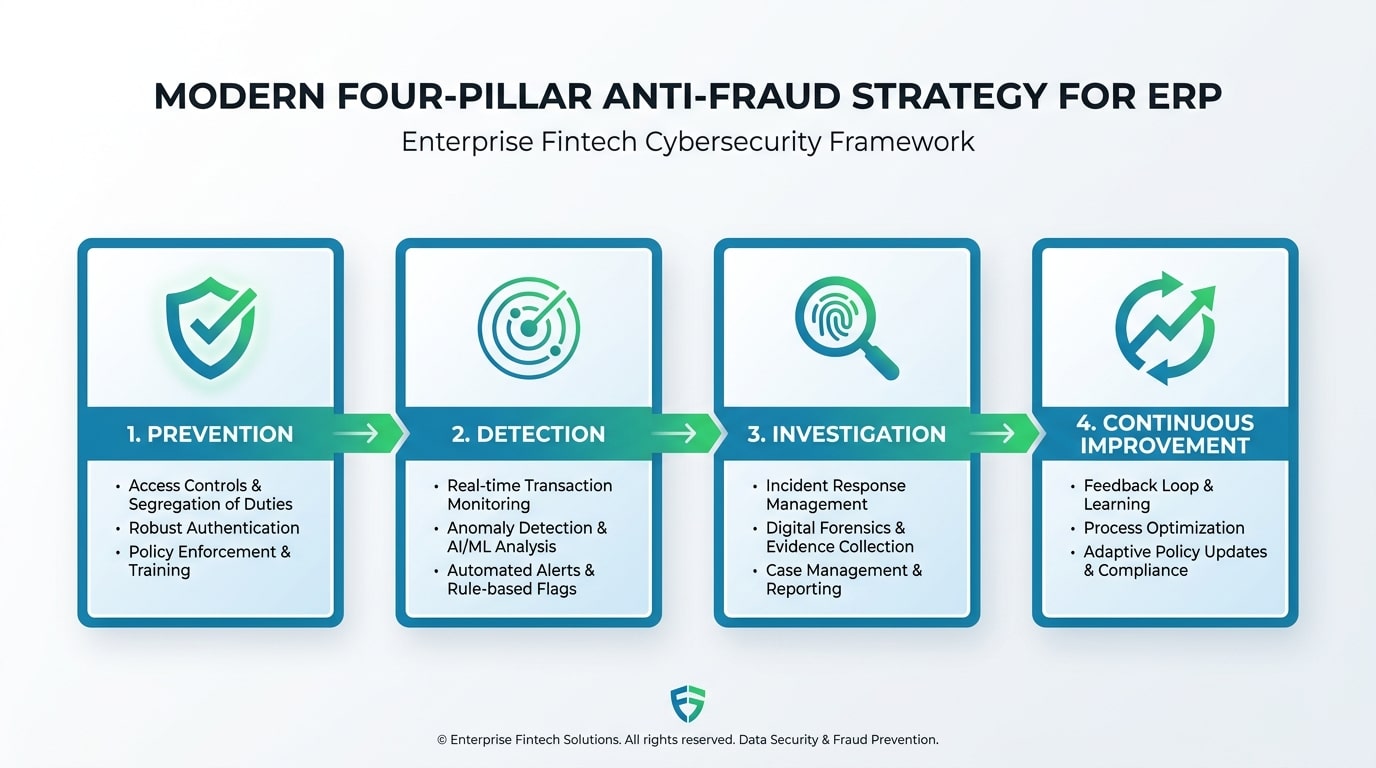
A modern strategy combines prevention, detection, investigation, and continuous improvement. Prevention begins with access governance and process design. Detection depends on continuous monitoring that cross-checks transactions against behavioral baselines in real time, not quarterly. Investigation requires ready protocols so that when a red flag appears, the response is structured rather than improvised.
Detelix supports this approach by operating as an independent control layer over sensitive ERP processes. It continuously scans vendor changes, payment patterns, approvals, and master data edits, and generates real-time alerts when activity deviates from expected behavior. The goal is not to add another dashboard, but to give finance and audit leaders the ability to act before money leaves the organization. Guidance from the GAO audit guide on internal controls reinforces that data mining, payment analysis, and vendor review are essential components of any serious fraud defense.
Did You Know
Independent control layers sit outside the ERP’s own permission model, which means they remain effective even when a trusted user with elevated access is the source of the anomaly. This is a structural advantage that in-system controls cannot fully replicate.
How Detelix Addresses Specific ERP Control Needs
| Business Need | How Detelix Helps in Practice |
|---|---|
| Detect unauthorized vendor bank changes | Real-time alerts on sensitive master data edits before the next payment run |
| Identify split invoices and threshold avoidance | Pattern analysis across related transactions rather than single-event review |
| Reduce dependence on manual reconciliation | Continuous cross-checking of transactions against expected behavior |
| Strengthen oversight of privileged users | Behavioral monitoring of high-access accounts and service users |
| Support audit and investigation readiness | Structured alert history and contextual evidence for each flagged event |
| Fit operational reality of finance teams | Independent layer that does not slow ERP workflows or require user changes |
Comparing Traditional Controls to Real-Time Protection
| Dimension | Traditional Controls | Real-Time Protection Layer |
|---|---|---|
| Timing | Periodic, after the fact | Continuous, while activity is happening |
| Scope | Sampled transactions | Full transaction population |
| Detection basis | Predefined rules and checklists | Behavioral patterns and cross-module correlation |
| Response speed | Days to months after an event | Minutes, before funds move |
| Dependence on manual review | High | Low, review focuses on flagged anomalies |
When to Run a Dedicated ERP Fraud Assessment
A dedicated fraud assessment is valuable after system implementation, major upgrades, mergers, restructuring, permission model changes, or any suspicious event. It is equally important to run one on a regular schedule even in stable periods, because control drift happens silently. Transitions create temporary gaps, and those gaps are exactly when fraudsters find room to operate.
Detelix Solutions That Close the ERP Control Gap

Proactive Monitoring
Continuous oversight of vendor changes, payment patterns, and approval flows across the entire ERP.

Real-Time Alerts
Immediate notifications when sensitive master data changes or transactions deviate from expected behavior.

Gatekeeper Control Layer
An independent oversight layer that validates sensitive actions without slowing ERP workflows.

Proven Experience
Decades of experience protecting enterprise systems across finance, operations, and critical supply chains.
Frequently Asked Questions
What is the difference between ERP fraud and general financial fraud?
ERP fraud happens inside the operational and accounting system through manipulated processes, permissions, or master data. General financial fraud is a broader category that may not involve an enterprise system at all. ERP fraud is harder to detect because it hides within legitimate workflows.
Are audit logs enough to detect insider fraud in an ERP?
No. Audit logs record actions but rarely provide the business context needed to distinguish fraud from routine work. Effective detection requires correlating logs with behavioral baselines, process rules, and real-time anomaly analysis.
What is the single most common ERP exploitation technique?
Manipulation of vendor master data, particularly changing bank account details on existing suppliers, is one of the most frequent and damaging techniques because it redirects legitimate payments without triggering standard alerts.
Why is segregation of duties so important in ERP environments?
It prevents any single user from controlling an entire transaction chain, such as creating a vendor, approving an invoice, and releasing payment. Without it, one person can execute and conceal fraud alone.
How quickly can real-time monitoring detect suspicious activity?
When properly implemented, monitoring can flag suspicious transactions within minutes of their occurrence, often before payments are actually released, which is the critical window for preventing loss.
Does automation increase or decrease ERP fraud risk?
Automation reduces human error but can increase fraud risk if automated workflows lack exception handling and independent oversight. The goal is automation paired with real-time control, not automation alone.
Ready to Move From Routine Monitoring to Real Control?
If fraudsters are exploiting ERP systems through the very workflows your organization relies on, can you see it happening in time to stop it?