
Stop SAP Fraud Before It Costs Your Business
Real-time ERP monitoring and fraud prevention tailored for finance, audit, and operations leaders. Get a free consultation with Detelix today.
- What is SAP Fraud Prevention?
- Why Fraud in SAP Systems is a Critical Business Risk
- How Common Frauds Occur in SAP Processes
- Why SAP Fraud is Rarely a One-Time Event
- Key SAP Security Controls to Implement First
- Early Warning Signs: Red Flags in SAP Data
- Is Segregation of Duties Enough on Its Own?
- Detection vs. Prevention: Building a Two-Layered Defense
- Comparing Approaches to SAP Fraud Prevention
- Common Mistakes That Weaken SAP Fraud Programs
- How to Identify Suspicious Patterns in SAP
- Choosing the Right SAP Fraud Prevention Solution
- Mapping Business Needs to Real-Time Control
- The Recovery Workflow: What to Do After Detection
- Can SAP Fraud Be Prevented Without Slowing Operations?
- How Long Does It Take to Implement SAP Fraud Prevention?
- Frequently Asked Questions
In many organizations, SAP environments look well-protected on paper. There are approval flows, role-based permissions, audit reports, and reconciliations. Yet when a transaction depends too heavily on routine review, after-the-fact analysis, or manual oversight, fraud and costly errors can still slip through unnoticed. SAP fraud prevention is not about adding more reports — it is about gaining real-time visibility into what is actually happening across sensitive ERP processes, so leadership can act before money leaves the organization. This article walks finance, audit, and operations leaders through the practical foundations of preventing fraud in SAP, the most common attack patterns, the controls that matter most, and how to build a defense that protects the business without slowing it down.
Key Takeaways
- SAP fraud most often exploits gaps in process, permissions, and oversight — not advanced technical vulnerabilities.
- Segregation of duties is essential, but it must be paired with continuous real-time monitoring to close gaps that collusion and management override can create.
- Vendor master data — especially bank account changes — is among the highest-risk areas in any ERP environment and requires strict dual approval with real-time alerting.
- A mature fraud prevention strategy combines preventive controls (locks on the door) with detective controls (cameras watching what actually happens).
- Risk-based controls, tuned thresholds, and clear investigation workflows allow organizations to protect the business without creating friction in routine operations.
- Phased implementation delivers faster value — starting with vendor master data, duplicate payment detection, and payment run anomalies before expanding coverage.
What is SAP Fraud Prevention?
SAP fraud prevention is a structured framework of controls, monitoring tools, and business processes designed to detect, block, and investigate unauthorized or suspicious activity inside ERP-driven workflows. It covers procurement, payments, master data, payroll, and financial close — the areas where money, permissions, and data intersect. Done well, it shifts the organization from reactive cleanup after losses to proactive defense of sensitive financial data.
The goal is not just to detect anomalies, but to operate a continuous fraud risk management program tailored to the real exposures of the business, as recommended in the COSO Fraud Risk Management Guide. Platforms such as Detelix serve as an efficient protection system that cross-checks ERP activity in real time, helping organizations identify human errors, embezzlement attempts, and process failures before they become losses.
Tip
Frame your SAP fraud prevention program around the specific workflows where money and master data intersect — vendor payments, bank detail changes, and journal entries. These three areas account for the majority of material fraud losses in ERP environments and should be your starting point for both controls and monitoring.
Why Fraud in SAP Systems is a Critical Business Risk
SAP sits at the heart of procurement, supplier payments, payroll, and financial reporting. A single weakness — a permission that is too broad, an unmonitored master data change, or an unchallenged payment override — can lead to direct financial loss, regulatory exposure, and damage to the integrity of the financial statements.
According to the ACFE 2024 Report to the Nations, internal control weaknesses are a leading driver of occupational fraud, and schemes often run for months before discovery. Standard ERP logs are rarely enough to detect sophisticated patterns. That is why specialized real-time control layers are needed — to give CFOs, controllers, and auditors visibility into what is happening right now, not only after a quarterly review.

Did You Know
The ACFE 2024 Report to the Nations found that the median duration of an occupational fraud scheme before detection was 12 months, and that organizations with real-time monitoring in place detected fraud significantly faster than those relying solely on periodic audit. Every month a scheme runs undetected adds to the total loss.
How Common Frauds Occur in SAP Processes
Most SAP frauds do not exploit advanced technical vulnerabilities. They exploit gaps in process, permissions, and oversight — using legitimate access in illegitimate ways.
The Mechanics of Vendor Fraud
Fictitious vendors, duplicate supplier records, and manipulated bank details are among the most common schemes. A perpetrator may set up a shell company that mimics a real supplier, or quietly change banking information on an existing vendor right before a payment run, redirecting funds to a controlled account.
Tip
Run a periodic cross-match between vendor bank account numbers and employee bank account numbers in your HR system. Shared banking details between employees and vendors is one of the clearest indicators of a fictitious vendor or insider fraud scheme — and this check takes minutes to automate.
Payment Manipulation
Splitting invoices to stay under approval thresholds, processing payments to inactive vendors, or pushing transactions outside policy windows are recurring patterns. Each looks routine in isolation, but reveals intent when viewed across time and behavior.
User Authority Abuse
When a single user can create a vendor, approve an invoice, and release a payment, the entire control chain collapses. This lack of separation is the root of most internal theft cases inside ERP systems.
Did You Know
Invoice splitting — dividing a large invoice into several smaller amounts to stay below approval thresholds — is one of the most common and hardest-to-catch payment manipulation schemes. Because each individual transaction appears compliant, it often passes undetected through standard approval workflows for months.
Why SAP Fraud is Rarely a One-Time Event
Unlike a single external breach, ERP fraud tends to repeat in small, deliberate increments. A modified bank account, a duplicated invoice, a manual journal entry — each event may seem minor, but together they create cumulative damage that erodes profitability and audit confidence. The longer the activity continues, the harder it becomes to unwind. This is why continuous monitoring matters far more than periodic sampling: the question is not whether something happened, but whether you can see it in time to stop it.
Key SAP Security Controls to Implement First
Not every control delivers the same value. The strongest starting point is the set of controls that reduce high-impact risk with reasonable effort — what experienced practitioners call priority controls.
Segregation of Duties
No single user should control a transaction from creation to payment. The GAO Federal Information System Controls Audit Manual highlights segregation of duties, access controls, and oversight of admin users as fundamental in ERP environments.
Master Data Integrity
Vendor bank accounts, addresses, and tax identifiers must be protected with strict workflows, dual approval, and change logs. Master data is where many frauds are quietly seeded.
Continuous Monitoring
Periodic audits cannot keep pace with daily transaction volumes. Real-time detection — with risk-based alerts and clear ownership — is now the operational standard for high-risk ERP processes.
Tip
When prioritizing controls, start with the three that consistently deliver the highest fraud risk reduction: locking vendor bank account changes behind dual approval with real-time alerts, detecting duplicate invoices before payment release, and restricting any single user from completing the full procure-to-pay cycle without a second authority.
Early Warning Signs: Red Flags in SAP Data
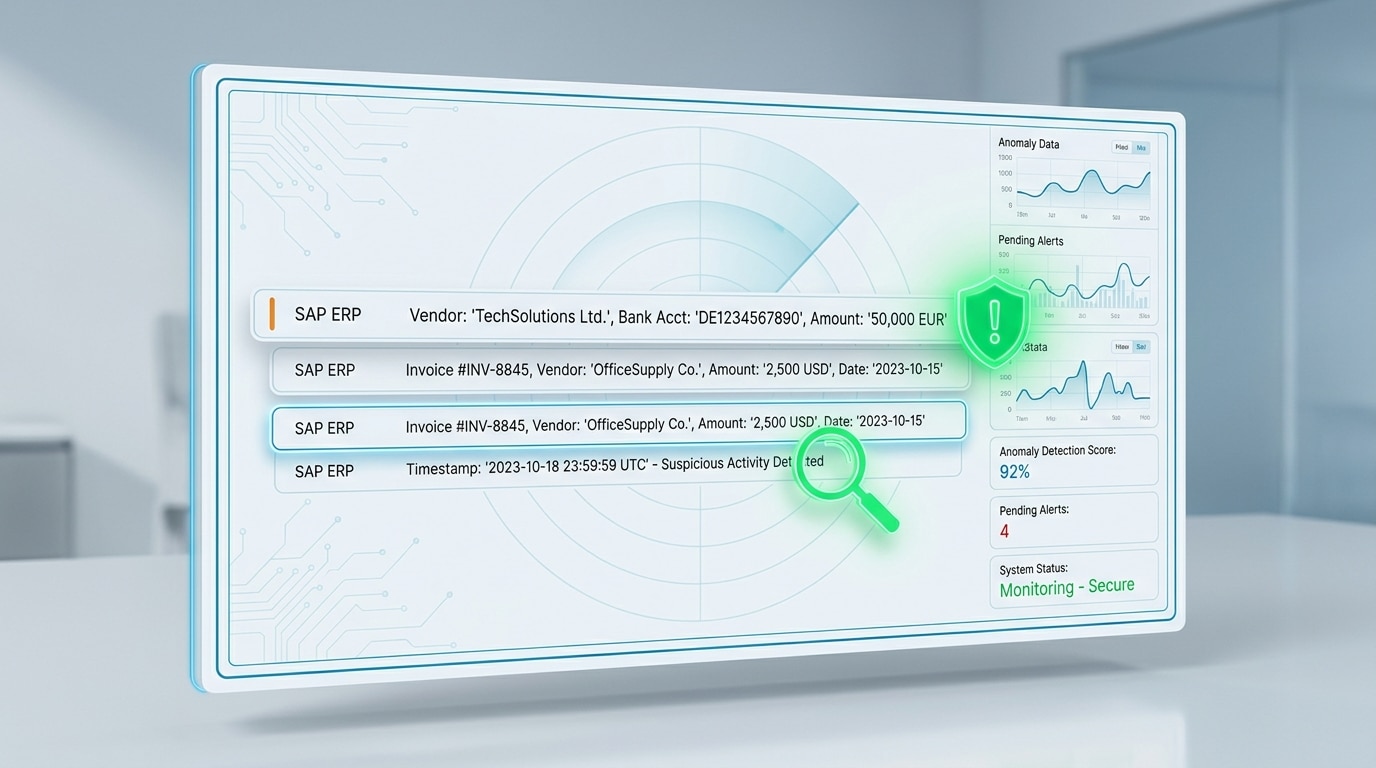
Strong programs train teams to recognize specific indicators rather than vague suspicion. Watch for vendor bank account changes immediately before a payment run, duplicate invoices with slight variations in number or amount, transactions executed at unusual hours, vendors sharing addresses or bank accounts with employees, and new suppliers receiving immediate high-value payments.
Other red flags include missing vendor information, threshold avoidance patterns, and master data edits that bypass standard approval. The risks involved in changing bank account details deserve particular attention, since this single field can route legitimate payments to a fraudster within minutes if not properly controlled.
Did You Know
Transactions processed outside normal business hours — late at night, on weekends, or during public holidays — are statistically more likely to be fraudulent than those executed during standard working hours. This is because perpetrators prefer to act when supervisors and colleagues are least likely to notice. Flagging off-hours activity is one of the quickest behavioral rules to implement.
Your SAP environment processes millions in payments every month. Is your team seeing what actually happens — or only what the reports show after the fact?
Is Segregation of Duties Enough on Its Own?
Segregation of duties is essential, but it is not a complete defense. It can be undermined by collusion between two employees, by management override, or by temporary access granted during projects and never revoked. NIST SP 800-171 defines separation of duties and least privilege as core requirements for reducing malicious activity, but emphasizes that they must be enforced continuously.
This is why preventive controls need a safety net of detective controls. When prevention fails — and at some point it will — real-time monitoring becomes the difference between catching a problem in hours and discovering it months later in an audit.
Detection vs. Prevention: Building a Two-Layered Defense
Prevention is the lock on the door: permissions, approval flows, blocked fields, and segregation of duties. Detection is the camera that watches what actually happens: real-time analytics, anomaly detection, and behavioral monitoring across transactions and master data.
Modern fraud schemes are designed to look like normal activity, so prevention alone is rarely sufficient. A mature SAP fraud prevention strategy combines both layers — preventing what can be prevented, and continuously detecting what slips through. This is the difference between managing activity and actually controlling it.
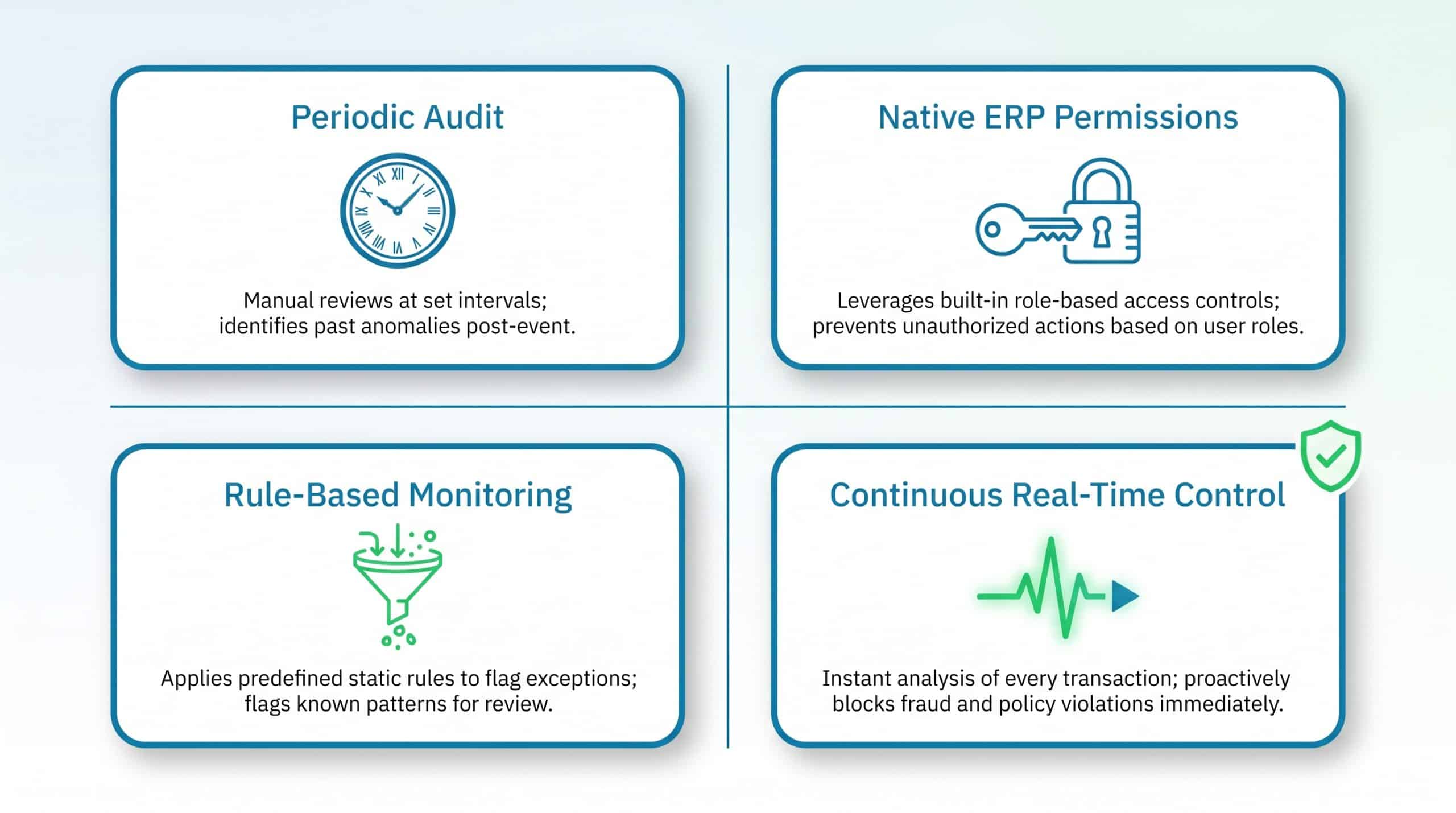
Comparing Approaches to SAP Fraud Prevention
| Approach | Primary Goal | Control Type | Example Use Cases | Strengths | Limitations |
|---|---|---|---|---|---|
| Periodic audit | Verify compliance after the fact | Detective | Quarterly vendor review, sample testing | Structured documentation | Slow, retrospective |
| Native ERP permissions | Restrict access by role | Preventive | SoD, role-based access | Built-in, low cost | Static, hard to monitor in real time |
| Rule-based monitoring | Flag known risk patterns | Detective | Duplicate invoices, threshold breaches | Predictable, explainable | Misses novel schemes |
| Continuous real-time control | Detect and alert during the activity | Preventive + detective | Bank detail changes, payment anomalies, master data edits | Acts before damage occurs | Requires tuning and ownership |
Common Mistakes That Weaken SAP Fraud Programs
Even well-funded programs fail when the fundamentals are off. The most frequent mistakes include relying solely on permissions without monitoring behavior, treating fraud prevention as a one-time project rather than an ongoing program, generating too many low-quality alerts that desensitize the team, ignoring master data controls in favor of payment-only monitoring, and failing to define a clear response workflow for confirmed incidents. Each of these gaps creates the illusion of control without the substance of it.
Tip
Alert fatigue is one of the most underestimated risks in fraud prevention programs. If your team receives hundreds of alerts per week and investigates fewer than 10%, the monitoring system has become noise. Invest time in tuning thresholds, adding context to alerts, and defining clear ownership for each alert category — this alone can double the program’s effectiveness without changing any underlying technology.
How to Identify Suspicious Patterns in SAP
Effective anomaly detection blends business rules with behavioral analysis. Rules catch known schemes — duplicate payments, threshold avoidance, payments to blocked vendors. Behavioral analysis catches deviations from normal — a user suddenly approving transactions outside their usual scope, a vendor receiving payments at unusual frequency, or a sequence of small edits to master data that together change a payment destination.
Risk scoring matters as much as detection. Not every anomaly is fraud, so weighting by amount, user role, transaction type, and historical context helps teams focus investigation effort where it matters most.
Choosing the Right SAP Fraud Prevention Solution
The right solution is the one that maps to your real business risks, not the longest feature list. When evaluating options, look for native coverage of the procure-to-pay cycle, configurable rules and risk scoring, low false-positive rates, clear investigation workflows, and an immutable audit trail. Implementation speed and minimal IT burden matter as much as analytical depth.
This is where Detelix is designed to fit naturally into Israeli and global organizations: it focuses on the highest-risk ERP processes, integrates without heavy IT lift, and gives finance and audit teams real-time visibility without overwhelming them with noise. The emphasis is on actionable alerts that lead to real control, not just more dashboards.
Did You Know
Many organizations discover during implementation that their existing ERP roles contain far more conflicting permissions than they realized. A structured segregation-of-duties analysis before deploying monitoring tools often reveals dozens of users with access combinations that create fraud risk — access that was granted for legitimate short-term reasons and never removed.
Mapping Business Needs to Real-Time Control
| Business Need | How Real-Time Control Helps |
|---|---|
| Protect supplier payments | Cross-checks bank detail changes, payment runs, and vendor history before funds leave |
| Strengthen master data | Flags edits to sensitive fields and verifies they follow approved workflows |
| Reduce duplicate payments | Identifies near-duplicate invoices and split transactions in real time |
| Improve audit readiness | Maintains a continuous audit trail of exceptions, decisions, and remediation |
| Support lean finance teams | Reduces manual review by prioritizing alerts based on risk |
The Recovery Workflow: What to Do After Detection
Detection is only the start. A disciplined response workflow turns an alert into protection. The sequence typically runs from alert validation, to triage and severity scoring, to evidence preservation, escalation to the right stakeholders, formal investigation, remediation, and finally lessons learned that strengthen future controls.
Throughout the process, an immutable audit trail is essential — for internal accountability, external audit, insurance claims, and any potential legal action. The Green Book standards for internal control provide a strong reference for documenting controls, exceptions, and investigation outcomes in a way that holds up to scrutiny.
Can SAP Fraud Be Prevented Without Slowing Operations?
Yes — when controls are designed around risk rather than applied uniformly. Blanket controls create friction, slow approvals, and breed workarounds. Risk-based controls focus the strongest oversight on the highest-exposure processes, such as bank detail changes, high-value payments, and manual journal entries, while keeping routine activity efficient. Tuning thresholds, automating low-risk approvals, and reducing false positives are what make a fraud prevention program sustainable in the long run.
How Long Does It Take to Implement SAP Fraud Prevention?
Realistic timelines depend on process complexity, the number of integrated systems, and organizational maturity. The most successful programs deliver quick wins in the first phase by covering a small set of high-impact use cases — typically vendor master data changes, duplicate payment detection, and payment run anomalies. Subsequent phases expand coverage to additional processes such as payroll, inventory, and journal entries, with continuous tuning to reduce noise and improve precision. Thinking in stages, rather than as a single launch, is what separates programs that endure from those that stall.
If you cannot see sensitive ERP activity as it happens, you are relying on hope between audits. Real control means knowing what is happening right now, identifying anomalies before money leaves the organization, and giving your finance, audit, and operations teams the confidence to act early. To explore how real-time alerts and continuous control can strengthen your SAP environment, talk to the Detelix team and see how proactive protection looks in practice.
Detelix SAP Fraud Prevention Solutions

Proactive Monitoring
Continuous real-time surveillance of SAP transactions, master data changes, and user behavior to surface fraud risk before it becomes a loss.

Real-Time Alerts
Instant risk-based notifications for high-priority events such as bank account changes, payment anomalies, and segregation-of-duties violations.

Gatekeeper Controls
Preventive blocking and dual-approval workflows for the most sensitive ERP actions, stopping unauthorized changes before they reach the payment stage.

Expert Implementation
Hands-on deployment by Detelix specialists who configure controls around your specific ERP landscape, risk profile, and compliance requirements.
See Detelix SAP Fraud Prevention in Action
Frequently Asked Questions
How can I prevent duplicate payments in SAP?
Combine vendor master cleanup, automated duplicate-invoice detection across number, amount, and date variations, and a real-time review of payment proposals before release.
Why is changing a vendor’s bank account a high-risk event?
Because a single field change can redirect every future payment to a fraudster. It must trigger verification, dual approval, and a real-time alert before the next payment run.
Can a fictitious vendor be detected inside SAP?
Yes. Patterns such as missing tax IDs, addresses matching employee records, immediate high-value activity, and shared bank accounts are strong indicators of shell-company schemes.
How do we know if user permissions create fraud risk?
Run a segregation of duties analysis against critical processes, review privileged access, and monitor whether users actually exercise conflicting capabilities — not just whether they hold them.
What is the difference between preventive and detective controls?
Preventive controls block unauthorized activity before it happens. Detective controls identify it as it occurs. Both are needed, because no preventive layer is perfect.
How quickly can fraud controls be deployed in SAP?
A focused first phase covering high-risk use cases such as bank detail changes and payment anomalies can typically be operational within weeks, with broader coverage rolled out in stages.
Is continuous monitoring better than periodic audit?
They serve different purposes. Continuous monitoring catches issues in time to act. Periodic audit validates the control environment. The strongest programs use both.
Ready to Take Control of Your SAP Environment?
Real fraud prevention means seeing every sensitive transaction as it happens — not reconstructing what went wrong after the loss. Talk to the Detelix team and find out what continuous real-time control looks like for your organization.