
Stop Fraud Before It Leaves Your ERP
Detelix delivers real-time AI-powered fraud detection for SAP, Oracle, Priority, and NetSuite — built for finance teams who need genuine control, not just reports.
- What is AI ERP Fraud Detection?
- Why Organizations Need Smart Fraud Alerts in the ERP
- How Machine Learning Fraud Detection in ERP Operates
- Fraud Detection vs. Anomaly Detection: Knowing the Difference
- Rule Engines vs. Machine Learning: A Practical Comparison
- Identifying Types of Fraud Within the ERP
- Solving the False Positive Dilemma
- Real-Time Detection: When Speed Actually Matters
- A Common Mistake: Treating AI as a Replacement for Process
- Roadmap for Implementing Machine Learning Fraud Detection in ERP
- How to Measure Success of Fraud Prevention
- Can AI Replace Internal Auditors?
- Business Need vs. How Detelix Helps
- How to Choose the Right AI ERP Fraud Detection Solution
- Frequently Asked Questions
In many organizations, financial controls look strong on paper. There are approval workflows, ERP permissions, reconciliations, and quarterly audits. Yet when fraud, payment errors, or policy deviations slip through, leaders often discover the gap only after the damage is done. This is the operational reality that has pushed CFOs, controllers, and internal auditors to look beyond traditional rule-based monitoring and toward intelligent systems that can see what is happening across the ERP in real time. AI ERP fraud detection is not a buzzword — it is a practical control layer that helps finance teams move from routine review to actual prevention, before money leaves the company.
Key Takeaways
- AI ERP fraud detection shifts organizations from reactive discovery to real-time, proactive prevention — catching risk before payments are executed.
- Machine learning models analyze combinations of signals across procurement, accounts payable, and master data, detecting patterns that rule-based engines consistently miss.
- Reducing alert fatigue is as important as detection accuracy — the right system surfaces fewer, higher-quality alerts that finance teams can act on immediately.
- Vendor bank account changes, duplicate invoicing, and SoD violations are the highest-value use cases for intelligent ERP monitoring.
- AI augments internal auditors rather than replacing them — it handles data volume and pattern recognition so humans can focus on judgment and remediation.
- Successful deployment follows a phased roadmap: discovery, pilot, calibration, and expansion — with measurable ROI visible from the first pilot phase.
What is AI ERP Fraud Detection?
AI ERP fraud detection is the use of artificial intelligence and machine learning to continuously monitor transactions, master data changes, user activity, and approval flows inside enterprise resource planning systems such as SAP, Oracle, Priority, and NetSuite. Instead of waiting for an audit cycle or a quarterly review, the system analyzes every action as it happens, learns what normal behavior looks like, and surfaces deviations that warrant attention.
The shift here is fundamental: organizations move from reactive discovery — finding fraud months after the fact — to proactive prevention. With Detelix, our hundreds of algorithms ensure every action in the ERP system is cross-checked against behavioral baselines, business logic, and known fraud patterns, giving finance leaders genuine oversight rather than the illusion of control.
Tip
When evaluating an AI fraud detection platform, ask the vendor to demonstrate how the system handles a vendor bank account change followed immediately by a large outbound payment. This single scenario reveals whether the platform analyzes event sequences — not just isolated transactions.
Why Organizations Need Smart Fraud Alerts in the ERP
Traditional rule-based systems were built for a slower, more predictable era. They catch what they were explicitly told to catch — a payment over a threshold, a duplicate invoice number, a known blacklisted vendor. But modern fraud is multi-vector: a small supplier change combined with an off-hours approval and a slightly inflated invoice can pass every individual rule while collectively representing a serious risk.
Smart fraud alerts in the ERP, powered by artificial intelligence fraud prevention, look at combinations of signals rather than isolated events. According to Israel’s State Comptroller, computerized payment systems are increasingly exposed to both internal and external exploitation, making intelligent oversight a business necessity rather than a luxury. You can review the relevant findings in the official report on computerized payment controls.
Did You Know
According to the Association of Certified Fraud Examiners (ACFE), organizations lose an estimated 5% of annual revenues to fraud each year — and the median time to detect a fraud scheme is 12 months. Real-time AI monitoring can reduce that detection window from months to minutes.
How Machine Learning Fraud Detection in ERP Operates
Machine learning fraud detection in ERP starts with data. The system ingests information from procurement, accounts payable, vendor master data, user logs, and approval histories. It then builds behavioral models that represent how each user, department, and process normally operates. When a new transaction arrives, the model compares it against those baselines and produces a decision in milliseconds.
Data Points Analyzed by the System
The system looks at vendor IBAN changes, invoice dates, payment terms, approver identity, time-of-day patterns, IP addresses, and relationships between entities. It also examines master data modifications — for example, a bank account change followed quickly by a payment — which is one of the most common patterns in CFO fraud schemes.
Tip
Ensure your fraud detection platform ingests user session data — not just transaction records. The time of day, device used, and sequence of actions within a session often contain stronger fraud signals than the transaction values themselves.
The Generation of Risk Scoring
Each transaction receives a numerical risk score based on the weighted combination of indicators. High scores trigger immediate alerts; medium scores feed investigation queues; low scores pass through silently. Crucially, modern systems provide explainability — the reasoning behind each score — so auditors can act with confidence. The principles of explainable anomaly detection for procurement fraud are central to making AI usable in regulated finance environments.
Did You Know
Explainability in AI fraud detection is not just a usability feature — it is increasingly a regulatory requirement. Financial regulators in multiple jurisdictions now expect organizations to be able to demonstrate why a transaction was flagged or cleared, which means black-box models are becoming unsuitable for enterprise use.
Fraud Detection vs. Anomaly Detection: Knowing the Difference
These terms are often used interchangeably, but they describe different problems. Anomaly detection finds anything statistically unusual — a one-time large but legitimate purchase, an end-of-quarter spike, a new supplier from a new region. Fraud detection focuses on intent and pattern: anomalies that align with known fraud typologies or that combine in ways consistent with malicious behavior.
All fraud is anomalous, but not all anomalies are fraud. A well-designed system filters the noise and helps your team focus on the small percentage of events where investigation actually pays off.
Tip
When reviewing vendor alerts, cross-reference anomalies with the business calendar. End-of-quarter procurement spikes and fiscal year-end payroll adjustments are normal anomalies — a well-tuned system should already know this context and suppress low-risk seasonal noise automatically.
Rule Engines vs. Machine Learning: A Practical Comparison
The most effective control environments combine both approaches. Rules handle the known and the regulated; machine learning handles the unknown and the evolving.
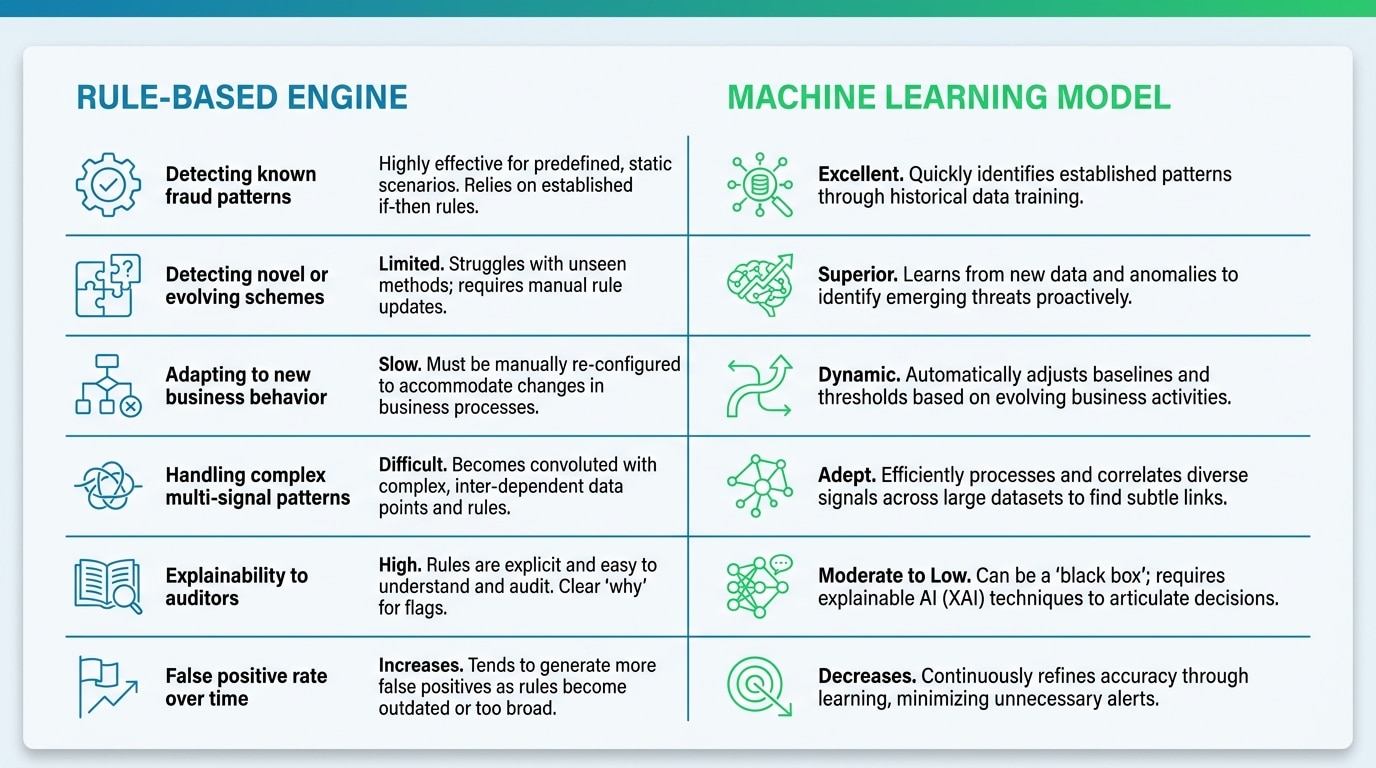
| Capability | Rule-Based Engine | Machine Learning Model |
|---|---|---|
| Detecting known fraud patterns | Strong | Strong |
| Detecting novel or evolving schemes | Limited | Strong |
| Adapting to new business behavior | Manual updates required | Continuous learning |
| Handling complex multi-signal patterns | Difficult | Designed for it |
| Explainability to auditors | Very high | High with proper design |
| False positive rate over time | Tends to grow | Improves with feedback |
Identifying Types of Fraud Within the ERP
Fraud inside an ERP rarely looks dramatic. It usually looks like a small deviation in a familiar process. Understanding the typologies helps you direct controls to where they matter most.
Procure-to-Pay Cycle Vulnerabilities
The P2P cycle is one of the most exploited areas in any organization. Common schemes include split purchase orders to bypass approval thresholds, fictitious vendors created in master data, and subtle modifications to vendor banking details. Recent investigations in Israel uncovered networks of fictitious vendor companies operating at scale, reminding finance leaders that vendor onboarding is a critical control point. For a deeper look at one of the highest-risk actions in this cycle, see our analysis on the dangers of changing bank account details in ERP systems.
Did You Know
Vendor master data fraud — particularly unauthorized bank account changes — accounts for a disproportionate share of high-value payment fraud losses. In many cases, the fraudulent change sits dormant in the system for weeks before the first payment is redirected, making timing analysis a critical detection signal.
Accounts Payable and Invoice Manipulation
Duplicate invoicing remains one of the costliest and most underdetected forms of loss. Standard ERP duplicate checks rely on exact matches — same vendor, same invoice number, same amount — which sophisticated schemes easily circumvent by altering a single character or splitting amounts across line items. Machine learning identifies near-duplicates, semantic matches, and timing anomalies that rule-based systems miss entirely. For more on this control gap, read our piece on Detecting Duplicate Payments in ERP – Why Controls Fail.
User Behavior and Privilege Abuse
Segregation of Duties (SoD) is a foundational control, but in practice it is often weakened by emergency access grants, role accumulation, or shared credentials. AI monitors how users actually behave — not just what they are permitted to do — and flags activity that suggests a single individual is controlling more of a process than policy intends.
Your ERP holds your most sensitive financial data. Are you monitoring it with the intelligence it deserves? Detelix gives finance and audit teams real-time visibility into every transaction, approval, and master data change — with alerts that actually lead to action.
Solving the False Positive Dilemma
Alert fatigue is the silent killer of fraud detection programs. When auditors receive hundreds of low-quality alerts per week, real risks get buried in the noise and the team loses trust in the system. Smart fraud alerts in the ERP solve this through context-aware thresholds, active learning from analyst feedback, and severity ranking that elevates the few alerts that truly require human attention.
Detelix is designed around this principle: fewer, better, more actionable alerts — each one accompanied by the operational context the investigator needs to decide quickly.
Tip
Track your team’s alert closure rate weekly. If investigators are closing more than 80% of alerts as false positives, that is a clear signal that thresholds need recalibration — not that the system is working well. A healthy fraud detection program should target a false positive rate below 20% within the first quarter of operation.
Real-Time Detection: When Speed Actually Matters
Not every process requires millisecond-level response, but several do. Vendor bank account changes, large outbound payments, master data modifications, and after-hours approvals are areas where minutes matter. For other workflows — periodic reconciliations, inventory adjustments, payroll runs — hourly or daily monitoring is sufficient.
The right architecture matches detection speed to business risk, ensuring that high-value transactions receive immediate scrutiny without overwhelming the system or the team.
A Common Mistake: Treating AI as a Replacement for Process
One of the most frequent missteps is deploying an intelligent system on top of broken processes and expecting it to compensate. AI strengthens controls; it does not invent them. If your vendor onboarding process lacks documentation requirements, or if approval thresholds are set too high, no model will fully close those gaps.
The correct sequence is: tighten the process, define what good looks like, then layer real-time intelligence on top to catch deviations from that standard.
Did You Know
Organizations that implement AI fraud detection without first reviewing their approval workflows and vendor onboarding procedures typically see 40–60% higher false positive rates in the first six months. Clean process design upstream is the single biggest predictor of AI detection quality downstream.
Roadmap for Implementing Machine Learning Fraud Detection in ERP
A successful deployment follows a predictable pattern. The goal is to demonstrate value early, build organizational confidence, and expand coverage over time.
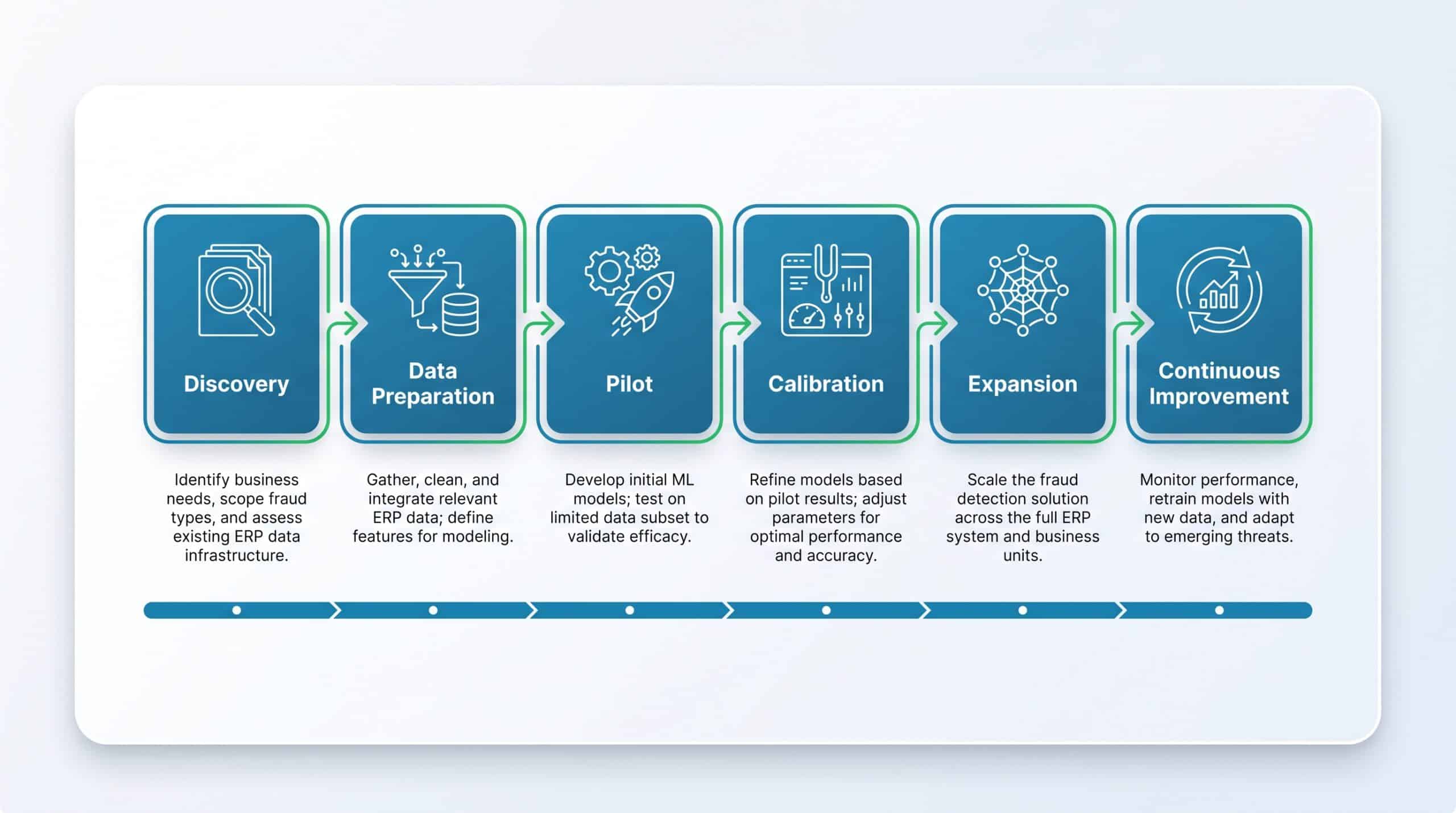
| Phase | Focus | Typical Outcome |
|---|---|---|
| Discovery | Map highest-risk processes and data sources | Prioritized use case list |
| Data preparation | Clean master data, standardize logs | Reliable training inputs |
| Pilot | Run on one or two processes (e.g., AP, vendor changes) | Initial alerts and tuning |
| Calibration | Adjust thresholds based on analyst feedback | Reduced false positives |
| Expansion | Extend to additional modules and entities | Enterprise-wide coverage |
| Continuous improvement | Update models, add typologies | Sustained ROI |
Detelix supports this trajectory with rapid integration into existing ERP environments and pre-built logic for common Israeli and global business scenarios, which shortens time-to-value significantly.
Tip
Start your pilot on the accounts payable module and vendor master data — these two areas consistently deliver the fastest measurable ROI and produce the clearest evidence of control improvement for your internal audit committee and board reporting.
How to Measure Success of Fraud Prevention
Counting fraud cases caught is only one metric, and often a misleading one. Stronger indicators include reduction in average investigation time, decrease in false positive rates, monetary value of losses prevented, percentage of high-risk processes covered, and improvement in audit readiness.
Israel’s Tax Authority reported recovering billions of shekels through digital monitoring of suspicious invoices via the Israel Invoice system, illustrating the scale of measurable impact when intelligent oversight is properly deployed.
Can AI Replace Internal Auditors?
No — and it should not. AI is augmented intelligence: it does the heavy lifting of data analysis, pattern recognition, and prioritization, freeing auditors and finance professionals to focus on judgment, interpretation, and remediation. Regulatory bodies, including Israel’s joint inter-ministerial team, have emphasized the need for tiered human involvement in AI-driven financial decisions. The relevant guidance is captured in the official press release on AI in the financial sector. The model is not “AI versus humans” — it is AI surfacing the right cases so humans can act on them.
Business Need vs. How Detelix Helps
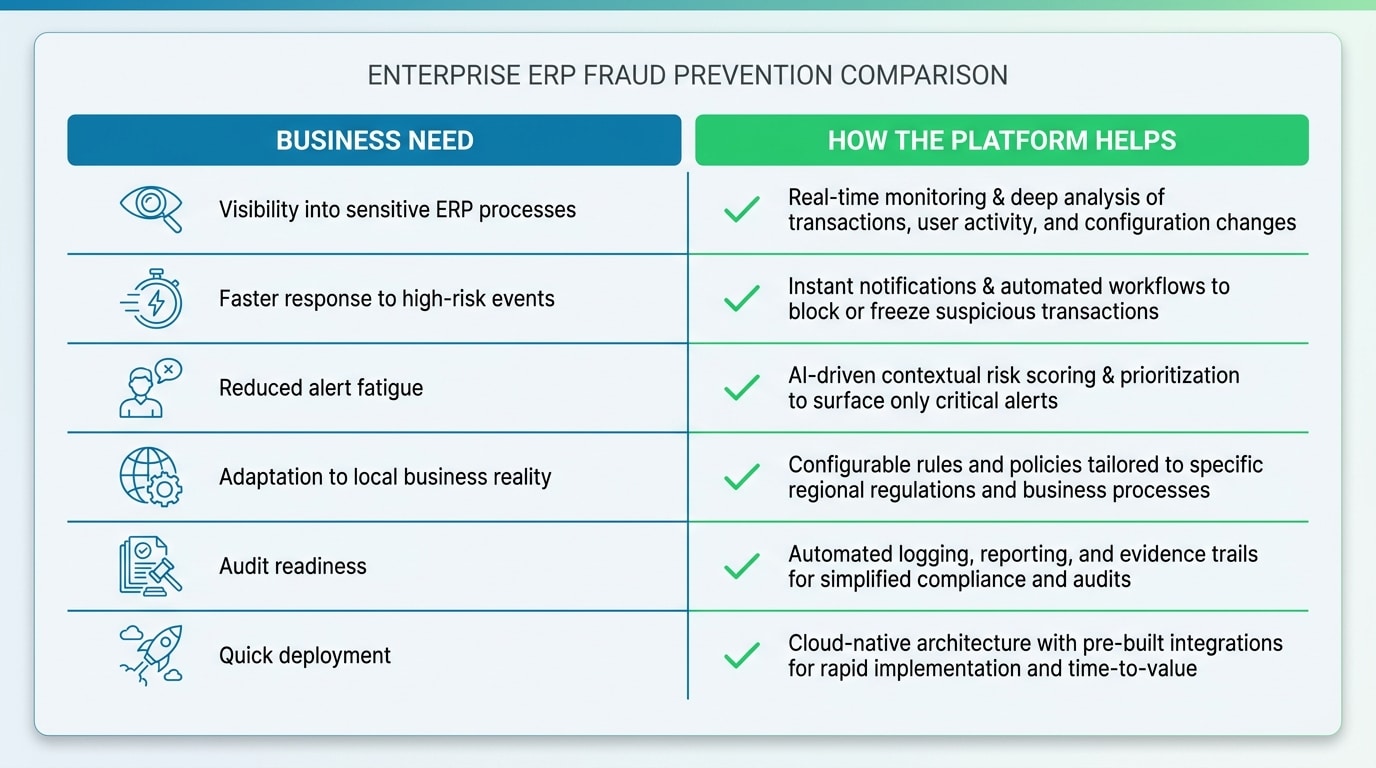
| Business Need | How the Platform Helps |
|---|---|
| Visibility into sensitive ERP processes | Continuous, cross-module monitoring across procurement, payments, payroll, and master data |
| Faster response to high-risk events | Real-time alerts prioritized by severity and business context |
| Reduced alert fatigue | Context-aware scoring that filters noise and highlights what matters |
| Adaptation to local business reality | Logic and use cases designed for Israeli regulatory and operational environments |
| Audit readiness | Explainable findings and traceable investigation history |
| Quick deployment | Pre-built integrations with common ERP platforms |
How to Choose the Right AI ERP Fraud Detection Solution
When evaluating solutions, focus on practical criteria rather than feature marketing. Can the system integrate with your specific ERP without lengthy custom development? Does it explain its alerts clearly enough for auditors and business owners to act? Can it process events in real time where needed and on schedule where appropriate? Does it allow your team to refine logic without depending on the vendor for every change?
And critically — does it reflect understanding of your industry and regulatory environment? A strong control partner brings knowledge, experience, and technology together, not just a dashboard.
Did You Know
Most ERP fraud detection implementations fail not because of the technology, but because of poor fit between the platform’s alert logic and the organization’s actual business processes. Vendors with deep ERP and industry expertise consistently outperform generic analytics platforms on time-to-value and long-term adoption rates.
Detelix ERP Fraud Prevention Solutions

Proactive Monitoring
Continuous surveillance of all ERP activity — transactions, master data changes, and user behavior — with intelligent prioritization so your team focuses where it counts.

Real-Time Alerts
Instant, explainable alerts delivered to the right people at the right time — with the context needed to investigate and resolve in minutes, not days.

Gatekeeper
A dedicated control layer for high-risk ERP actions — including vendor bank account changes and payment approvals — that enforces policy before funds move.

Deep ERP Experience
Hundreds of pre-built detection algorithms built on years of experience across SAP, Oracle, Priority, and NetSuite — covering Israeli and global regulatory requirements.
See Detelix ERP Fraud Detection in Action
Frequently Asked Questions
What is the difference between AI and rule-based detection?
Rule-based detection catches predefined scenarios; AI learns behavioral baselines and catches combinations of signals that no individual rule would identify. The strongest programs use both approaches together — rules for the known and regulated, machine learning for the unknown and evolving.
How does the system identify a duplicate payment?
Beyond exact-match checks, machine learning models compare invoice content semantically, detect near-duplicates with minor variations, and analyze timing patterns to flag potential duplicates that bypass standard ERP validation. This catches sophisticated schemes that alter a single character in an invoice number or split amounts across line items.
Can this be implemented on legacy ERP systems?
Yes. Modern fraud detection platforms connect through data exports, APIs, or database-level integrations, meaning legacy ERPs can benefit from real-time intelligent oversight without requiring system replacement or lengthy custom development cycles.
How long until we see meaningful results?
Initial value typically appears during a focused pilot. Significant improvement in alert quality and coverage usually follows a calibration period of several weeks to a few months, after which alert accuracy improves substantially as the model learns from investigator feedback.
Is AI fraud detection suitable for mid-sized organizations?
Absolutely. Mid-sized organizations often have leaner finance teams, which makes intelligent prioritization even more valuable. Modern platforms scale to organizational size and complexity, and the risk exposure in mid-market companies is just as real as in large enterprises.
Does the system handle vendor master data changes?
Yes — and this is one of the highest-value use cases. Bank account modifications, new vendor creation, and changes to payment terms are monitored continuously to prevent redirection-of-funds schemes. The system correlates master data changes with subsequent payment activity to detect timing-based fraud patterns.
What happens when the model produces a false positive?
Analyst feedback feeds back into the model, refining thresholds and improving accuracy over time. This active learning loop is what separates modern fraud detection from static rule engines — the system gets measurably better the more your team interacts with it, rather than degrading as business conditions change.
Ready to Move From Routine Monitoring to Real Control?
If your finance and audit teams are still relying on after-the-fact reports to catch what should have been prevented, the gap between managing activity and actually controlling it will only widen. Request a tailored walkthrough of how Detelix delivers real-time visibility, intelligent alerts, and explainable risk scoring across your most sensitive financial processes.