Gain Real-Time Visibility Into Every ERP Configuration Change
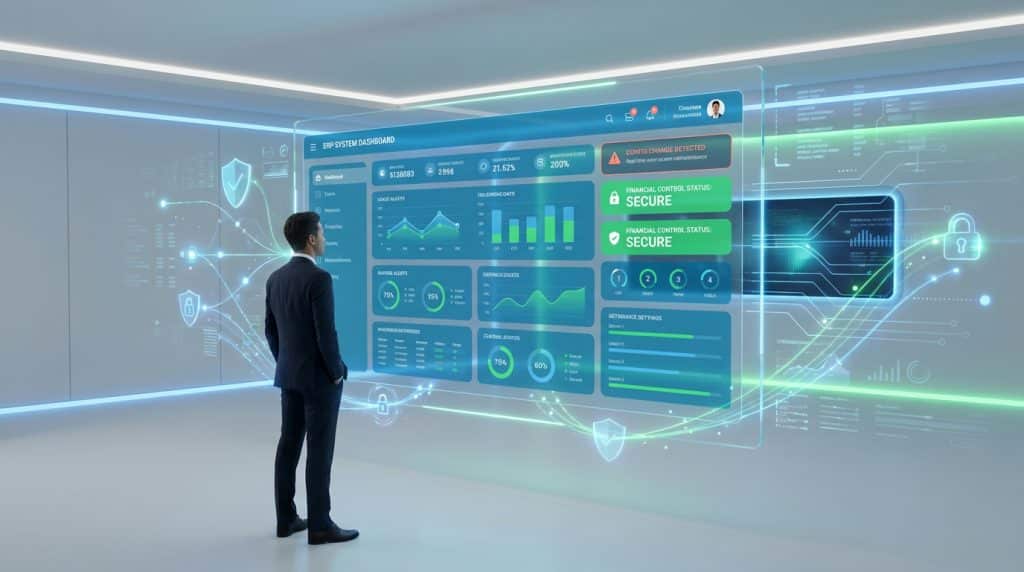
Stop relying on periodic audits to catch critical changes. Detelix gives finance leaders continuous monitoring of the system settings that drive financial reporting accuracy.
- What Exactly Is ERP Change Monitoring for Finance Controls?
- Why Configuration Drift Threatens Finance Process Integrity
- Change Management vs. ERP Change Detection
- Which Critical Fields Deserve Monitoring in Financial Controls?
- The Real Danger of Unauthorized Master Data Changes
- How to Define Critical Field Change Alerts Without Overwhelming Your Team
- Real-Time Monitoring or Daily Checks — What Does Finance Need?
- How ERP Change Monitoring Supports SOX Compliance and Financial Audits
- Continuous Controls Monitoring and Why Change Detection Is Its Foundation
- Spotting a Dangerous Change: Red Flags That Should Trigger Investigation
- Reducing False Positives in Configuration Drift Monitoring
- Who Should Own ERP Change Monitoring?
- Building a Baseline: The First 90 Days After an ERP Go-Live
- A Practical Framework: From Baseline to Ongoing Detection
- How to Measure Whether Your Change Monitoring Program Is Working
- The Evolving Audit Landscape
- Common Mistakes That Undermine ERP Change Monitoring Programs
- Frequently Asked Questions
Financial controls in many organizations look robust on paper. Approval workflows exist, ERP permissions are configured, reconciliations run on schedule, and audit binders fill up each quarter. Yet beneath this polished surface, a different reality often unfolds. A posting rule gets quietly adjusted. A tolerance threshold is raised during an urgent month-end fix. A user role gains an extra authorization that bypasses segregation of duties. These small, often well-intentioned changes accumulate inside the ERP system, and because no one watches the configuration layer in real time, risk slips through unnoticed until a late-stage audit finding or a financial misstatement forces attention.
Key Takeaways
- ERP change monitoring for finance controls provides continuous visibility into the system settings that determine how every transaction is recorded, approved, and reported.
- Configuration drift — the gradual divergence between your approved ERP state and its actual state — is one of the most common and least detected sources of financial risk.
- Change management policies protect you only against changes that follow the rules; change detection catches everything else, including emergency fixes, direct table edits, and integration-driven modifications.
- Risk-based alerting, tiered by criticality, prevents alert fatigue while ensuring that genuinely dangerous changes receive immediate attention.
- Continuous monitoring creates the structured, timestamped evidence trail that auditors and regulators increasingly expect under SOX, PCAOB AS 2201, and evolving technology-assisted audit standards.
What Exactly Is ERP Change Monitoring for Finance Controls?
ERP change monitoring for finance controls is the continuous, systematic process of identifying, documenting, and alerting on modifications to system parameters that govern financial data. This goes far beyond tracking who logged in or which transactions were posted. It focuses on the structural layer — posting logic, account determination rules, approval thresholds, tax configurations, mandatory field settings, and user authorizations — that dictates how financial information flows through the system. When any of these elements change without detection, the integrity of every downstream report, reconciliation, and control is potentially compromised.
Tip
Start your monitoring scope with the configuration elements that directly feed your financial statements. Posting rules, account determination tables, and approval thresholds should be the first items on your detection list — they carry the highest downstream impact if silently altered.
Leading governance frameworks reinforce this principle. The GAO Green Book identifies ongoing monitoring as a fundamental component of any healthy internal control system, emphasizing that control quality must be evaluated continuously rather than only during periodic assessments.
Why Configuration Drift Threatens Finance Process Integrity
Configuration drift occurs when the actual state of your ERP system gradually diverges from its approved, documented state. It rarely happens through a single dramatic event. Instead, it builds through dozens of small adjustments: an emergency transport applied on a Friday evening, a consultant tweaking a posting key during a project phase, a parameter changed to resolve a month-end discrepancy and never reverted. Over weeks and months, the system you believe you are running is no longer the system that is actually running.
Did You Know
According to NIST SP 1800-34, a baseline configuration is defined as a set of approved specifications at a fixed point in time that should only change through formal change control procedures. Configuration monitoring means continuously comparing the live system against that baseline and reporting any deviation.
This is particularly dangerous for finance because the symptoms often appear far from the cause. A recurring reconciliation break, an unexpected variance in cost allocation, or a spike in manual journal entries may all trace back to a configuration change made weeks earlier. Without configuration drift monitoring, the root cause remains invisible. Detelix addresses this challenge by providing real-time visibility into ERP configuration changes, helping financial managers detect human error, unauthorized modifications, and process deviations before they cascade into costly problems.
Change Management vs. ERP Change Detection — A Common Misconception
Many finance and IT leaders assume that having a change management process eliminates the need for change detection. In practice, these are two complementary but distinct disciplines. Change management is the policy-driven process of requesting, approving, and documenting a modification before it is made. Change detection is the technical capability to identify what actually changed in the system — including changes that never went through the formal process at all.
Even organizations with mature change advisory boards experience undocumented changes. Emergency fixes bypass normal workflows. Direct table edits occur during data migrations. Integration feeds update configuration parameters without human review. ERP change detection catches all of these, regardless of whether a ticket exists. Without it, your change management policy protects you only against the changes people choose to follow the rules for.
Tip
Cross-reference every detected change against your approved change list automatically. This single step separates authorized modifications from unauthorized ones and immediately highlights the changes that require investigation — without requiring a human to manually compare logs against tickets.
Which Critical Fields Deserve Monitoring in Financial Controls?
Not every ERP field carries the same risk. Effective ERP change monitoring for finance controls requires a deliberate focus on fields whose modification directly affects financial reporting accuracy, control effectiveness, or fraud exposure. The table below categorizes the most common critical field areas.
| Category | Examples of Critical Fields | Risk If Changed Undetected |
|---|---|---|
| Account Determination Rules | Posting keys, GL account assignments, revenue recognition rules | Transactions post to wrong accounts; misstatement of financial results |
| Approval Thresholds & Tolerances | Invoice matching tolerances, payment release limits | Bypassed approval controls; unauthorized payments processed |
| Tax Configuration | Tax codes, jurisdiction assignments, withholding parameters | Incorrect tax reporting; regulatory penalties |
| Master Data Fields | Vendor bank details, customer payment terms, intercompany settings | Payment fraud; revenue leakage; inaccurate consolidation |
| User Roles & Authorizations | Role assignments, sensitive transaction codes, SoD-relevant permissions | Segregation of duties violations; ability to create and approve own transactions |
| Mandatory Field Settings | Required fields on purchase orders, invoices, journal entries | Incomplete records; weakened data quality controls |
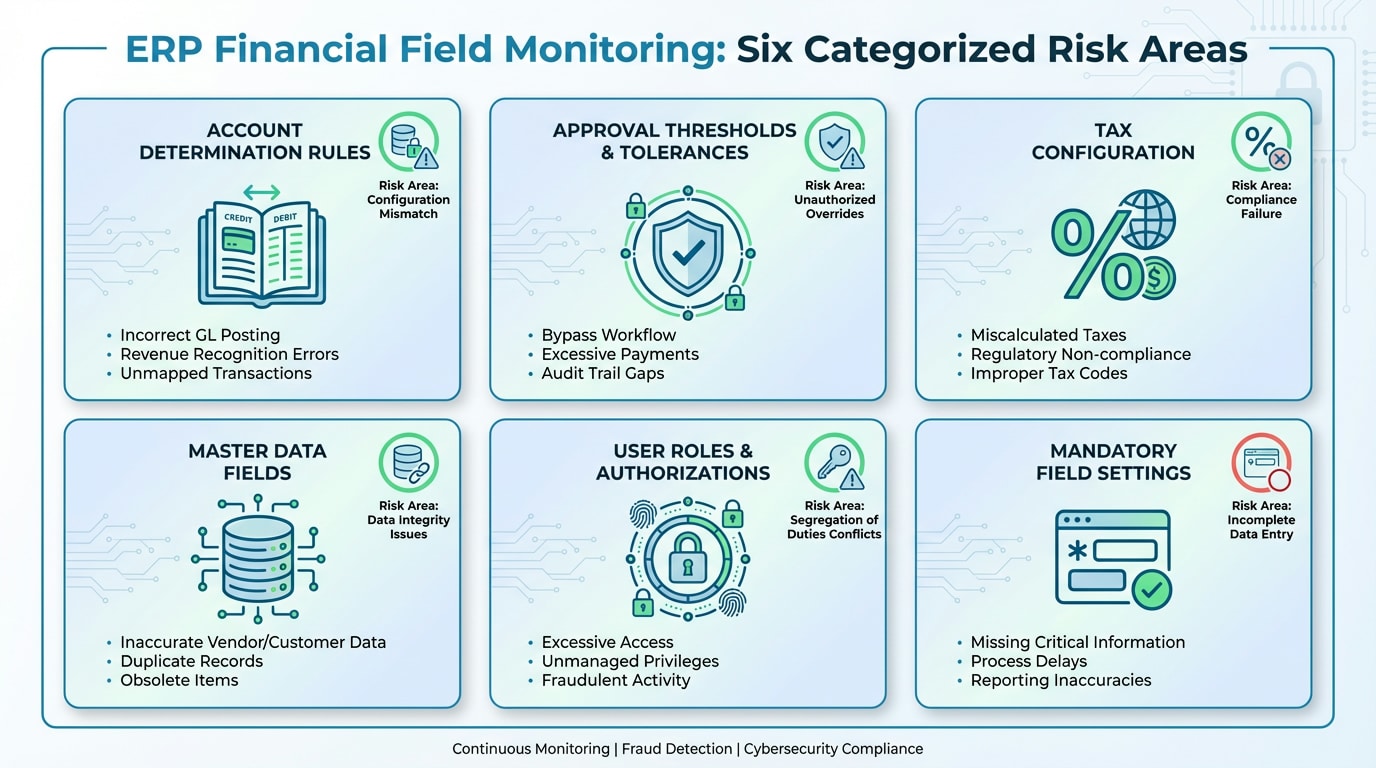
Criticality should be assessed based on impact on financial reporting, volume of affected transactions, ability to circumvent an existing control, and whether the change produces a “silent failure” — a situation where the error does not trigger any immediate system warning but quietly distorts downstream data.
Did You Know
A single unauthorized modification to a supplier’s bank routing number can redirect an entire payment run to a fraudulent account. By the time the legitimate vendor calls to ask about the missing payment, the funds are often unrecoverable.
The Real Danger of Unauthorized Master Data Changes
Among all critical field categories, master data changes — particularly to vendor and company bank account details — represent one of the highest-risk scenarios. A single unauthorized modification to a supplier’s bank routing number can redirect an entire payment run to a fraudulent account. By the time the legitimate vendor calls to ask about the missing payment, the funds are often unrecoverable. For a deeper exploration of this specific risk, consider the dangers of changing bank account details in ERP systems and why automated alerts on these fields are essential.
Tip
Implement dual-notification alerts on vendor bank detail changes: one alert goes to finance operations for immediate verification, and a second goes to compliance for audit trail documentation. This ensures both rapid response and regulatory evidence in a single workflow.
How to Define Critical Field Change Alerts Without Overwhelming Your Team
Alert fatigue is one of the most common reasons ERP monitoring initiatives fail. When every change generates a notification, the team quickly learns to ignore them. The solution is risk-based alerting: configuring triggers based on who made the change, what was changed, in which environment, and what the potential financial impact is. A well-designed alerting framework also cross-references each change against an approved change list, suppressing notifications for modifications that have a valid, pre-approved ticket.
A quality alert should include the before-and-after values, the object identifier, the business owner responsible for that area, a link to the corresponding change request (if one exists), and an assessment of which financial processes are affected. This context transforms the alert from noise into actionable intelligence.
| Alert Level | Response Time | Typical Triggers |
|---|---|---|
| Critical | Immediate (real-time) | Change to bank details, SoD-violating role assignment, posting rule override without ticket |
| High | Within hours | Tolerance threshold increase, tax code modification, mandatory field removal |
| Informational | Periodic review (daily/weekly) | Non-financial parameter update, cosmetic field change, scheduled transport |
Detelix supports this tiered approach by allowing organizations to define detection rules aligned with their specific risk appetite, ensuring that finance teams receive only the alerts that truly require attention while maintaining a complete audit trail of every change.
Real-Time Monitoring or Daily Checks — What Does Finance Actually Need?
The answer depends on the risk profile of each monitored element. Changes to user authorizations, payment-related configurations, and core posting rules typically warrant near-real-time detection because they can enable immediate financial harm — an unauthorized payment, a fraudulent journal entry, or a bypassed approval. For lower-risk parameters, such as report formatting settings or non-financial master data fields, a daily or weekly scan may be sufficient.
Did You Know
A practical approach called “frequency by criticality” maps each monitored object to a risk tier, then assigns a detection cadence that matches. This avoids the extremes of either ignoring changes for weeks or flooding your team with thousands of real-time notifications for items that carry minimal financial consequence.
The right balance is a layered architecture: real-time detection for the highest-risk items that can cause immediate damage, hourly or near-real-time checks for high-priority configuration areas, and daily or weekly scans for the broader parameter landscape. This ensures comprehensive coverage without creating an unmanageable volume of alerts.
Your ERP configuration determines how every financial transaction is recorded and reported. Are you confident nothing has changed since your last audit?
How ERP Change Monitoring Supports SOX Compliance and Financial Audits
For organizations subject to SOX or similar financial reporting regulations, ERP change monitoring provides a documented evidence layer that auditors increasingly expect. Under PCAOB AS 2201, auditors can “benchmark” automated application controls — relying on testing from a prior period — only if they can verify that the control has not changed since the baseline. This means the organization must be able to demonstrate, with evidence, that relevant configurations, tables, and parameters remained intact.
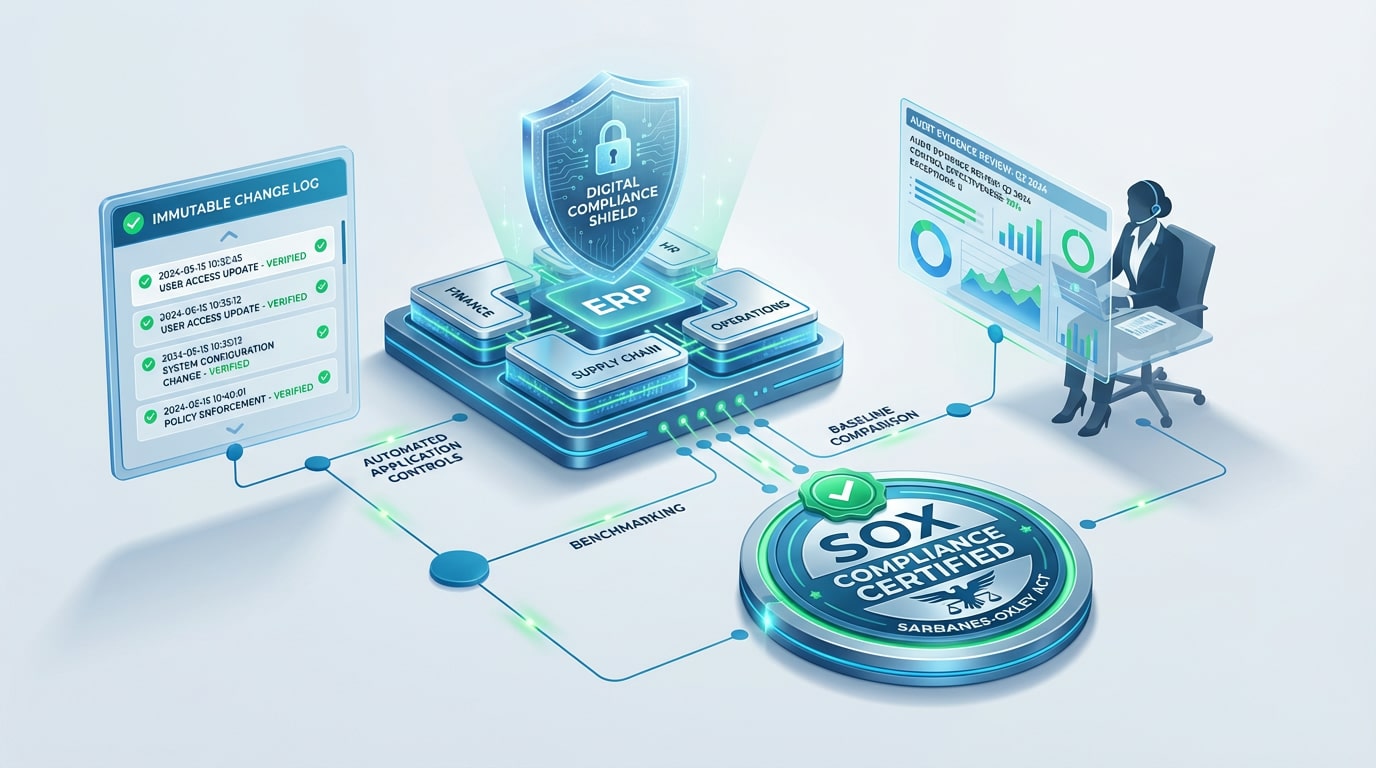
Without change monitoring, proving this is extremely difficult. With it, you can show auditors a timestamped, immutable log of every change (or the absence of changes) across the audit period. This accelerates audit fieldwork, reduces the number of sample items auditors need to test, and strengthens your overall control narrative: “We know who changed what, when, why, and what we did about it.”
Tip
Prepare your change monitoring reports in the format your external auditors prefer before audit season begins. Providing pre-structured evidence packages — organized by control objective and time period — can reduce audit fieldwork duration by weeks and lower external audit fees significantly.
What Is Continuous Controls Monitoring and Why Change Detection Is Its Foundation
Continuous Controls Monitoring (CCM) represents the shift from periodic, sample-based audit testing to ongoing, automated assurance that controls are operating effectively. As described in ISACA’s practical approach to CCM, this includes defining automated tests, setting monitoring frequencies, and establishing alarm-handling workflows for exceptions.
ERP change monitoring for finance controls is a foundational component of CCM because it detects the structural changes that can break a control before the broken control produces a visible error. A CCM program that only monitors transactions without watching the configuration layer is like monitoring traffic speed without noticing that someone moved the stop signs.
Spotting a Dangerous Change: Red Flags That Should Trigger Investigation
Not every ERP configuration change is a threat. Distinguishing a legitimate, approved modification from a potentially dangerous one requires context. A dangerous change is one that alters a financial outcome, modifies an approval path, or expands permissions in a way that increases risk for misstatement or fraud — especially if it lacks proper authorization.
Red flags worth defining in your detection rules include changes made outside the approved change window, modifications performed by privileged or “firefighter” accounts, changes without a corresponding change ticket, changes that are reversed shortly after being made (a possible cover-up pattern), and configuration modifications that coincide with authorization changes for the same user. When these patterns appear, the exception workflow should route the alert to both finance and compliance for review.
Did You Know
Changes that are made and then quickly reversed — sometimes within the same day — can indicate a cover-up pattern. A user might temporarily modify a tolerance threshold to push through an unauthorized payment, then revert the setting to avoid detection during a scheduled review. Only real-time monitoring catches this pattern reliably.
Reducing False Positives in Configuration Drift Monitoring
False positives erode trust in any monitoring program. Reducing them requires moving beyond the simplistic model of “any change equals an alert.” Instead, effective ERP change detection applies context: who initiated the change, what was the scope, was it part of a scheduled transport, and does it match an entry on the pre-approved allowlist. Grouping related changes into a single logical event also helps. For example, a planned system upgrade that modifies fifty parameters should generate one consolidated review item, not fifty individual alerts.
Threshold-based filtering adds another layer: only flag changes whose business impact exceeds a defined level. A tolerance increase from $50 to $55 may be negligible, but from $50 to $5,000 is a fundamentally different risk. The goal is to ensure that when an alert does fire, the team trusts it enough to act immediately.
Tip
Maintain a living allowlist of expected changes tied to approved projects, upgrades, and maintenance windows. Automatically suppress alerts for changes that match an allowlist entry. Review and expire allowlist entries regularly to prevent them from becoming permanent blind spots.
Who Should Own ERP Change Monitoring — Finance, IT, or Compliance?
Ownership disputes frequently stall monitoring initiatives. The most effective model distributes responsibility. Finance defines what is critical and why — because only finance understands the downstream reporting and control implications. IT manages the technical infrastructure, log collection, and integration with ERP systems. Compliance or internal audit validates that the monitoring design covers regulatory requirements and reviews exceptions that cross organizational boundaries.
In practice, this means finance sets the detection rules and receives the business-critical alerts, IT ensures system health and data integrity, and compliance provides independent oversight. Detelix facilitates this shared-ownership model by delivering role-specific dashboards and alert routing, so each stakeholder sees exactly the information relevant to their responsibility without needing to parse through technical noise.
Building a Baseline: The First 90 Days After an ERP Go-Live
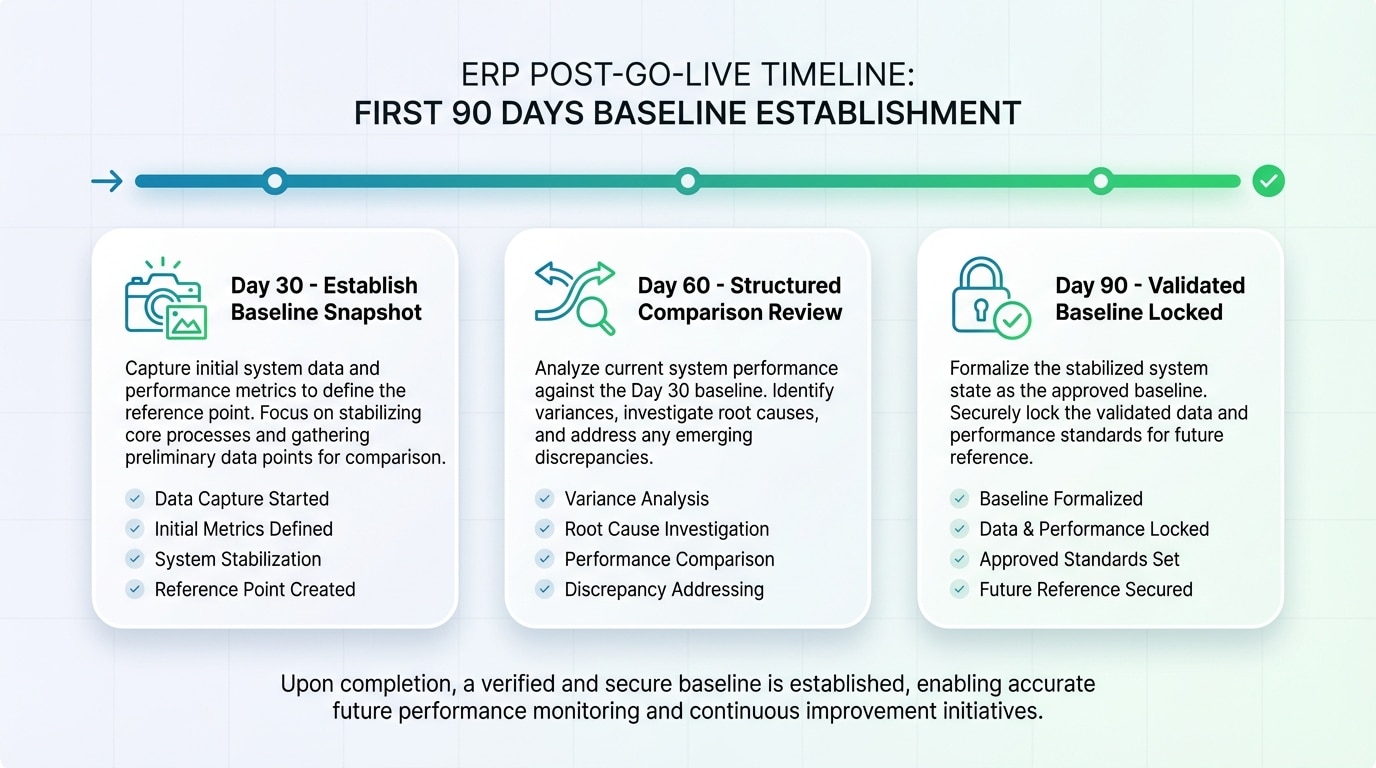
The period immediately following an ERP implementation or major upgrade is one of the highest-risk windows for configuration drift. During go-live, teams often apply rapid fixes, grant temporary elevated access, and adjust parameters under pressure. If these changes are not captured and reviewed, the system enters its “steady state” with an unknown number of undocumented deviations from the designed configuration.
Did You Know
Best practice is to establish a formal baseline snapshot within the first 30 days after go-live, then conduct a structured comparison at day 60 and day 90. Any deviation found during these reviews should be classified as either “accept and update baseline” or “revert to design.” After 90 days, the validated baseline becomes the ongoing reference point for all future change detection.
A Practical Framework: From Baseline to Ongoing Detection
Implementing ERP change detection does not require a multi-year program. A practical framework follows three phases. First, establish the baseline: document all financial posting logic, account determination rules, approval thresholds, and user authorizations in their current approved state. The COSO Internal Control — Integrated Framework provides a useful structure for mapping these elements to the five components of internal control.
Second, automate detection: deploy monitoring that compares the live system against the baseline at the frequency appropriate to each risk tier. This catches not only formal changes but also emergency fixes, direct table edits, and integration-driven modifications that bypass standard workflows. Third, assign business owners: every alert category should have a named individual in finance who is responsible for reviewing and resolving it. Without clear ownership, alerts accumulate unreviewed and the program loses credibility.
Tip
When assigning business owners for alert categories, choose individuals who have the authority to both investigate and remediate. An alert owner who can only escalate but not act creates an unnecessary bottleneck that slows response times and increases risk exposure during the delay.
How Do You Measure Whether Your Change Monitoring Program Is Working?
Measuring success requires more than counting alerts. Consider tracking the following metrics: average time from change to detection (detection latency), percentage of changes that had a valid, pre-approved ticket (change compliance rate), number of exceptions escalated versus resolved within the target window, reduction in audit findings related to configuration or access, and the ratio of actionable alerts to total alerts (signal-to-noise ratio). Over time, these metrics should show improving change discipline, faster response times, and fewer surprises during audit season.
Did You Know
Organizations with mature ERP change monitoring programs typically see their change compliance rate (percentage of changes with pre-approved tickets) improve from under 60% to above 90% within two audit cycles. The monitoring itself creates accountability that drives better behavior across the organization.
The Evolving Audit Landscape: Technology-Assisted Analysis and Electronic Evidence
Regulatory expectations are shifting. The PCAOB’s 2024 updates to auditing standards AS 1105 and AS 2301 clarify auditor responsibilities when using technology-assisted analysis, with increased emphasis on the reliability of electronic information and the testing of relevant controls — including both IT general controls and application controls. Organizations that already have mature ERP change monitoring in place are better positioned to meet these expectations, because they can provide auditors with structured, verifiable electronic evidence rather than relying on manual screenshots and narrative walkthroughs.
Management is also expected to assess and report on material changes in internal controls over financial reporting, as outlined by the SEC in Release 33-8212. ERP change monitoring directly supports this obligation by creating a continuous record of what changed, when, and whether it was addressed.
Common Mistakes That Undermine ERP Change Monitoring Programs
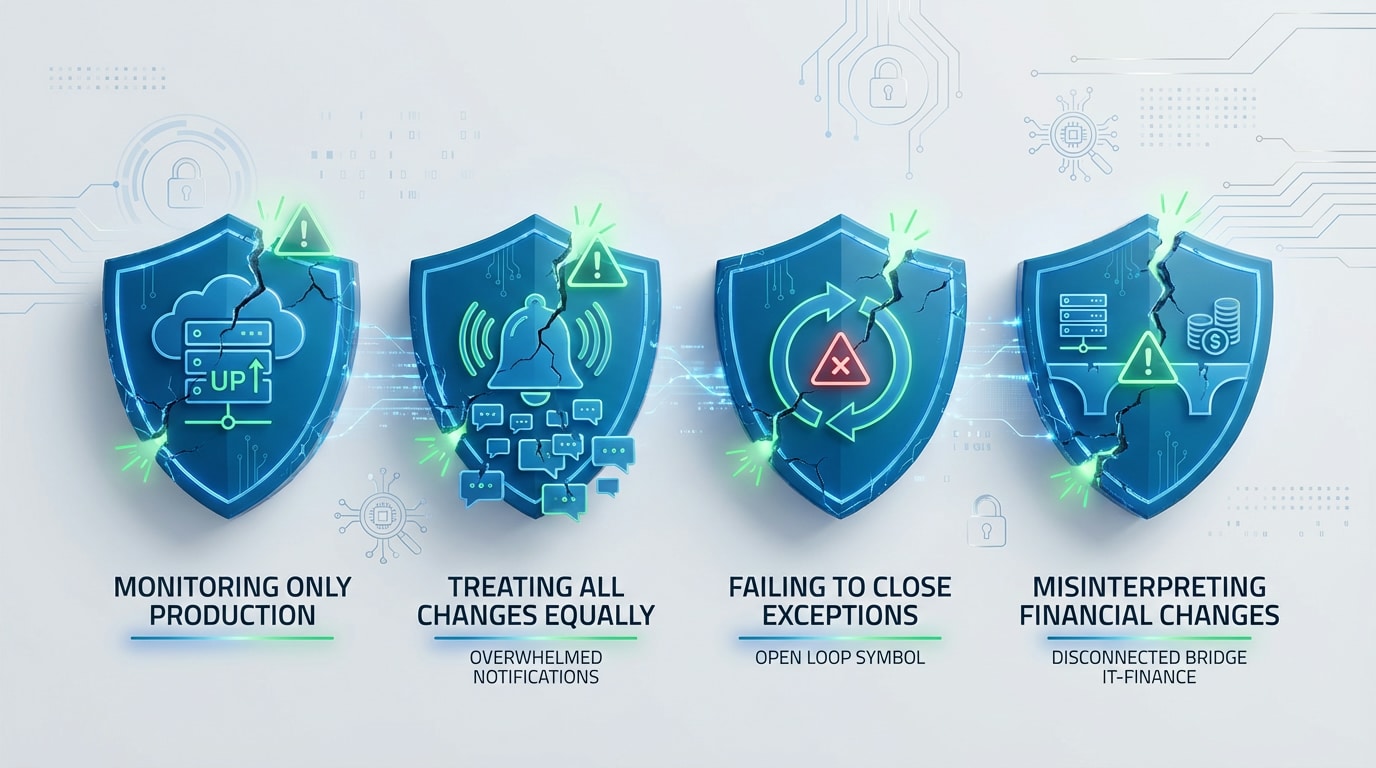
Several patterns consistently weaken monitoring initiatives. Monitoring only production while ignoring changes promoted from development or test environments leaves a blind spot — by the time a risky change reaches production, it may already be embedded in a transport chain. Treating all changes equally, without risk tiering, leads to alert fatigue and disengagement. Failing to close the loop on exceptions — detecting a change but never confirming whether it was authorized — turns monitoring into an expensive logging exercise with no control value. And relying solely on IT to interpret financial configuration changes means business-critical shifts may be dismissed as “technical” without understanding their reporting impact.
Tip
Extend your monitoring scope to include pre-production environments, especially the quality assurance or staging system. A risky configuration change that enters the transport pipeline will eventually reach production — catching it before promotion gives you time to assess and block it without disrupting live operations.
Detelix ERP Monitoring Solutions

Proactive Monitoring
Continuous surveillance of ERP configurations, user activities, and critical system parameters to detect risks before they become incidents.

Real-Time Alerts
Instant notifications on critical ERP changes with risk-tiered routing, ensuring the right stakeholder responds at the right time.

GateKeeper
Automated enforcement of segregation of duties and access control policies, preventing unauthorized permission escalations in real time.

Experience
Decades of expertise in ERP security, financial controls, and compliance — delivered through a platform built by practitioners for practitioners.
See Detelix in Action
Frequently Asked Questions
Can ERP change monitoring replace manual control testing?
It does not replace manual testing entirely, but it significantly reduces the scope. By providing continuous, automated evidence that key configurations have not changed, it allows auditors and control owners to focus manual testing on areas where changes did occur or where automated coverage does not yet exist.
How long does it take to implement an ERP change detection program?
A focused implementation covering the highest-risk financial configurations can be operational within weeks, not months. The critical path is defining the baseline and assigning business owners — technical deployment is often the faster part of the process.
Does ERP change monitoring work for cloud-based ERP systems?
Yes. Cloud ERP platforms generate change logs and audit trails just as on-premise systems do. The monitoring approach may differ in how data is extracted, but the principles of baseline comparison, risk-tiered alerting, and exception management apply equally.
What is the difference between ITGC monitoring and application control monitoring?
IT General Controls (ITGC) cover broad infrastructure and access controls — change management processes, logical access, and program development. Application control monitoring focuses on the specific business rules and configurations within the ERP application itself, such as posting logic, approval workflows, and calculation parameters. Both are necessary; ERP change monitoring for finance controls sits primarily in the application control layer but depends on effective ITGCs for data integrity.
How does Detelix help reduce the cost of compliance?
Detelix automates the detection, documentation, and routing of ERP configuration changes, which reduces the manual effort required during audit preparation. By providing a continuous, structured evidence trail, it shortens audit cycles and decreases the number of sample items auditors need to test independently. This translates into lower external audit fees and reduced internal resource allocation for compliance activities.
Ready to Close the Gap Between Perceived Control and Actual Control?
Move from periodic reviews to continuous, automated ERP change monitoring. Gain real visibility, real evidence, and real control over the systems that drive your financial reporting.