
Protect Your Oracle ERP From Financial Fraud — Before It Costs You
Detelix delivers continuous monitoring, automated controls, and real-time alerting across your Oracle environment. Get a free consultation with our ERP security experts today.
- Understanding Oracle ERP Fraud Prevention
- Why Fraud Monitoring Matters More Than Ever
- What Real Damage Looks Like Inside an Oracle Environment
- Common Fraud Scenarios Within Oracle Environments
- Fraud Detection vs. Fraud Monitoring: Why Proactive Wins
- Comparison: Periodic Audits vs. Continuous Control
- Essential Security Controls for Preventing Oracle Business Risk
- Why Permissions Quietly Become Dangerous Over Time
- How to Identify Excessive Access and Risky Privileges
- Leveraging AI and Advanced Analytics in Oracle ERP
- Early Warning Signs of Financial Fraud in ERP
- Business Value: Beyond Just Stopping Theft
- How Detelix Maps to Real Business Needs
- How to Implement a Robust Oracle Fraud Prevention Project
- Why Organizations Still Struggle to Detect Fraud in Time
- Choosing the Right Oracle ERP Security Solution
- Frequently Asked Questions
Financial controls that look strong on paper can still leave significant gaps in practice. When sensitive Oracle processes depend on routine manual oversight or after-the-fact reporting, risk accumulates quietly — often for months before anyone notices. Oracle ERP fraud prevention is the discipline that closes that gap by combining automated controls, continuous monitoring, and behavioral analytics to protect financial integrity across the entire Oracle ecosystem. The right approach moves an organization from the illusion of control to genuine, real-time visibility over the processes that matter most.
Key Takeaways
- Oracle ERP fraud prevention is a layered strategy — not a single tool — combining access governance, segregation of duties enforcement, master data protection, and real-time alerting.
- Continuous monitoring detects anomalies as they happen, while periodic audits only reveal damage after the fact — often too late to recover funds fully.
- Master data manipulation, SoD conflicts, and excessive permissions are among the most common and costly fraud vectors inside Oracle environments.
- AI-driven behavioral analytics identify subtle deviations that rule-based systems miss, enabling predictive rather than reactive fraud control.
- A phased implementation starting with highest-risk areas — vendor master data, accounts payable, and procurement — delivers early protection and organizational confidence.
- Effective fraud prevention reduces manual audit workload, improves audit readiness, and gives leadership real-time visibility across sensitive financial processes.
Understanding Oracle ERP Fraud Prevention
Oracle ERP fraud prevention is a holistic framework that protects financial and operational processes inside Oracle environments through layered controls, behavioral analytics, and continuous oversight. It is not a single tool — it is a strategy that combines access governance, segregation of duties, master data protection, and real-time alerting to prevent damage before it occurs.
Platforms such as Detelix support this approach by continuously cross-checking transactions, permissions, and master data changes inside Oracle, so exceptions are flagged the moment they appear. The objective is straightforward: protect financial integrity, strengthen operational stability, and give leadership confidence that sensitive ERP processes are genuinely under control.
Tip
When defining your Oracle ERP fraud prevention strategy, map the three highest-risk process areas first — typically vendor master data, accounts payable, and payroll — before expanding coverage. Starting focused produces faster wins and builds internal alignment across finance, IT, and audit teams.
Why Fraud Monitoring Matters More Than Ever in Modern Enterprises
Your Oracle ERP holds the crown jewels of the organization: vendor master data, payment files, payroll, procurement workflows, and the general ledger. When any of these areas lack continuous monitoring, a single overlooked change can translate into significant financial loss or a compliance breach. The centralization that makes ERP so powerful is also what concentrates the risk.
Master data is a particularly common blind spot. A quiet edit to a supplier’s payment details can redirect funds for months before anyone notices, as detailed in the risks of changing bank account details in ERP systems. Without automated oversight, these manual changes can pass through standard approval flows undetected — turning a routine update into a serious financial exposure.
Did You Know
The Association of Certified Fraud Examiners (ACFE) estimates that organizations lose approximately 5% of annual revenues to fraud each year, and the median time to detect occupational fraud is 12 months. In ERP environments without continuous monitoring, that detection window is often even longer.
What Real Damage Looks Like Inside an Oracle Environment
Fraud inside ERP rarely resembles a dramatic breach. More often, it looks like a legitimate transaction performed by an authorized user who knows the process well — someone with the right credentials, operating within normal business hours, following familiar approval workflows. That is precisely what makes it difficult to detect using traditional reviews.
Israel’s State Comptroller has repeatedly highlighted the operational risk of broad permissions and insufficient monitoring in financial systems, as shown in official audit findings on ERP financial controls. The pattern is consistent: when no one is watching in real time, damage compounds quietly across payment cycles until the cumulative loss becomes impossible to ignore.
Tip
Request a sample of all vendor master data changes made in the last 90 days — including who made the change, what was changed, and whether an approval was recorded. If your team cannot produce this list within minutes, your current controls have a significant gap that continuous monitoring would immediately close.
Common Fraud Scenarios Within Oracle Environments
To control risk effectively, finance and audit leaders need to recognize how fraud actually unfolds in ERP systems. The most damaging scenarios are usually those that exploit weak boundaries between roles, processes, and master data — areas where manual oversight cannot keep pace with transaction volume.
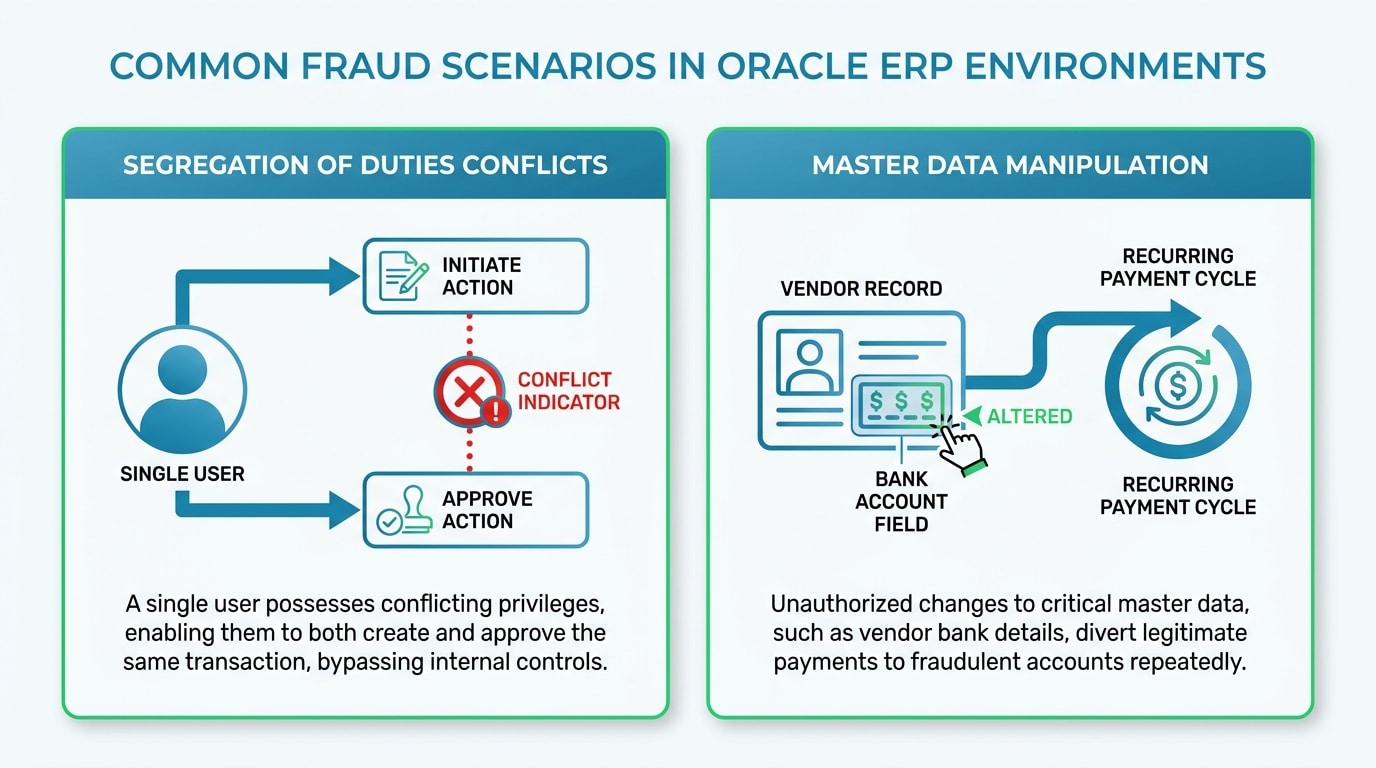
Segregation of Duties (SoD) Conflicts
SoD conflicts arise when a single user can both initiate and approve a sensitive transaction — for example, creating a vendor and approving its payment. According to Oracle’s documentation on Segregation of Duties, separating these functions is essential to prevent both intentional misuse and accidental errors that can lead to financial loss. In practice, these conflicts accumulate gradually as roles evolve and are rarely cleaned up proactively.
Master Data Manipulation
Changes to vendor bank accounts, the creation of ghost suppliers, or subtle edits to employee payroll records are among the most common fraud vectors. Because master data sits behind every transaction, even small unauthorized changes can produce large, recurring losses across many payment cycles — often without triggering any existing alert rules.
Did You Know
In accounts payable fraud schemes involving vendor master data manipulation, the average loss per incident is significantly higher than most other internal fraud types — partly because the same change enables repeated misdirected payments until the scheme is discovered. Automated cross-checking of every master data change is the most direct defense.
Ghost Employees and Payroll Fraud
Payroll fraud involving fictitious employees or inflated compensation records is another high-impact scenario. When a single user can both create an employee record and approve payroll runs, the conditions for ongoing theft are present. Continuous cross-referencing of HR records against payroll outputs closes this exposure.
Invoice and Payment Manipulation
Submitting duplicate invoices, inflating invoice values, or approving payments to unauthorized recipients are recurring patterns in Oracle Accounts Payable environments. Detection depends on correlating invoice data with purchase orders, goods receipts, and vendor history — which manual sampling simply cannot cover at scale.
Fraud Detection vs. Fraud Monitoring: Why Proactive Wins
It is important to separate three terms that are often used interchangeably. Detection identifies that something has already happened. Monitoring observes activity continuously and surfaces unusual patterns as they emerge. Prevention combines both with controls that intervene before damage occurs. Detection alone leaves you reacting to losses; continuous monitoring with strong controls gives you the ability to act before a payment is released or a record is altered.
This distinction matters because most fraud is reversible only in a narrow window. Once funds leave the company, recovery becomes complicated, costly, and often partial. The shift from periodic review to real-time control is what defines a modern Oracle ERP fraud prevention strategy — and it is where the measurable difference in financial outcomes is found.
Tip
When building the business case for continuous monitoring, calculate your organization’s average time-to-detection under current controls and multiply that by your average monthly AP outflow in high-risk categories. That figure represents the realistic exposure window your current approach leaves open — and the potential value of closing it.
Comparison: Periodic Audits vs. Continuous Control
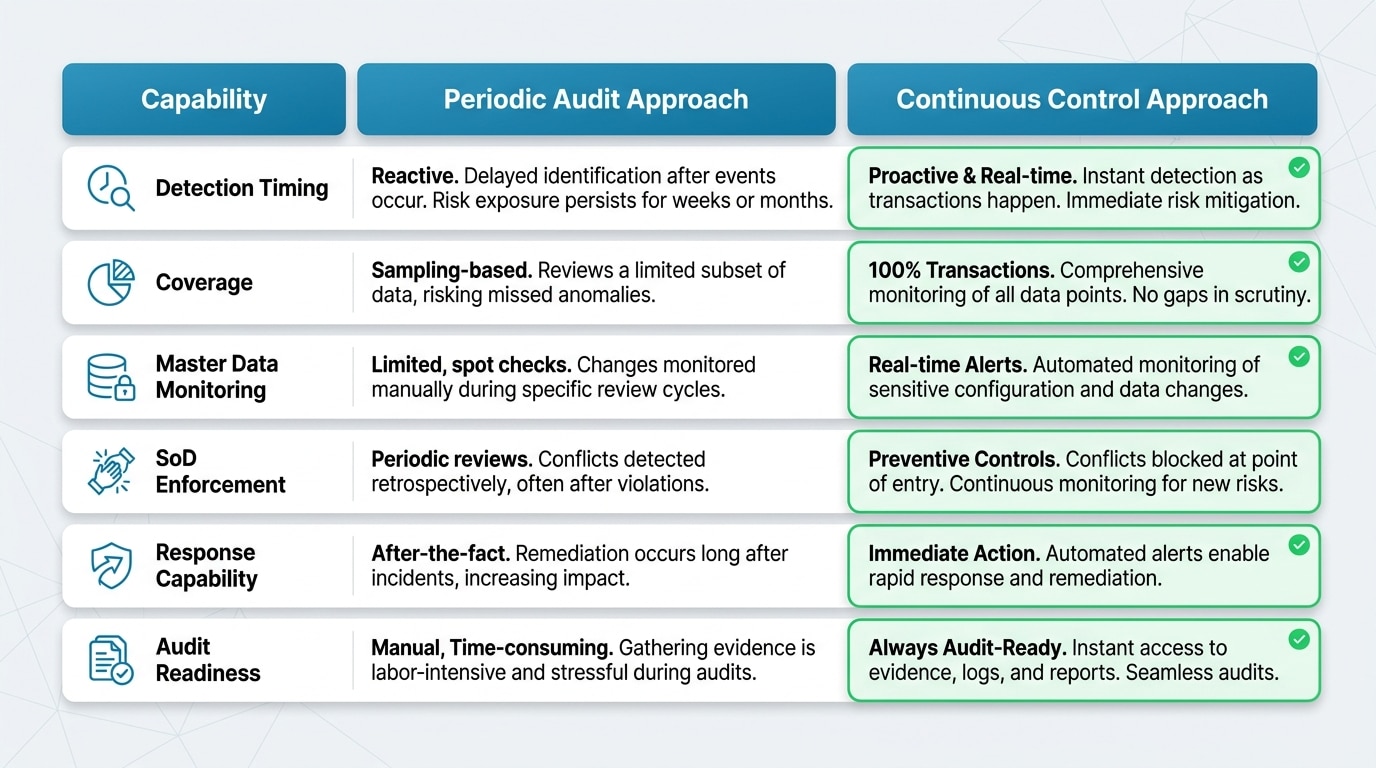
| Capability | Periodic Audit Approach | Continuous Control Approach |
|---|---|---|
| Detection timing | Days to months after the event | Real time, as the action occurs |
| Coverage | Sample-based | Full transaction population |
| Master data monitoring | Manual spot checks | Automated cross-checks on every change |
| SoD enforcement | Reviewed at quarter end | Enforced and alerted continuously |
| Response capability | Reactive investigation | Preventive intervention |
| Audit readiness | Requires preparation cycles | Always-on evidence trail |
Essential Security Controls for Preventing Oracle Business Risk
Strong Oracle ERP security depends on a layered defense rather than any single control. The foundation includes role-based access, least privilege enforcement, segregation of duties, master data oversight, and continuous alerting on high-risk transactions. Each layer compensates for the limits of the others — no single control is sufficient when sophisticated internal actors know the system well.
The principle of least privilege deserves particular attention. Every user should hold only the access required to perform their role — nothing more. Oracle’s Overview of ERP Security Implementation emphasizes this as a core design principle, and automating its enforcement is what turns a written policy into operational reality.
Did You Know
Studies consistently show that a majority of ERP fraud is committed by current employees — not external actors — and that most perpetrators hold legitimate system access. This makes access governance and least-privilege enforcement the single most impactful controls an organization can invest in.
Your Oracle ERP processes sensitive financial data around the clock. Detelix provides continuous, automated controls that surface exceptions in real time — before payments are released and before records are permanently altered.
Why Permissions Quietly Become Dangerous Over Time
In most organizations, permissions accumulate gradually. An employee changes roles, joins a project, covers for a colleague, or supports a one-time ERP implementation. Each time, access is granted — and rarely revoked. Over months and years, users hold combinations of privileges they were never meant to retain. These “toxic combinations” are often invisible until something goes wrong, because no manual process systematically reviews what each user can do across the full scope of their Oracle access.
Continuous review of role assignments, supported by automated conflict detection, is the only practical way to keep this drift in check at scale. Without it, the permission landscape becomes an increasingly concentrated source of risk that grows silently alongside normal organizational change.
How to Identify Excessive Access and Risky Privileges
Identifying dangerous permissions starts with mapping which roles can perform which actions across the financial process chain — from vendor creation through invoice approval to payment release. From there, the focus shifts to detecting conflicts — combinations of privileges that, together, allow a single user to complete a sensitive end-to-end process without any independent check.
Reviews should run continuously, not annually, because the risk profile changes every time a role is modified, a new user is added, or a business process is restructured. Detelix supports this with continuous mapping of user activity against role definitions inside Oracle, surfacing combinations that violate policy and flagging users whose access patterns deviate from their declared responsibilities — giving audit and IT teams a clear, current picture rather than a quarterly snapshot.
Tip
Prioritize reviewing users who have changed roles in the last 12 months. Role changes are the most common source of toxic permission accumulation, because inherited access from previous roles is rarely removed systematically. Filtering your access review by recent role changes surfaces the highest-risk population fastest.
Leveraging AI and Advanced Analytics in Oracle ERP
Modern fraud rarely fits neatly into a static rule. Sophisticated schemes evolve over time, mimic normal transaction patterns, and often span multiple users or sessions to distribute risk. This is where behavioral analytics and machine learning become genuinely valuable — they identify subtle deviations from established norms that rule-based systems would routinely miss.
Consider a finance user who suddenly processes a high volume of payment changes at 2:00 AM, or a procurement officer approving invoices just below their authorization threshold with unusual frequency. Each pattern, in isolation, might appear acceptable within any single rule. Together, they form a clear behavioral signal that warrants investigation. By combining AI-driven analytics with structured control rules and continuous oversight, Oracle environments can move from reactive defense to predictive risk management.
Early Warning Signs of Financial Fraud in ERP
Experienced auditors and CFOs learn to recognize early indicators long before a loss materializes. These commonly include: repeated edits to vendor master data in a short period, round-number transactions that fall just below review thresholds, after-hours activity by users without a clear operational need, approval sequences that skip normal reviewers, and transactions that break from a vendor’s established historical pattern.
No single signal proves wrongdoing. What matters is the accumulation and correlation of signals across users, vendors, and time periods. A platform that continuously correlates these indicators can identify risk concentrations that no manual review process would catch within a practical timeframe — providing the early warning window that makes intervention possible.
Did You Know
The “just below threshold” pattern — where transactions are deliberately structured to avoid triggering approval requirements — is one of the most commonly observed indicators in ERP fraud investigations. Automated threshold analysis that detects clustering of transactions near authorization limits is a highly effective early warning control.
Business Value: Beyond Just Stopping Theft
The return on a strong Oracle ERP fraud prevention program reaches well beyond loss avoidance. Automated controls reduce the manual review burden on audit and finance teams, eliminate noise around routine transactions, and produce a continuous evidence trail that makes audit cycles dramatically smoother. Leadership gains visibility into what is happening across sensitive processes right now — not in the next quarterly report.
For organizations handling high transaction volumes, scalability of the underlying data infrastructure matters as well. Solutions built on the Oracle Data Platform for financial services are designed to handle large-scale transaction monitoring without slowing operational workflows — essential for enterprises where both processing speed and detection accuracy are non-negotiable requirements.
How Detelix Maps to Real Business Needs
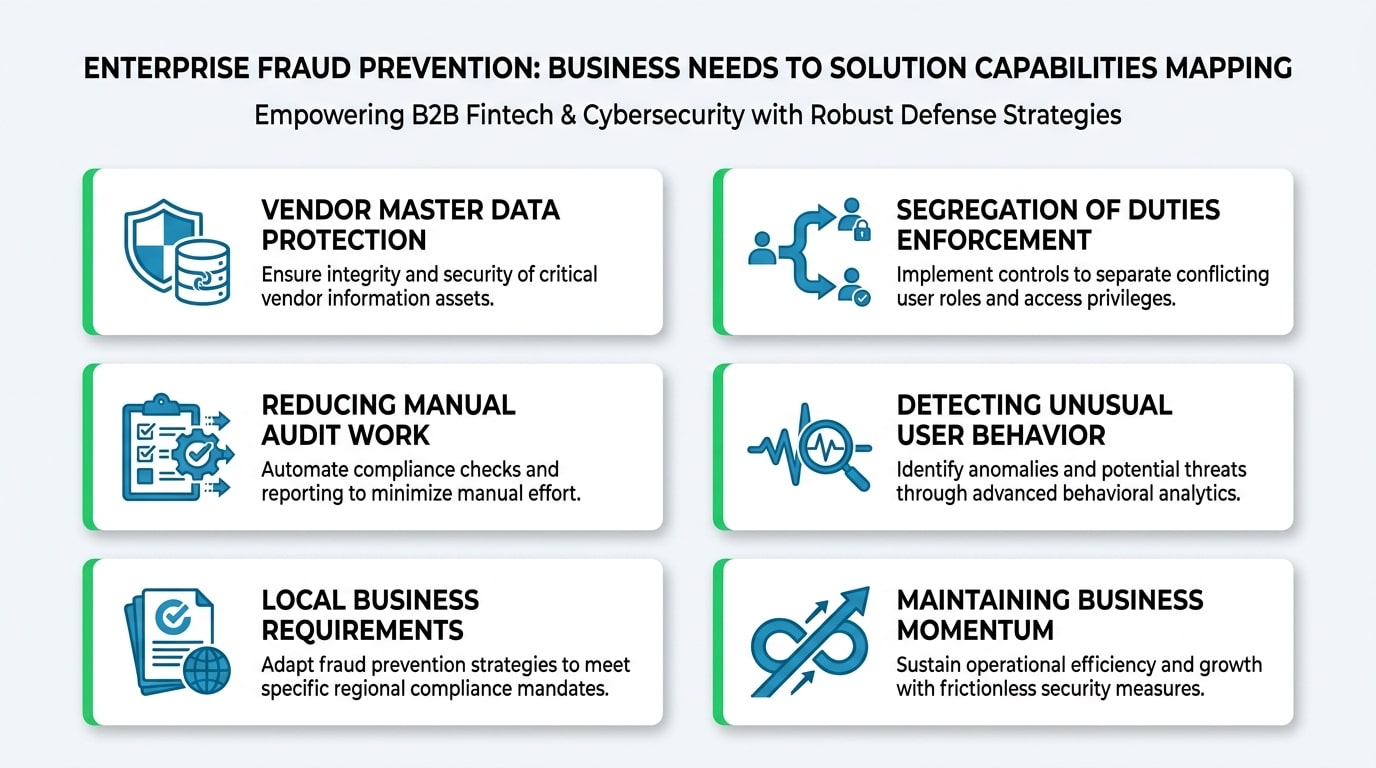
| Business Need | How the Detelix Approach Helps in Practice |
|---|---|
| Protecting vendor master data | Continuous cross-checks on every change to bank details, contact information, and supplier records inside Oracle. |
| Enforcing segregation of duties | Ongoing detection of toxic role combinations and real-time alerts when conflicting actions are attempted. |
| Reducing manual audit work | Automated evidence trails and prioritized alerts that reduce noise for finance and audit teams. |
| Detecting unusual user behavior | Behavioral analytics that flag deviations from each user’s normal activity pattern across Oracle modules. |
| Supporting local business requirements | Practical implementation suited to Israeli enterprises, with attention to local processes, languages, and regulatory context. |
| Maintaining business momentum | Non-intrusive monitoring that surfaces exceptions without slowing payment, procurement, or reconciliation cycles. |
How to Implement a Robust Oracle Fraud Prevention Project
Successful programs do not attempt to cover everything simultaneously. They begin with a focused risk map — identifying the processes where exposure is highest, typically accounts payable, procurement, vendor master data, and payroll. From there, the approach moves through three practical phases: mapping current risks and control gaps, defining monitoring rules and alert thresholds, and continuously calibrating based on results and feedback from finance and audit teams.
A phased rollout produces early wins, builds organizational confidence, and avoids the resistance that accompanies disruptive change. It also creates the space for finance, IT, audit, and operations to align on what genuine control looks like for the specific business — which is essential for building a program that lasts and scales alongside the organization.
Tip
Begin your implementation project with a two-week current-state assessment covering vendor master data changes, SoD conflict mapping, and access review for users in AP and procurement roles. This establishes a clear risk baseline that justifies investment, defines alert priorities, and gives the project team concrete findings to present to leadership from day one.
Why Organizations Still Struggle to Detect Fraud in Time
The most common reason organizations miss fraud is fragmentation. Finance sees transactions. IT sees access logs. Audit sees periodic samples. Risk management sees policies. When no system connects these views in real time, small anomalies in each domain never combine into a complete picture. By the time someone notices, the damage has often already occurred and compounded across multiple payment cycles.
Continuous, integrated monitoring solves this by correlating signals across domains — turning isolated data points into actionable risk intelligence that the right people can act on immediately. The integration is not just technical; it also changes how finance, IT, and audit teams work together, because they share a common, current view of where risk actually sits.
Choosing the Right Oracle ERP Security Solution
When evaluating a solution, look beyond whether it generates alerts. Examine the depth of coverage across sensitive processes, the quality and prioritization of those alerts, the ability to investigate exceptions with full transparency, and how easily the platform adapts to your specific Oracle configuration and business processes. The right solution should reduce noise, not add to it, and should produce evidence that finance, audit, and IT teams can all independently trust and act upon.
Detelix Oracle ERP Security Solutions

Proactive ERP Monitoring
Continuous, automated monitoring of Oracle transactions, master data changes, and user activity — surfacing exceptions before they become losses.

Real-Time Fraud Alerts
Prioritized, actionable alerts delivered the moment a high-risk action or anomalous pattern is detected across your Oracle environment.

Access and SoD Control
Automated detection of toxic role combinations and segregation of duties violations, with continuous review of user permissions across Oracle modules.

Expert Implementation
Hands-on Oracle ERP security implementation by specialists with deep experience across Israeli enterprises and international regulatory frameworks.
See Detelix Oracle ERP Protection in Action
Frequently Asked Questions
What is the biggest challenge in Oracle ERP fraud prevention?
The biggest challenge is managing the complexity of segregation of duties across thousands of permissions and role combinations inside Oracle. Without automated mapping and continuous review, dangerous combinations accumulate silently as users change roles over time — creating a growing exposure that no manual process can track at scale.
Can standard Oracle logs prevent fraud on their own?
Logs are essential, but on their own they are inherently reactive. They only become preventive when monitored continuously and correlated with behavioral patterns, master data changes, and approval sequences — which is precisely what a real-time control platform like Detelix is designed to do. Logs alone tell you what happened; continuous monitoring tells you what is happening right now.
How does Detelix integrate with existing Oracle workflows?
The approach is non-intrusive. Detelix monitors activity, master data changes, and transaction patterns continuously without altering existing approval flows or slowing operational processes. Exceptions are surfaced to the right stakeholders before they become losses, with no disruption to the finance or procurement workflows your team depends on daily.
What are toxic combinations in ERP permissions?
Toxic combinations are sets of privileges that, when held by a single user, allow them to complete a sensitive financial process entirely on their own — without any independent check or approval. Classic examples include invoice entry combined with payment approval, or vendor creation combined with the ability to modify bank details and release payments. These combinations represent the core SoD risk inside Oracle environments.
How long does it take to implement a fraud prevention solution?
Implementation timelines depend on the scope of Oracle modules covered and process complexity, but a phased approach typically delivers meaningful protection in the first stages without requiring full deployment before value is realized. Starting with the highest-risk areas — vendor master data and accounts payable — produces early coverage while broader monitoring expands systematically across additional process areas.
Is real-time monitoring disruptive to finance operations?
When designed well, no. Effective monitoring surfaces only meaningful exceptions, prioritizes alerts by risk level, and allows routine transactions to flow without interference. The objective is greater control visibility without slowing the business — which is achievable when alert thresholds are carefully calibrated to your organization’s specific transaction patterns and risk appetite.
When should an organization start a fraud prevention project?
The right time is before an incident occurs — not after. Organizations that wait until a confirmed loss typically face longer recovery cycles, regulatory scrutiny, reputational damage, and significantly higher remediation costs than those that build continuous control proactively. The cost of prevention is consistently a fraction of the cost of a single meaningful fraud event.
Ready to Move From Routine Monitoring to Real Control?
If your current Oracle ERP controls only show you what already happened, it is time to change that. Detelix delivers continuous, automated fraud prevention that protects your financial processes around the clock — giving your leadership team the real-time visibility and confidence they need to operate without exposure.